

Leading Micropipette & Scientific Lab, Medical instrument Manufacturer and Deler A Legacy Of Scientific Precision .



Leading Micropipette & Scientific Lab, Medical instrument Manufacturer and Deler A Legacy Of Scientific Precision .
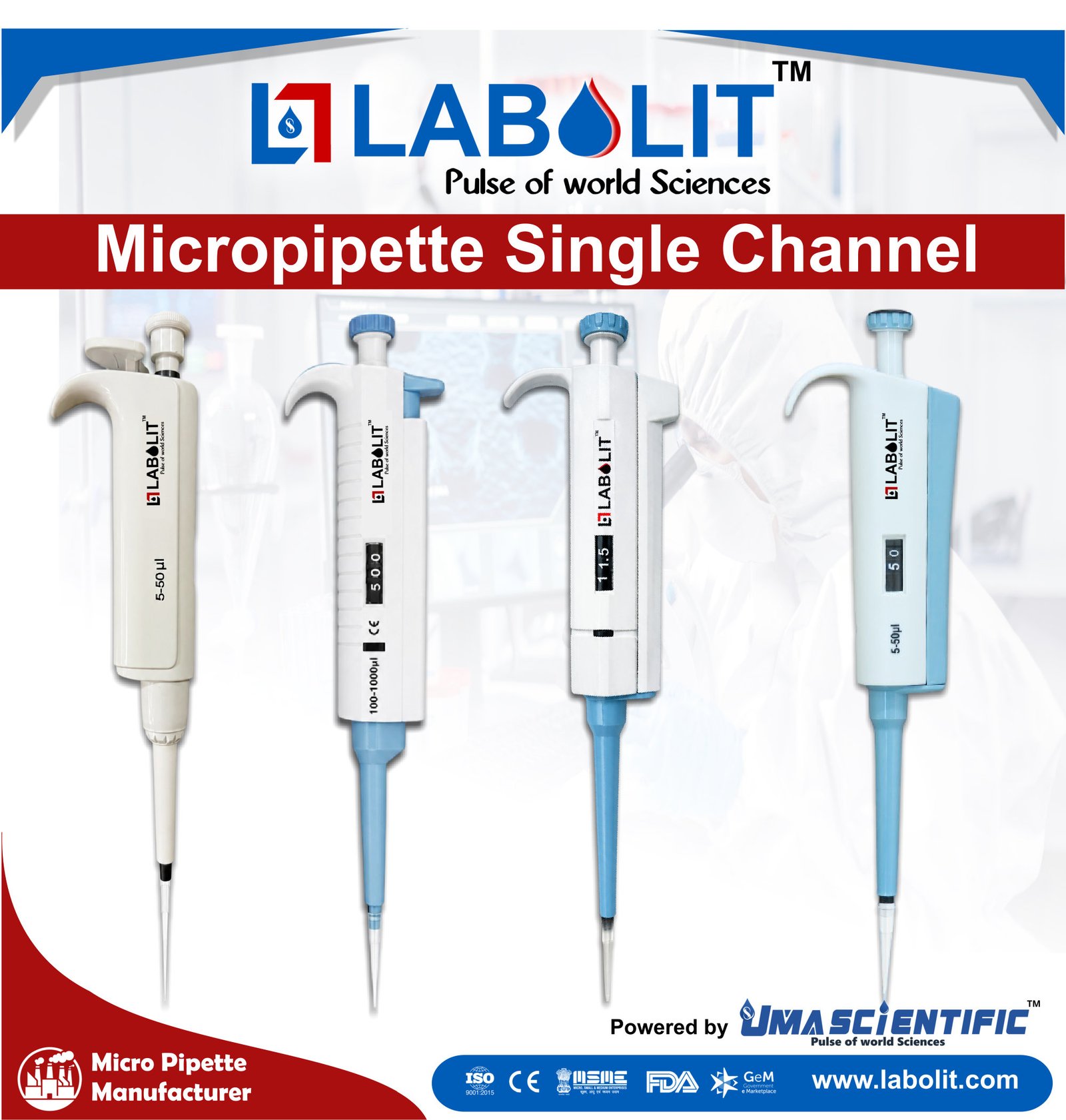
Selecting the best micropipette is an important decision for any laboratory that performs regular liquid handling. Micropipettes are used to aspirate and dispense small quantities of liquid, making them essential equipment in pharmaceutical laboratories, biotechnology laboratories, research institutions, diagnostic centers, hospitals, pathology laboratories, universities, food testing laboratories, forensic laboratories and many other scientific facilities.
A micropipette may look like a simple laboratory instrument, but its performance can directly influence the consistency and reproducibility of liquid-handling procedures. Choosing the correct volume range, using compatible pipette tips, following appropriate pipetting techniques and maintaining the instrument properly are all important for reliable laboratory work.
Modern laboratories commonly use both fixed volume micropipettes and variable volume micropipettes. Among them, variable volume micropipettes are particularly popular because they provide flexibility for different laboratory procedures.
For example, LABOLIT’s variable-volume micropipette range shown in the supplied product material includes:
These different ranges allow laboratories to select a suitable instrument according to their working volume.
This guide explains everything buyers should know before purchasing a micropipette, including types, volume ranges, applications, pipette tips, calibration, maintenance, ergonomics, OEM manufacturing, bulk purchasing and important factors to consider when comparing micropipette suppliers.
A micropipette is a precision laboratory instrument designed to transfer small quantities of liquid.
The liquid volume is normally expressed in microliters, abbreviated as µL.
For reference:
1,000 µL = 1 mL
Therefore, a 100 µL liquid transfer represents only one-tenth of a milliliter.
This ability to handle very small volumes makes micropipettes indispensable in laboratories where precise liquid transfer is required.
A typical mechanical micropipette operates using a piston mechanism. The movement of the piston changes the pressure inside the pipette and allows the instrument to aspirate liquid into a disposable pipette tip and subsequently dispense it into another vessel.
Although the principle is relatively simple, many factors influence pipetting performance. These include the design of the pipette, tip compatibility, volume range, liquid properties, operator technique, temperature, maintenance and calibration.
A laboratory may perform dozens, hundreds or even thousands of liquid transfers during a normal working day.
If the wrong pipette is selected, several problems may occur.
These can include:
For this reason, a laboratory should select a micropipette according to its actual application rather than choosing a product only because it is inexpensive or has a high maximum volume.
The best micropipette is not necessarily the most expensive model.
The best micropipette is the one that matches the laboratory’s:
One of the first decisions when purchasing a micropipette is whether to select a fixed volume or variable volume model.
A fixed volume micropipette is designed for a specific volume.
Examples may include:
A fixed-volume pipette can be useful when the same volume is repeatedly transferred during a particular procedure.
However, a laboratory may need several fixed-volume pipettes if it works with many different volumes.
A variable volume micropipette allows the user to adjust the selected volume within a specified operating range.
For example, a 20–200 µL micropipette may be used for different volumes within that range, subject to the manufacturer’s specifications.
Variable volume micropipettes are popular because they provide flexibility.
A laboratory can use different settings for different protocols without requiring a separate pipette for every volume.
For many laboratories, a set of variable-volume micropipettes covering different ranges provides a practical liquid-handling solution.
The volume range is one of the most important specifications to consider.
A pipette should be selected according to the volume that is actually being transferred.
LABOLIT’s displayed variable-volume range includes:
| Micropipette Range | General Application Area |
|---|---|
| 0.5–10 µL | Very small liquid transfers |
| 2–20 µL | Small-volume applications |
| 5–50 µL | Small routine transfers |
| 10–100 µL | General laboratory liquid handling |
| 20–200 µL | Medium-volume microliter transfers |
| 100–1000 µL | Larger microliter transfers |
These are general selection categories. Exact performance should always be checked against the manufacturer’s technical specifications.
The 0.5–10 µL micropipette is intended for very small liquid volumes.
Small-volume pipetting is common in molecular biology and other research applications where reagents and samples may be used in very small quantities.
Potential applications include:
At very low volumes, operator technique becomes especially important.
The 2–20 µL variable volume micropipette provides another option for small-volume liquid handling.
It can be useful for:
The selected volume should always remain within the manufacturer’s specified operating range.
A 5–50 µL micropipette can be suitable for many small-volume laboratory applications.
Typical uses may include:
Its wider range provides flexibility for routine liquid handling.
The 10–100 µL micropipette is a common range for general laboratory work.
It can be used in:
This range is particularly useful when a laboratory frequently works with moderate microliter volumes.
A 20–200 µL micropipette provides flexibility for many routine liquid-transfer applications.
Potential applications include:
When selecting a pipette, the working volume should be considered rather than simply the maximum capacity.
The 100–1000 µL micropipette is designed for larger microliter-volume transfers.
It can be useful for:
When working close to the upper end of a pipette’s range, users should follow the manufacturer’s operating instructions carefully.
A good micropipette should provide a combination of useful characteristics rather than only one feature.
Important characteristics include:
The instrument should match the laboratory’s working volume.
The pipette should provide reliable results when used correctly.
Ergonomics matter when the pipette is used repeatedly.
The selected volume should be easy to set and read.
Compatible pipette tips should be readily available.
The instrument should be practical to clean and maintain.
The manufacturer or supplier should provide appropriate support for laboratories requiring calibration.
A clear warranty provides additional purchasing confidence.
Professional support can be valuable for laboratories and distributors.
For distributors and private-label businesses, OEM capability can be an important advantage.
Two words commonly used when discussing micropipette performance are accuracy and precision.
They are not identical.
Accuracy describes how close the delivered volume is to the intended volume.
For example, if the target volume is 100 µL, accuracy relates to how close the actual delivered volume is to 100 µL.
Precision describes how consistently the pipette delivers the same volume during repeated measurements.
A pipette may provide good precision while still being inaccurate if it repeatedly delivers a volume that differs from the intended target.
For high-quality laboratory work, both accuracy and precision are important.
Even a high-quality micropipette can show different results if it is used incorrectly.
Factors affecting performance can include:
Therefore, purchasing a good micropipette is only the first step.
Correct usage and maintenance are equally important.
Laboratory professionals may perform hundreds of pipetting cycles in one working session.
Consequently, ergonomics should not be ignored.
Important ergonomic considerations include:
An ergonomic pipette can help make repetitive liquid handling more comfortable.
For laboratories with high workloads, ergonomics can be an important purchasing criterion.
A single channel micropipette contains one liquid-handling channel.
It is useful when samples are processed individually.
Applications include:
Single-channel pipettes are highly versatile and are often part of the basic equipment set in laboratories.
A multichannel micropipette can transfer liquid through multiple channels at the same time.
Common versions include:
Multichannel micropipettes are particularly useful for microplates and repeated parallel transfers.
For laboratories performing large numbers of repetitive transfers, multichannel pipetting can save significant operator time.
Ask the following questions:
Do you normally transfer liquid one sample at a time?
A single-channel pipette may be appropriate.
Do you regularly work with multiwell plates?
A multichannel model may improve efficiency.
Do you perform repetitive transfers?
A multichannel pipette may reduce repetitive work.
Do you frequently change sample positions?
A single-channel pipette may provide greater flexibility.
The right choice depends on workflow.
Pipette tips are not simply accessories.
They are a critical part of the liquid-handling system.
A compatible tip should:
Poorly fitting tips can contribute to inconsistent pipetting.
Many micropipettes are designed to work with commonly available universal-style tips.
However, users should always confirm compatibility with the specific pipette.
A good fit is important because the tip must remain securely attached during aspiration and dispensing.
Filter tips contain a filter designed to help prevent aerosols from entering the pipette mechanism.
They are particularly useful in applications where contamination control is important.
Potential applications include:
Filter tips should be selected according to the laboratory’s procedure and contamination-control requirements.
Sterile tips are used where sterile liquid handling is required.
They can be useful in applications involving:
Sterility requirements should always be determined by the laboratory’s SOP.
Some liquid-handling applications benefit from tips designed to minimize liquid retention.
This can be useful when working with:
Tip selection should be based on the physical characteristics of the liquid and the application.
Correct technique is essential for consistent results.
Choose a pipette that covers the required volume.
Adjust the volume to the required setting.
Always check the volume display.
Fit the compatible tip securely.
Operate the plunger according to the manufacturer’s instructions.
Place the tip correctly and aspirate smoothly.
Bubbles can affect the amount of liquid transferred.
Position the tip correctly.
Press the plunger in a controlled manner.
Use the tip-ejection mechanism where available.
Use a new tip whenever required by the laboratory procedure.
Never set the volume outside the manufacturer’s specified range.
Do not use a large-volume pipette when a smaller range is more appropriate.
Fast movement can affect liquid aspiration and dispensing.
Immersing the tip too deeply can affect aspiration.
Consistent technique is important.
Tip reuse can increase contamination risks.
Dirty or damaged components can affect performance.
Critical laboratory procedures may require regular calibration verification.
Calibration is an important component of laboratory equipment management.
Over time, pipettes can experience changes in performance due to:
Calibration can help determine whether the pipette remains within the required performance specifications.
Laboratories should establish calibration procedures based on:
ISO 8655 is an internationally recognized standard series related to piston-operated volumetric apparatus.
When purchasing a micropipette, laboratories should examine the manufacturer’s documentation carefully.
A customer may need to distinguish between:
The exact documentation required depends on the laboratory’s quality system and application.
Proper maintenance can help extend the working life of a micropipette.
A basic maintenance program may include:
Clean external surfaces according to the manufacturer’s recommendations.
Check the tip cone for contamination or damage.
Inspect relevant seals and O-rings where applicable.
Check whether the plunger and volume adjustment mechanism operate normally.
Verify pipetting performance according to the laboratory’s procedure.
Calibrate according to the established schedule.
Correct storage helps protect the instrument.
A pipette should generally be:
A pipette should not simply be left on the edge of a laboratory bench where it can easily fall.
Autoclavability depends entirely on the model.
Some micropipettes may have components that are designed for autoclaving, while others may not be.
There can also be differences between:
Therefore, customers should always check the manufacturer’s specifications before autoclaving.
Never assume that all laboratory micropipettes are autoclavable.
Air-displacement micropipettes are widely used for routine liquid handling.
They operate by moving a piston that displaces air between the piston and the liquid.
They are commonly suitable for aqueous laboratory liquids.
For unusual liquids, users may need special techniques or alternative pipetting technologies.
Positive displacement systems are designed differently.
The piston interacts more directly with the liquid through a specialized tip or capillary system.
They may be useful for certain liquids with challenging characteristics, such as:
The correct pipetting technology depends on the liquid and application.
Viscous liquids do not behave like water.
Examples include certain:
For viscous liquids, aspiration and dispensing speed can influence the result.
Specialized pipetting techniques may be required.
Volatile liquids can evaporate more easily.
This can affect the volume being transferred.
Depending on the liquid, laboratories may need:
Always follow the appropriate laboratory SOP.
Molecular biology is one of the most common fields where micropipettes are used.
Applications include:
Because molecular biology protocols often involve small volumes, appropriate micropipette selection is important.
PCR workflows commonly require small quantities of:
A suitable micropipette can make preparation easier and more consistent.
Filter tips may also be selected when contamination control is important.
Biotechnology laboratories use micropipettes across many research workflows.
Potential applications include:
The volume range depends on the specific protocol.
Pharmaceutical laboratories use micropipettes in research, development and testing environments.
Potential applications include:
For regulated laboratory environments, appropriate documentation and calibration may be required.
Diagnostic laboratories perform procedures involving samples and reagents in controlled volumes.
Micropipettes can support:
Proper contamination control and laboratory SOPs should be followed.
Pathology laboratories may use micropipettes for various sample and reagent-handling tasks.
The appropriate pipette depends on:
Food testing laboratories perform microbiological and analytical procedures.
Micropipettes may be used for:
Different volume ranges may be needed depending on the testing procedure.
Forensic laboratories often handle small samples and specialized reagents.
Micropipettes can be used for:
Forensic laboratories may place additional emphasis on traceability, contamination control and documentation.
Educational laboratories are another major application area.
Students may use micropipettes to learn:
Choosing durable, easy-to-use equipment can be useful in teaching laboratories where many users share the instruments.
A simple decision-making process can make purchasing easier.
List the volumes most frequently used.
For example:
5 µL, 10 µL, 20 µL, 50 µL, 100 µL, 200 µL, 500 µL.
Match them to suitable pipette ranges.
Is it:
Occasional pipetting has different ergonomic requirements from hundreds of cycles per day.
Consider whether you work with individual tubes or microplates.
Decide whether you need:
Determine whether you need calibration or other technical documentation.
Compare warranty and replacement policies.
A reliable supplier should be able to support technical and commercial requirements.
There is no single micropipette that is best for every laboratory.
Consider:
0.5–10 µL
Consider:
2–20 µL
or
5–50 µL
depending on the protocol.
Consider:
10–100 µL
Consider:
20–200 µL
Consider:
100–1000 µL
This is a general guide. Actual selection should be based on the laboratory protocol and required performance.
Many laboratories do not use just one pipette.
A combination of ranges provides broader coverage.
For example, a laboratory may select:
This allows the laboratory to handle a broad range of volumes.
Using the appropriate pipette for each volume is generally preferable to using one pipette for every application.
OEM micropipettes are particularly relevant to laboratory-equipment distributors.
A distributor may want to sell a variable volume micropipette under its own brand.
OEM services may include:
The supplied LABOLIT product material specifically promotes OEM availability and shows branding options for the pipette and box.
This makes the product range relevant not only to end-user laboratories but also to businesses developing their own laboratory equipment brand.
OEM purchasing can help distributors create a consistent product portfolio.
For example, a company may sell:
OEM Micropipette + OEM Pipette Tips + OEM Tip Box + Other Laboratory Equipment
This can create a complete liquid-handling product line.
OEM customers should discuss:
before finalizing the order.
When selecting an OEM partner, consider:
Can the supplier consistently supply the required quantity?
Does the manufacturer offer multiple volume ranges?
Can the pipette and box be branded according to your requirements?
Does the manufacturer have a defined quality-control process?
Can the required product documentation be provided?
Can the packaging be customized?
Are warranty and replacement terms clearly defined?
Can technical and commercial requirements be communicated clearly?
When searching for a micropipette supplier in India, buyers should compare suppliers based on the complete package.
Important considerations include:
A supplier with a complete laboratory equipment portfolio may also make procurement easier for institutions purchasing multiple products.
A manufacturer can provide greater control over product availability, OEM requirements and customization.
For customers looking for a micropipette manufacturer in India, the evaluation should include:
LABOLIT is positioned as a laboratory product brand offering variable-volume micropipettes and OEM solutions.
The price of a micropipette depends on many factors.
These may include:
Therefore, buyers should not compare two micropipettes based solely on price.
A lower purchase price may not provide the same documentation, warranty, service or product support.
Bulk purchasing is common among:
Before placing a bulk order, buyers should finalize:
For OEM orders, product samples or artwork approval may also be required before mass production.
Before purchasing, use the following checklist:
☐ Correct volume range
☐ Correct channel configuration
☐ Suitable application
☐ Compatible tips
☐ Accuracy specifications
☐ Precision specifications
☐ Appropriate operating mechanism
☐ Calibration requirements understood
☐ Comfortable grip
☐ Easy volume adjustment
☐ Easy tip ejection
☐ Suitable for workload
☐ Warranty
☐ Service support
☐ Spare parts where applicable
☐ Documentation
☐ Branding available
☐ Packaging customization
☐ Printing requirements confirmed
☐ MRP requirement confirmed
Laboratories can reduce errors by developing standardized pipetting procedures.
A good SOP can specify:
Training laboratory personnel according to the SOP is equally important.
Even the best micropipette requires correct handling.
Training should cover:
Experienced users may naturally develop better technique, but standardized training is still important when multiple people share laboratory equipment.
Possible causes may include:
Check the tip and operating mechanism according to the manufacturer’s instructions.
Possible causes include:
Slow, controlled pipetting may help depending on the application.
Possible causes may include:
Inspect the pipette and use compatible tips.
Check for:
If the problem persists, service may be required.
Service may be appropriate when:
Laboratories should follow the manufacturer’s service recommendations.
Efficient liquid handling can save time.
For laboratories performing repetitive procedures, a suitable combination of:
can improve workflow.
The goal is not simply to buy the most expensive equipment but to create a liquid-handling system that matches the laboratory’s actual needs.
The LABOLIT product range shown in the supplied material provides multiple variable volume options covering common laboratory requirements.
The range includes:
0.5–10 µL
2–20 µL
5–50 µL
10–100 µL
20–200 µL
100–1000 µL
The product presentation also highlights:
For laboratories and distributors, having multiple ranges under one product brand can simplify procurement and product selection.
The best micropipette depends on the laboratory’s required volume, application, accuracy requirements, workload, tip compatibility and budget.
Variable volume provides flexibility, while fixed volume can be convenient for repetitive procedures requiring one dedicated volume.
There is no single universal range. Laboratories commonly use multiple ranges depending on their applications.
A range such as 5–50 µL can cover 50 µL, while a broader range may also cover it. The best choice depends on the required performance and manufacturer’s specifications.
A 10–100 µL or 20–200 µL model may cover 100 µL. Select according to the actual application and performance requirements.
A 100–1000 µL variable volume micropipette is a suitable range to consider for 500 µL.
No. Micropipettes have defined operating ranges. Laboratories typically use several pipettes to cover different volumes.
Micropipette tips are disposable components attached to the pipette and used to aspirate and dispense liquids.
Not necessarily. Compatibility should always be confirmed between the pipette and the selected tip.
An OEM micropipette is manufactured or supplied for another company to market under its own brand or customized specifications.
OEM branding options depend on the manufacturer. LABOLIT’s supplied product material highlights OEM availability and single-color branding options.
The required calibration frequency depends on the laboratory’s quality system, usage, application and applicable procedures.
Only if the specific model is designed for autoclaving. Always check manufacturer instructions.
Tips affect fit, liquid transfer and contamination control. Appropriate compatible tips are essential.
Yes. Their adjustable volume makes them suitable for many research workflows.
Yes. They can be used for sample preparation, reagent transfer, dilution and various research and testing procedures.
Yes. They are widely used for controlled transfer of samples and reagents.
Yes. Appropriate small-volume micropipettes are commonly used for PCR preparation.
Accuracy describes closeness to the target volume, while precision describes consistency between repeated measurements.
Different laboratory procedures require different volumes. Multiple ranges allow users to select an appropriate instrument for each application.
When choosing the best micropipette for laboratory use, the most important consideration is not simply the brand or price. Buyers should evaluate the complete product and determine whether it matches the laboratory’s actual requirements.
The key factors include:
For general laboratory users, variable volume micropipettes provide excellent flexibility because they can cover different volumes within their specified operating range.
A laboratory that combines the correct micropipette, compatible tips, proper technique, regular maintenance and appropriate calibration can establish a more consistent and efficient liquid-handling workflow.
For laboratories, research institutions, pharmaceutical companies, diagnostic centers, universities, distributors and OEM customers looking for variable volume laboratory pipettes, selecting the right model and supplier is the first step toward dependable liquid handling.
Brand: LABOLIT
Product: Variable Volume Micropipette
Configuration: Single Channel
Volume Ranges:
OEM: Available
OEM Branding: Available as per agreed requirements
Product & Box Branding: Available for OEM customers
MRP Printing: Optional as required
LABOLIT – Pulse of World Sciences is a laboratory equipment brand offering products for scientific and laboratory applications. Its product portfolio includes micropipettes and other laboratory equipment designed for different research, diagnostic, pharmaceutical, educational and industrial laboratory requirements.
For customers interested in variable volume micropipettes, OEM branding, bulk requirements, distribution opportunities and laboratory equipment, LABOLIT can be contacted for product specifications and commercial details.
Website: www.labolit.com
Email: sales@labolit.com
Contact: +91-7379207507 | +91-7347707507
How to Choose the Best Micropipette for Laboratory Use
