

Leading Micropipette & Scientific Lab, Medical instrument Manufacturer and Deler A Legacy Of Scientific Precision .



Leading Micropipette & Scientific Lab, Medical instrument Manufacturer and Deler A Legacy Of Scientific Precision .
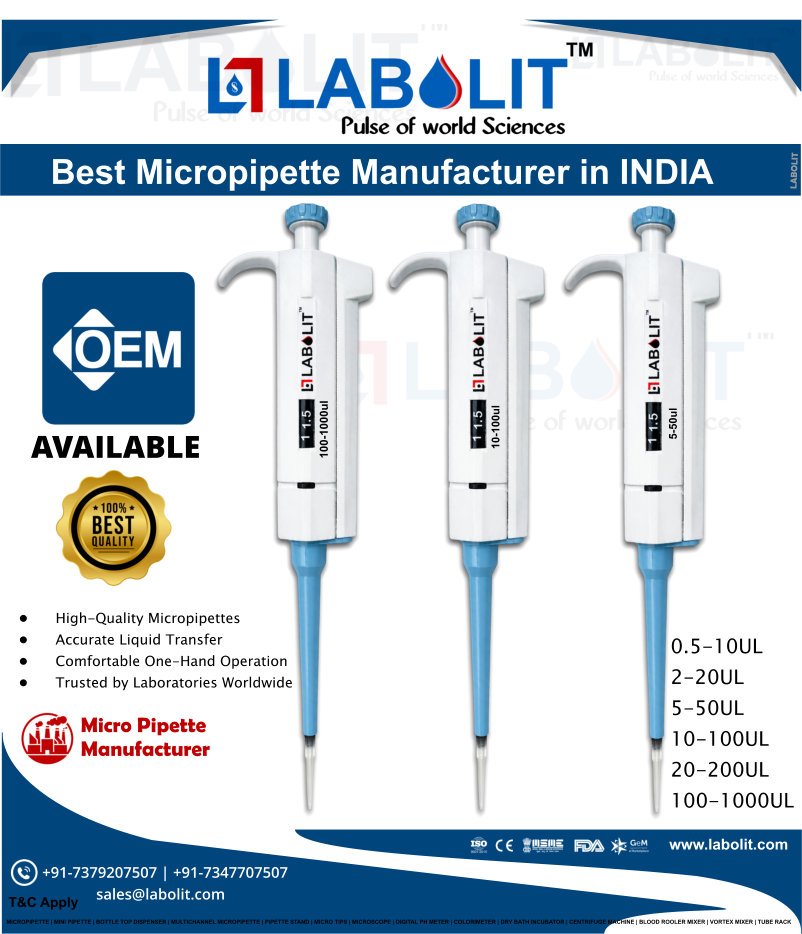
When laboratory procedures require accurate transfer of small liquid volumes, ordinary measuring cylinders, beakers, or standard pipettes may not provide the required precision. A micropipette offers a practical solution by allowing laboratory professionals to select a particular volume and transfer the liquid using a controlled mechanism.
Among the different types available, the variable volume micropipette is particularly useful because one pipette can be adjusted to handle different volumes within its specified operating range.
For example, a laboratory may require different volumes such as 5 µL, 20 µL, 50 µL, 100 µL, 200 µL, or 500 µL during different procedures. Instead of purchasing a separate fixed-volume pipette for every requirement, a variable volume micropipette can cover a range of volumes.
LABOLIT offers variable volume micropipettes designed for laboratory liquid-handling applications, with multiple volume ranges and OEM branding solutions. The product range shown in the supplied product image includes:
These ranges allow laboratories to select an appropriate micropipette according to their application and required liquid volume.
A micropipette is a precision laboratory instrument used to measure and transfer small quantities of liquid. The term micro refers to microliter-scale liquid handling.
One microliter is equal to:
1 µL = 0.001 mL
This means:
1,000 µL = 1 mL
Because laboratory experiments often involve very small sample volumes, accurate liquid transfer is essential. Even a small variation in the volume transferred can affect experimental results, especially in applications involving reagents, DNA, RNA, proteins, enzymes, pharmaceutical formulations, or diagnostic samples.
The basic operation appears simple, but accurate pipetting depends on several factors, including:
Therefore, selecting a suitable micropipette is an important decision for every laboratory.
A variable volume micropipette is an adjustable pipette that allows the user to select a liquid volume within a specified range.
Variable volume micropipettes are popular because they provide flexibility.
Common variable volume ranges include:
The correct range should always be selected according to the actual volume being transferred.
Laboratory experiments frequently depend on accurate quantities of liquids. A reagent concentration, sample ratio, dilution, reaction mixture, or assay result can be influenced by the volume of liquid used.
For example, if a protocol requires 50 µL of a reagent and significantly more or less liquid is transferred, the final reaction may not perform as expected.
Micropipettes help laboratory personnel perform repeatable liquid transfers.
They are particularly valuable when working with:
A reliable micropipette can therefore contribute to efficient laboratory workflows and consistent liquid handling.
Although designs vary between manufacturers and models, a conventional mechanical micropipette generally contains several important components.
The plunger is pressed by the operator to operate the piston mechanism.
A two-step plunger system is commonly used in many mechanical micropipettes.
The first stop is generally associated with aspiration and normal dispensing, while the second stop can be used to expel residual liquid from the tip.
Users should follow the manufacturer’s operating instructions for the specific model.
The volume adjustment system allows the user to select the required liquid volume.
The selected volume is normally displayed through a mechanical volume indicator.
Before pipetting, the user should confirm that the selected volume is within the specified range of the pipette.
The volume display shows the selected setting.
A clear display is important because it allows the operator to quickly confirm the selected volume before starting an experiment.
The tip cone is the lower section of the micropipette where the disposable pipette tip is attached.
The tip cone must be compatible with the selected pipette tips.
The disposable pipette tip comes into direct contact with the liquid.
Tips should be selected according to:
For sensitive laboratory applications, appropriate sterile or filtered tips may be required.
Many micropipettes include a tip-ejection mechanism.
After completing the liquid transfer, the operator can use the ejector to remove the used disposable tip without directly touching it.
The piston is a key component of the liquid-handling mechanism.
The movement of the piston creates the displacement required to aspirate and dispense liquid.
The mechanical performance of the piston system can have a significant influence on pipetting performance.
The supplied LABOLIT product image presents a range of Micro Pipette Variable Volume models designed for laboratory liquid handling.
The product presentation highlights:
High-Quality Micropipettes
and provides several volume options:
The image also highlights OEM availability, making the range suitable for businesses, distributors, laboratory-equipment companies, and organizations that require private-label or customized branding.
LABOLIT’s product presentation also identifies the company as a Micropipette Manufacturer and provides OEM branding as a product offering.
Choosing the correct volume range is one of the most important aspects of purchasing a micropipette.
A micropipette should not be selected simply because its maximum capacity is high. Instead, the pipette should be selected according to the volume that needs to be transferred.
For example, if a laboratory frequently transfers 8 µL, a 0.5–10 µL micropipette may be more appropriate than a 100–1000 µL model.
Similarly, if the required volume is approximately 500 µL, a 100–1000 µL micropipette would generally be the appropriate range.
The 0.5–10 µL range is designed for very small liquid transfers.
It can be useful for applications where microliter-level handling is required.
Potential applications include:
Because the volumes are very small, proper pipetting technique becomes particularly important.
The 2–20 µL micropipette is suitable for small-volume laboratory applications.
It can be useful for:
The exact performance requirements should be evaluated according to the laboratory protocol.
A 5–50 µL micropipette provides a broader range for routine small-volume liquid handling.
This type of pipette can be useful in:
The 10–100 µL range is one of the useful ranges for routine laboratory liquid handling.
It can be used for:
The adjustable design allows the operator to set the required volume within the pipette’s specified range.
A 20–200 µL variable volume micropipette can cover a wide range of common laboratory liquid transfer requirements.
It can be used for:
The 100–1000 µL range is suitable for larger microliter-volume transfers.
It can be useful for:
For volumes approaching 1 mL, choosing an appropriate tip and using correct pipetting technique are especially important.
Micropipettes can broadly be divided into fixed-volume and variable-volume models.
A fixed-volume micropipette is designed for one specific volume.
For example:
Fixed-volume pipettes can be useful when the laboratory repeatedly performs the same liquid transfer.
A separate pipette may be needed for each different volume.
A variable volume micropipette can be adjusted within a specified range.
The operator must correctly set the volume before use.
For laboratories performing many different liquid-transfer procedures, variable volume models can be particularly convenient.
A single channel micropipette contains one tip channel and transfers liquid one sample at a time.
Single-channel pipettes are commonly used for:
They provide flexibility when samples are arranged individually or when different volumes must be transferred between individual tubes.
A multichannel micropipette contains multiple channels, allowing several samples to be transferred simultaneously.
Common configurations include:
Multichannel pipettes are especially useful for microplates and applications involving repeated transfers across multiple wells.
For high-throughput laboratories, multichannel pipettes can significantly improve the speed of routine procedures.
OEM stands for Original Equipment Manufacturer.
In the laboratory-equipment industry, OEM micropipette programs allow companies to purchase micropipettes under their own brand or with customized branding.
OEM solutions can be useful for:
The LABOLIT product material specifically highlights OEM AVAILABLE.
According to the supplied product presentation, OEM branding can be provided with single-color printing on the pipette and box, with MRP printing available as an optional requirement.
This can help businesses establish their own laboratory-equipment brand without developing a complete micropipette manufacturing setup from the beginning.
OEM products allow businesses to market laboratory products under their own brand name.
The packaging can be customized according to the agreed OEM requirements.
Branding can be applied to the product and packaging according to the OEM specification.
Companies already selling laboratory consumables can add micropipettes to their product portfolio.
OEM manufacturing can support distributors that want to develop their own private-label product line.
Choosing the correct micropipette involves more than simply selecting a brand.
Consider the following factors.
Determine the actual volume you need to transfer.
For example:
Always verify the manufacturer’s stated operating range.
Different applications have different accuracy requirements.
For analytical and research applications, users should review the manufacturer’s accuracy and precision specifications before purchasing.
Precision refers to how consistently the pipette delivers repeated measurements.
A pipette may need to deliver the same volume repeatedly with minimal variation.
A pipette should be comfortable to use, particularly when the operator performs hundreds of pipetting cycles.
Important ergonomic considerations include:
Make sure suitable tips are readily available.
A pipette is only as practical as its compatible tips.
Laboratories that require controlled measurement should consider calibration and maintenance support.
Calibration requirements depend on:
Using the correct pipetting technique is essential for obtaining reliable results.
A general workflow includes the following steps.
Choose a pipette whose operating range covers the required volume.
Adjust the volume mechanism to the desired value.
Do not exceed the specified range.
Attach a compatible disposable tip securely.
Avoid excessive force.
For certain applications, aspirating and dispensing the liquid once or several times before the actual transfer can help condition the tip.
The appropriate procedure depends on the liquid and application.
Press the plunger to the appropriate stop before aspirating.
Place the tip at the appropriate depth in the liquid and slowly release the plunger.
Avoid rapid aspiration.
Allow a short stabilization period when appropriate.
Move the tip into the receiving vessel and press the plunger smoothly.
For appropriate air-displacement pipetting procedures, the second stop may be used to expel residual liquid.
Remove the used tip using the tip ejector.
Even a high-quality micropipette can produce inconsistent results if used incorrectly.
Using a pipette outside its intended range can lead to poor performance and may damage the instrument.
Always check the volume display before aspirating.
Rapid aspiration or dispensing can introduce errors, especially with certain liquids.
The tip should not be unnecessarily deep in the liquid.
Avoid touching the tip with hands or contaminated surfaces.
Disposable tips should be replaced according to the laboratory’s contamination-control procedures.
Pipettes used for critical measurements should be maintained and calibrated according to the laboratory’s quality system.
Calibration is an important part of laboratory pipette management.
A micropipette may gradually change in performance because of:
Calibration helps determine whether the pipette is delivering the intended volume within specified tolerances.
Many laboratories establish periodic calibration schedules based on:
For regulated laboratories, calibration records may also form part of quality documentation.
ISO 8655 is an important international standard series associated with piston-operated volumetric apparatus, including pipettes.
Laboratories should distinguish between:
When purchasing a micropipette, customers should request the appropriate technical documentation and calibration information applicable to the specific product.
This is especially important for laboratories operating under quality-management systems.
Micropipettes are essential in molecular biology because many procedures use very small quantities of reagents and samples.
Applications may include:
In such applications, accurate and consistent liquid handling can help improve reproducibility.
Biotechnology laboratories often work with biological samples, reagents, proteins, enzymes, cells, and nucleic acids.
Micropipettes are used throughout many stages of laboratory workflows.
Typical applications include:
Different volume ranges can be selected depending on the procedure.
Pharmaceutical laboratories use liquid-handling equipment for research, development, quality control, analytical work, and sample preparation.
Micropipettes can be used for:
For pharmaceutical environments, documentation, calibration, traceability, and maintenance can be important purchasing considerations.
Diagnostic laboratories handle a wide range of biological samples and reagents.
Micropipettes may be used for:
Because diagnostic procedures can be sensitive to sample and reagent quantities, proper pipetting practices are essential.
Pathology laboratories perform many procedures requiring controlled handling of liquids.
Micropipettes can support:
The appropriate pipette range depends on the specific application.
Micropipettes are not limited to professional research facilities.
They are also commonly used in:
Teaching students correct pipetting technique is an important part of laboratory education.
Food and beverage testing laboratories perform microbiological, chemical, and analytical procedures.
Micropipettes can be used during:
The pipette and tip selection should be based on the laboratory’s specific procedures.
Forensic laboratories may handle extremely small samples and specialized reagents.
Micropipettes can be used in laboratory procedures involving:
Because forensic testing can require high levels of traceability and documentation, pipette maintenance and calibration should be incorporated into the laboratory’s quality procedures.
Variable volume micropipettes provide several practical advantages.
One instrument can cover multiple volume settings within its range.
Operators can quickly adjust the volume for different procedures.
Fewer individual pipettes may be required compared with using only fixed-volume models.
Variable volume pipettes can be used across a broad range of laboratory applications.
They are practical for laboratories handling different samples and reagents throughout the day.
Proper maintenance helps preserve the working condition of the instrument.
Wipe the external surfaces regularly using an appropriate cleaning method.
Do not expose the instrument unnecessarily to aggressive chemicals.
Inspect the tip cone regularly for contamination or damage.
Mechanical components such as seals and O-rings can wear over time.
When not in use, store the pipette appropriately, preferably on a suitable pipette stand where practical.
Mechanical impact can affect the piston system and other components.
Always follow the specific cleaning, maintenance, and storage instructions provided by the manufacturer.
A pipette stand provides a designated storage location for laboratory pipettes.
Benefits include:
Keeping a micropipette on a laboratory bench can increase the chance of it being knocked over or contaminated.
Micropipette tips are an essential part of the liquid-handling system.
Tips should be:
For sensitive applications, laboratories may require:
Using compatible tips helps support consistent pipetting performance.
Filter tips can help reduce the risk of aerosol contamination entering the pipette mechanism.
They can be useful for applications where contamination control is important.
Sterile tips are used where sterile liquid handling is required.
The appropriate tip should always be selected according to the laboratory procedure.
Micropipettes are available with different operating principles.
Air-displacement micropipettes are widely used for routine aqueous laboratory liquids.
They operate by moving a piston and displacing air between the piston and the liquid.
Positive-displacement pipettes use a piston that directly interacts with the liquid through a specialized tip or capillary system.
They can be advantageous for certain challenging liquids, including liquids with unusual physical properties.
The correct technology depends on the application.
Not every liquid behaves like water.
Liquids can vary in:
Examples of challenging liquids include:
For challenging liquids, specialized pipetting techniques or equipment may be required.
Users should consult the manufacturer’s recommendations for the specific liquid.
Two important terms in liquid handling are accuracy and precision.
Accuracy describes how close the delivered volume is to the intended volume.
Precision describes how consistently repeated measurements agree with one another.
A pipette can be precise without necessarily being accurate if it consistently delivers a volume different from the target.
For laboratory work, both characteristics matter.
Several practices can improve liquid-handling consistency.
Operator training is equally important.
When purchasing a micropipette, selecting a reliable manufacturer or supplier is important.
Consider:
Does the supplier offer the volume ranges you need?
Can the supplier provide relevant technical specifications and documentation?
Is calibration or calibration-related support available?
What warranty or replacement policy is offered?
If you are a distributor or private-label company, does the manufacturer provide OEM services?
Can the supplier assist with technical questions and service requirements?
Are products and compatible tips readily available?
Is suitable product packaging available for distribution and transport?
The laboratory equipment market includes many distributors that prefer selling products under their own brand.
An OEM program allows a distributor to build brand recognition while sourcing the product from an experienced manufacturing partner.
For example, an OEM customer may require:
The exact OEM specifications, minimum order quantity, printing requirements, and packaging arrangements should be confirmed with the manufacturer before placing an order.
India has a growing laboratory-equipment market serving:
Indian micropipette manufacturers and suppliers can support both domestic and international customers with different volume ranges and OEM requirements.
LABOLIT’s product presentation positions its variable-volume micropipettes for laboratory use and highlights OEM availability.
For customers looking for a micropipette manufacturer in India, important factors include product quality, technical support, volume-range availability, documentation, warranty, supply capacity, and OEM capability.
A dependable micropipette supplier should be able to provide a complete liquid-handling solution rather than only one product.
A laboratory may require:
Buying from a supplier with a broader laboratory-equipment portfolio can simplify procurement.
The LABOLIT variable-volume micropipette range shown in the supplied product material is positioned as a high-quality laboratory liquid-handling product.
The displayed ranges include:
0.5–10 µL | 2–20 µL | 5–50 µL | 10–100 µL | 20–200 µL | 100–1000 µL
This selection covers many common microliter-scale laboratory requirements.
The product presentation also includes:
For specific technical specifications such as systematic error, random error, operating force, calibration procedure, tip compatibility, and sterilization capability, customers should refer to the model-specific technical datasheet.
Warranty is another important consideration when buying laboratory equipment.
A warranty can provide customers with additional confidence regarding product support.
The warranty terms should clearly specify:
The supplied LABOLIT product offering may be supported by a warranty depending on the specific model and purchase terms. Customers should confirm the applicable warranty terms with the supplier before ordering.
Correct storage can help protect the instrument.
Recommended general practices include:
For adjustable micropipettes, storing the pipette at the manufacturer’s recommended setting can also be part of proper laboratory practice.
Cleaning procedures depend on the pipette design and the type of contamination.
External surfaces can generally be cleaned according to the manufacturer’s instructions.
If liquid enters the internal mechanism, the pipette may need to be disassembled and serviced by an appropriately trained person.
Never use a cleaning chemical unless it is compatible with the pipette’s materials.
Not every micropipette is fully autoclavable.
Some models are:
The manufacturer should clearly specify which components can be autoclaved and the recommended temperature, pressure, time, and procedure.
Users should never assume that a micropipette is autoclavable simply because it is made from plastic components.
Always follow the model-specific manufacturer’s instructions.
Mechanical micropipettes use a manual piston mechanism.
Digital or electronic pipettes use an electronic motor or control system.
Advantages can include:
Potential benefits include:
The right choice depends on the laboratory’s requirements and budget.
Research laboratories often require several volume ranges because experiments can involve different sample and reagent volumes.
A laboratory may maintain a collection such as:
This combination provides broad coverage for common microliter liquid-handling tasks.
Researchers should select the smallest appropriate volume range for their application rather than using an unnecessarily large pipette.
Pharmaceutical R&D laboratories require reliable liquid handling during formulation development, analytical testing, screening, and research procedures.
Micropipettes can support:
Documentation and calibration can be particularly important in controlled laboratory environments.
Biotechnology applications often involve sensitive biological materials.
Micropipettes are used for:
Correct tip selection and contamination-control practices are essential.
PCR workflows commonly involve very small volumes.
Pipetting accuracy is important because PCR mixtures may contain:
The appropriate pipette volume range should be selected based on the protocol.
For PCR and molecular biology, laboratories may also use filtered tips to reduce contamination risk.
DNA and RNA laboratory workflows can involve very small sample volumes.
Micropipettes help transfer:
Good laboratory technique is especially important to avoid cross-contamination.
ELISA and other microplate-based workflows may involve repetitive transfer of small volumes across multiple wells.
Single-channel micropipettes can be useful for individual transfers, while multichannel pipettes can increase throughput when multiple wells need to be handled simultaneously.
The appropriate pipette should be selected based on:
Sample preparation is one of the most common applications for micropipettes.
They can be used to:
Consistent pipetting can help make sample preparation more reproducible.
Micropipettes are one component of a complete liquid-handling system.
A modern laboratory may use:
The right combination depends on laboratory workload and application.
Before purchasing, create a checklist.
1. What volume do you need?
Identify your working volume.
2. Fixed or variable?
Choose fixed volume for dedicated repetitive work or variable volume for flexibility.
3. Single or multichannel?
Choose according to the workflow.
4. What tips are required?
Confirm compatibility.
5. Is calibration required?
Determine your laboratory’s quality requirements.
6. Is OEM branding required?
For distributors and private-label businesses, confirm OEM availability.
7. What warranty is offered?
Understand the warranty terms.
8. Is after-sales support available?
Confirm service and technical assistance.
9. What documentation is supplied?
Request relevant product and calibration documents.
10. What is the expected workload?
Heavy daily usage may require additional consideration of ergonomics and maintenance.
Before placing an order, customers can ask the supplier:
These questions can help buyers make a more informed purchasing decision.
Private-label laboratory equipment is becoming an important business model for distributors and laboratory-equipment companies.
A company may already have:
Instead of manufacturing every component itself, it can work with an OEM manufacturer.
An OEM micropipette program can include:
Product + Branding + Box + Label + Documentation + Commercial Packaging
The exact scope depends on the agreement between the OEM customer and manufacturer.
Working with an Indian manufacturer can provide several commercial advantages for domestic customers, subject to the supplier’s capabilities.
Potential benefits include:
For exporters, Indian manufacturers can also support international supply programs depending on their export capabilities.
Micropipettes are widely used in laboratories around the world.
International buyers may look for:
Manufacturers serving export markets should understand the documentation and regulatory requirements applicable to the destination country and product.
Quality control can occur at several stages:
Materials used for the body and mechanical components can be inspected.
Individual components can be checked before assembly.
The pipette can be inspected after assembly.
The operating mechanism can be checked.
Pipetting performance can be evaluated according to applicable procedures.
The finished product can be visually and functionally inspected before packaging.
A structured quality-control system helps support consistent manufacturing.
Professional laboratory customers may require documentation for procurement and quality systems.
Depending on the product and customer requirements, documentation may include:
Customers should clearly communicate their documentation requirements before ordering.
Universities, government laboratories, hospitals, research institutes, and public-sector organizations may procure laboratory equipment through formal purchasing procedures.
For such procurement, buyers may evaluate:
A detailed product specification sheet can simplify the procurement process.
Diagnostic laboratories require equipment capable of supporting routine sample and reagent handling.
Micropipettes may be used for:
For diagnostic applications, customers should ensure that the selected pipette is appropriate for the specific laboratory procedure and follows the laboratory’s quality-control requirements.
The price of a micropipette can vary depending on:
Bulk OEM orders may have different commercial terms from individual laboratory purchases.
Customers should compare the complete value proposition rather than considering only the initial purchase price.
Bulk purchasing can be useful for:
For bulk orders, buyers should confirm:
A simple selection guide is:
| Volume Range | Typical Working Area |
|---|---|
| 0.5–10 µL | Very small liquid volumes |
| 2–20 µL | Small-volume applications |
| 5–50 µL | Small routine transfers |
| 10–100 µL | General laboratory work |
| 20–200 µL | Medium microliter transfers |
| 100–1000 µL | Larger microliter transfers |
This table is a general purchasing guide. The final selection should be based on the actual protocol, required performance, and manufacturer’s specifications.
For consistent results:
Good technique and good equipment work together.
Although micropipettes are relatively small instruments, laboratory safety should always be considered.
Users should:
The pipette should never be used as a substitute for appropriate laboratory safety procedures.
Liquid handling continues to evolve.
Future developments may include:
Despite technological changes, manual micropipettes will continue to be important because they are flexible, portable, and practical for many laboratory applications.
A micropipette is a laboratory instrument used to accurately aspirate and dispense small volumes of liquid, generally in the microliter range.
A variable volume micropipette allows the operator to adjust the liquid volume within the specified operating range of the instrument.
A fixed-volume pipette is designed for one volume, while a variable-volume pipette can be adjusted within a defined range.
A pipette range that includes 10 µL should be selected, such as a 0.5–10 µL or 2–20 µL model, depending on the required performance and manufacturer’s specifications.
A 10–100 µL or 20–200 µL micropipette may cover 100 µL, depending on the required application and performance.
A 100–1000 µL micropipette is designed to cover this volume range.
The pipette itself is reusable, while disposable pipette tips are generally replaced after use according to laboratory procedures.
The calibration frequency depends on laboratory requirements, frequency of use, application, risk assessment, manufacturer recommendations, and applicable quality standards.
No. Autoclaving capability varies by model. Always follow the manufacturer’s instructions.
An OEM micropipette is supplied for a company that wants to market the product under its own brand or according to customized branding requirements.
OEM programs may allow product and packaging branding. The exact printing and packaging options should be confirmed with the manufacturer.
Common ranges include 0.5–10 µL, 2–20 µL, 5–50 µL, 10–100 µL, 20–200 µL, and 100–1000 µL.
A micropipette is an essential liquid-handling instrument for modern laboratories. From molecular biology and biotechnology to pharmaceutical research, diagnostics, pathology, food testing, academic research, and forensic applications, micropipettes help laboratory professionals transfer small volumes of liquid in a controlled and repeatable manner.
The variable volume micropipette offers additional flexibility because the operator can select different volumes within the specified range. The LABOLIT range shown in the supplied product material includes 0.5–10 µL, 2–20 µL, 5–50 µL, 10–100 µL, 20–200 µL, and 100–1000 µL, providing options for many common laboratory liquid-handling requirements.
When selecting a micropipette, laboratories should consider volume range, accuracy, precision, ergonomics, tip compatibility, calibration, maintenance, warranty, documentation, and after-sales support. For distributors and laboratory-equipment companies, OEM micropipettes can provide an opportunity to develop private-label laboratory products with customized branding and packaging.
The quality of liquid handling depends not only on the instrument but also on correct pipetting technique, compatible tips, proper maintenance, regular performance verification, and trained laboratory personnel.
For laboratories looking for a dependable variable volume micropipette, choosing the correct volume range and a suitable manufacturer is the first step toward an efficient liquid-handling workflow.
Available Volume Ranges:
Product Type: Single Channel Variable Volume Micropipette
Brand: LABOLIT
OEM: Available
Branding: Single-color branding options available as per OEM requirements
Packaging Branding: Available as per OEM requirements
MRP Printing: Optional, as required
LABOLIT focuses on laboratory liquid-handling products and provides multiple micropipette volume ranges for different laboratory requirements. The product range is suitable for customers looking for laboratory micropipettes as well as businesses seeking OEM and private-label solutions.
For bulk requirements, OEM branding, distributor enquiries, product specifications, and commercial quotations, customers can contact the supplier directly.
LABOLIT – Pulse of World Sciences
Website: www.labolit.com
Email: sales@labolit.com
Contact: +91-7379207507 | +91-7347707507
Micropipette, Variable Volume Micropipette, Micropipette Manufacturer, Micropipette Supplier, Micropipette India
Laboratory Micropipette, Adjustable Micropipette, Single Channel Micropipette, Variable Volume Pipette, Lab Pipette, Liquid Handling Equipment, Laboratory Equipment Manufacturer, Micropipette Manufacturer in India, Micropipette Supplier in India, OEM Micropipette, OEM Micropipette Manufacturer, Private Label Micropipette, Laboratory Pipette, Research Laboratory Equipment, Pharmaceutical Laboratory Equipment, Biotechnology Laboratory Equipment, Diagnostic Laboratory Equipment, Microliter Pipette, Adjustable Pipette, Laboratory Liquid Handling, LABOLIT Micropipette, LABOLIT Variable Volume Micropipette, Micropipette 10–100 µL, Micropipette 100–1000 µL, Micropipette 20–200 µL, Micropipette 5–50 µL, Micropipette 2–20 µL, Micropipette 0.5–10 µL.
Micropipette: Complete Guide to Variable Volume Micropipettes, Uses, Applications and OEM Solutions
