

Leading Micropipette & Scientific Lab, Medical instrument Manufacturer and Deler A Legacy Of Scientific Precision .



Leading Micropipette & Scientific Lab, Medical instrument Manufacturer and Deler A Legacy Of Scientific Precision .
A high-quality micropipette helps laboratory professionals achieve reliable, repeatable and accurate results while reducing liquid wastage and improving workflow efficiency.
This comprehensive guide explains everything about micropipettes, including their construction, working principle, different types, volume ranges, applications, proper pipetting techniques, calibration, maintenance, common mistakes, advantages and how to select the right micropipette for your laboratory.
A micropipette is a precision laboratory instrument used to aspirate and dispense small quantities of liquid. The measured liquid volume is commonly expressed in microliters (µL).
One microliter is equal to:
1 µL = 0.001 mL
For example:
Micropipettes are particularly useful when laboratory procedures require precise transfer of small liquid volumes.
They are commonly used for:
The basic principle is simple: the user presses the plunger, attaches a suitable pipette tip, aspirates a specified volume of liquid and then dispenses that liquid into another container.
Before selecting a micropipette, it is important to understand laboratory volume units.
The symbol for microliter is:
µL
A microliter is a very small volume.
For example:
1,000 µL = 1 mL
Therefore, a micropipette with a volume range of 100–1000 µL can transfer liquids from 0.1 mL to 1 mL.
Common micropipette volume ranges include:
Fixed-volume micropipettes may be available in volumes such as:
The correct range should always be selected according to the volume required for the laboratory procedure.
LABOLIT micropipettes are designed for laboratory liquid handling applications where controlled and consistent liquid transfer is required.
The LABOLIT range includes fixed-volume and variable-volume micropipettes.
Depending on the model, users can select a suitable volume range according to their application.
Common LABOLIT variable-volume ranges include:
| Micropipette Range | Typical Application |
|---|---|
| 0.5–10 µL | Molecular biology and very small volumes |
| 2–20 µL | PCR and reagent transfer |
| 5–50 µL | Molecular biology and analytical work |
| 10–100 µL | General laboratory applications |
| 20–200 µL | Routine liquid handling |
| 100–1000 µL | Larger laboratory liquid volumes |
LABOLIT micropipettes are also available in different configurations, including fixed-volume and variable-volume models.
Understanding the different parts of a micropipette is important for correct operation, maintenance and troubleshooting.
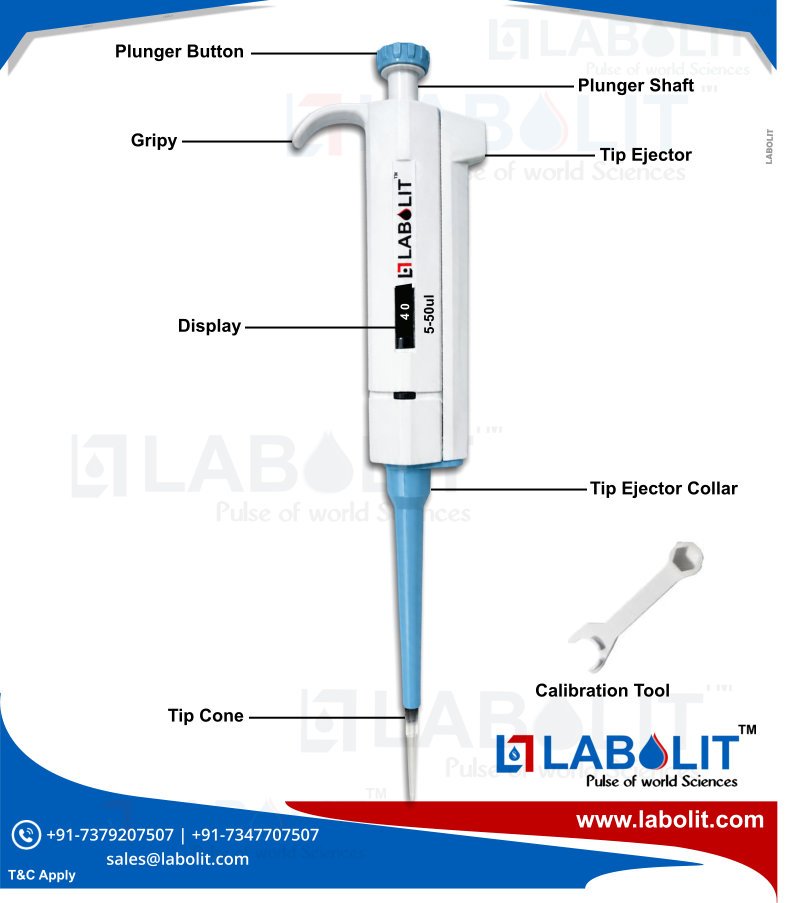
The LABOLIT micropipette shown in the supplied image contains several clearly identifiable components.
The plunger button is located at the top of the micropipette.
It is pressed by the user’s thumb during aspiration and dispensing.
The plunger normally operates through two stages:
The first stop is used for aspirating the selected volume and dispensing the measured liquid.
The second stop is generally used during the final dispensing or blow-out step to help expel remaining liquid from the tip.
Correct use of the plunger helps improve pipetting consistency.
The plunger shaft is connected to the plunger mechanism.
When the plunger button is pressed, the internal mechanism moves to control the displacement of air and therefore the amount of liquid aspirated into the pipette tip.
The plunger mechanism is an important part of the pipette because it directly influences volume delivery.
The grippy or finger support provides a comfortable location for the user’s hand and fingers.
An ergonomic grip is particularly important when the micropipette is used for extended periods.
Good ergonomic design can help reduce:
A comfortable micropipette can make repetitive laboratory liquid-handling tasks easier.
The tip ejector allows the user to remove the used pipette tip without touching it directly.
This is particularly important for laboratory safety and contamination control.
After dispensing the sample, the user can press the tip ejector to release the disposable tip.
Variable-volume micropipettes normally include a volume display.
The display indicates the selected volume.
For example, a LABOLIT micropipette may have a range such as:
5–50 µL
The volume adjustment mechanism allows the operator to select the required volume within the specified range.
The user should always verify the displayed volume before beginning pipetting.
The tip ejector collar is located around the lower portion of the pipette body.
It forms part of the tip-ejection mechanism and helps move the tip ejector assembly when the ejector button is operated.
The tip cone is the lower connection point where the disposable pipette tip is attached.
A suitable pipette tip should fit securely onto the tip cone.
A poor tip fit can cause:
Therefore, selecting compatible pipette tips is essential.
Some adjustable micropipettes include a calibration tool.
The calibration tool can be used by qualified personnel or authorized calibration laboratories to adjust the pipette when necessary.
Calibration should be performed according to applicable laboratory procedures and manufacturer recommendations.
Most conventional adjustable micropipettes operate using an air-displacement principle.
Inside the pipette is a piston system.
When the plunger is operated, the piston changes the volume of air inside the pipette.
When a disposable tip is attached and immersed in liquid, releasing the plunger creates a pressure difference.
This pressure difference causes the liquid to enter the pipette tip.
The liquid can then be dispensed into another vessel by pressing the plunger.
The general process is:
Plunger movement → piston movement → air displacement → pressure change → liquid aspiration/dispensing
The exact volume delivered depends on the mechanical movement of the piston and the calibration of the instrument.
Air-displacement pipettes are widely used because they are versatile and suitable for many routine laboratory applications.
Proper technique is essential for accurate results.
Choose a micropipette whose operating range covers the desired volume.
For example, if you need to transfer 35 µL, a:
5–50 µL
pipette would generally be appropriate.
Avoid using a 100–1000 µL pipette for a 35 µL transfer because it is outside its intended range.
Adjust the volume mechanism until the required volume appears on the display.
Never force the volume adjustment mechanism beyond the specified operating range.
For example, if the micropipette is rated:
5–50 µL
do not attempt to set it to 60 µL.
Press the micropipette tip cone vertically into a compatible tip.
The tip should be securely attached.
Do not apply excessive force because unnecessary force can damage the tip cone or tip.
Press the plunger smoothly until the first stop.
Avoid pressing too quickly.
Smooth plunger operation can improve repeatability.
Place the tip into the liquid.
The immersion depth should be appropriate for the pipette volume and tip size.
Do not immerse the tip unnecessarily deeply because liquid may enter the tip exterior or cause contamination.
Slowly release the plunger.
The liquid will be drawn into the tip.
Maintain the pipette in an appropriate vertical position during aspiration.
After aspiration, allow a short pause before removing the tip from the liquid.
This helps ensure that the desired liquid volume has been completely aspirated.
Move the micropipette to the destination container while keeping the tip away from surfaces that could cause contamination.
Press the plunger smoothly to the first stop.
Then press to the second stop if the procedure calls for complete dispensing or blow-out.
Press the tip ejector to remove the disposable tip.
Dispose of the used tip according to the laboratory’s waste-management procedures.
A fixed-volume micropipette is designed to deliver one predetermined volume.
Examples include:
Fixed-volume pipettes can be useful when a laboratory repeatedly performs procedures requiring the same volume.
Advantages include:
For high-volume repetitive laboratory procedures, fixed-volume models can provide convenient operation.
For example:
5–50 µL
means the pipette can be adjusted for different volumes within that range, according to the manufacturer’s specifications.
Variable-volume pipettes are popular because one instrument can be used for multiple liquid-handling tasks.
| Feature | Fixed Volume | Variable Volume |
|---|---|---|
| Volume | One specified volume | Multiple volumes within range |
| Flexibility | Lower | Higher |
| Repetitive tasks | Excellent | Excellent |
| Multiple protocols | Limited | Very useful |
| Volume adjustment | Usually not required | Required |
| Typical use | Repetitive procedures | General laboratory work |
Both types can be valuable depending on the laboratory’s requirements.
Choosing the correct volume range is one of the most important aspects of pipette selection.
Suitable for very small liquid volumes.
Applications may include:
A versatile range for small-volume applications.
Common applications include:
This range is widely used for laboratory applications requiring small-to-medium microliter volumes.
Examples include:
Suitable for many routine laboratory procedures.
It can be useful for:
A commonly used general-purpose volume range.
Applications include:
This range is suitable for larger liquid volumes within the micropipette category.
Applications include:
In laboratory research, even a small volume error can influence the final result.
Suppose an experiment requires a precise reagent concentration.
If the volume transferred is incorrect, the final concentration can also be incorrect.
This can affect:
Therefore, high-quality pipettes and proper pipetting technique are essential.
Accuracy and precision are related but different concepts.
Accuracy describes how close the measured volume is to the intended or reference volume.
Precision describes how consistently repeated measurements agree with each other.
A pipette can potentially provide repeatable results while still being incorrectly calibrated.
Therefore, both accuracy and precision are important.
Pipette calibration is the process of checking and, when required, adjusting a pipette so that its delivered volume meets specified performance requirements.
Calibration is particularly important in:
Calibration may be performed using appropriate gravimetric or other validated procedures.
ISO 8655 is an important international standard series related to piston-operated volumetric apparatus, including many types of laboratory pipettes.
Laboratories should select and verify pipette performance according to the applicable standard, manufacturer specifications and their internal quality-management requirements.
Where regulatory or accreditation requirements apply, laboratories should maintain appropriate calibration records.
Several factors can influence pipette performance.
Temperature can affect liquid density and air-displacement pipetting.
Viscosity, volatility and surface tension can influence aspiration and dispensing.
Fast or inconsistent plunger movement can reduce repeatability.
Poor-quality or incompatible tips may affect liquid transfer.
Incorrect calibration can lead to systematic volume errors.
The angle and orientation of the pipette can influence aspiration.
Incorrect immersion depth can affect aspiration.
For certain applications, pre-wetting the tip can improve consistency.
Even an excellent micropipette can provide poor results if it is used incorrectly.
A pipette should not be used outside its specified operating range.
Always check the volume display before beginning the procedure.
Rapid plunger movement can lead to inconsistent aspiration or dispensing.
Maintain an appropriate position during aspiration.
Damaged or poorly fitting tips can cause leakage and inaccurate volumes.
Disposable tips should normally be replaced between samples when required to prevent contamination and maintain sample integrity.
Avoid unnecessary contact between the pipette tip and laboratory surfaces.
Excessive immersion can increase the risk of liquid contamination and inconsistent aspiration.
Used tips should be removed safely using the tip ejector mechanism where available.
Regular verification and calibration are important for critical laboratory work.
Proper maintenance can help extend the service life of a micropipette.
Wipe the external surface using a suitable laboratory-approved cleaning method.
Regularly inspect the tip cone for:
The plunger should move smoothly.
If unusual resistance or mechanical problems occur, the pipette should be inspected by qualified personnel.
Ensure that the tip ejector operates smoothly.
Micropipettes should ideally be stored on a suitable pipette stand rather than left lying on the laboratory bench.
Proper storage helps protect the pipette from:
A pipette stand provides a safe and convenient location for storing micropipettes when they are not in use.
Benefits include:
For laboratories using multiple micropipettes, a dedicated stand can be particularly useful.
Micropipette tips are an essential part of the liquid-handling system.
The tip forms the interface between the pipette and the liquid.
A suitable tip should:
For sensitive applications, laboratories may select sterile, filtered or low-retention tips according to their requirements.
Sterile tips are widely used in applications where contamination control is important.
Examples include:
Filtered tips can also help reduce the risk of aerosol contamination entering the pipette.
Low-retention tips are designed to reduce the amount of liquid remaining on the inner surface of the tip.
They can be particularly useful when working with:
Micropipettes are essential in molecular biology.
They are commonly used for:
Molecular biology experiments often involve very small liquid volumes, making precision liquid handling essential.
Polymerase Chain Reaction (PCR) requires precise amounts of:
Because PCR reactions can use small total volumes, incorrect pipetting can significantly influence experimental results.
A suitable micropipette helps researchers transfer reagents consistently.
Diagnostic laboratories use micropipettes for various sample and reagent-handling procedures.
Applications may include:
Correct pipetting technique is essential because laboratory test results may depend on accurate liquid volumes.
Pharmaceutical laboratories use micropipettes for:
Accurate liquid handling contributes to reliable laboratory results and reproducible testing.
Biotechnology laboratories often perform experiments involving small quantities of biological materials.
Micropipettes can be used in:
Microbiology laboratories use pipettes for transferring:
Accurate liquid handling is especially important when preparing standardized experimental conditions.
Food and beverage laboratories may use micropipettes for:
Reliable volume measurement supports repeatable analytical procedures.
Universities, colleges and educational institutions use micropipettes for teaching and research.
Students may use micropipettes in:
Proper training is important before students begin independent pipetting work.
Forensic laboratories may use micropipettes for very small-volume sample preparation and molecular analysis.
Applications can include:
Forensic work often requires careful contamination control and documentation.
A single-channel micropipette contains one tip cone and transfers liquid through one pipette tip at a time.
Advantages include:
Single-channel pipettes are among the most common laboratory pipettes.
A multichannel micropipette can transfer liquid through multiple tips simultaneously.
Common configurations include:
Multichannel pipettes can improve productivity in applications involving microplates.
They are commonly used in:
Some micropipette models are designed to withstand autoclaving.
Autoclavability can be particularly useful where strict contamination-control procedures are required.
However, users should always follow the specific manufacturer’s instructions regarding:
Not every pipette component is necessarily designed for repeated autoclaving.
Some models may have selected components that can be autoclaved while other parts require alternative cleaning or decontamination methods.
Always refer to the applicable product documentation.
Laboratory technicians may perform hundreds or thousands of pipetting actions during a working day.
Ergonomic design therefore matters.
Important ergonomic features include:
An ergonomic micropipette can make repetitive laboratory work more comfortable.
Before purchasing a micropipette, consider the following factors.
Determine the minimum and maximum volumes that your laboratory regularly uses.
Choose fixed volume for repetitive single-volume applications.
Choose variable volume when multiple volumes are required.
Choose single-channel for individual samples.
Choose multichannel for microplate and high-throughput work.
For critical analytical work, select an instrument with appropriate performance specifications.
Ensure that suitable tips are readily available.
Consider sterile or filtered tips and autoclavability where applicable.
If the pipette will be used extensively, ergonomic design should be considered.
Choose a supplier or manufacturer that can provide suitable calibration and service support.
Suppose you need to transfer 10 µL.
You might have several options:
All may potentially cover 10 µL, but laboratories should select the range that best matches their required volume and performance needs.
In general, choosing a suitable pipette range rather than using one oversized pipette for every task can help achieve better control and accuracy.
Micropipettes and graduated cylinders serve different purposes.
A graduated cylinder is generally intended for measuring larger volumes.
A micropipette is designed for precise transfer of small volumes.
For microliter-level work, a micropipette is generally the appropriate instrument.
A conventional dropper is not designed for high-precision volume measurement.
A micropipette is specifically engineered for controlled liquid transfer.
Therefore, when an experiment requires precise microliter volumes, a micropipette is much more appropriate.
Serological pipettes are generally used for larger liquid volumes, often in milliliter ranges.
Micropipettes are generally designed for smaller microliter volumes.
Both are important liquid-handling instruments but serve different volume requirements.
The following practices can improve consistency:
For certain applications, pre-wetting can improve pipetting consistency.
The basic concept involves aspirating and dispensing the same liquid before the actual measurement.
Pre-wetting can help condition the inner surface of the tip, especially for some liquids where evaporation or surface effects may influence delivery.
The exact technique should be selected based on the liquid and laboratory procedure.
Viscous liquids can behave differently from water-like solutions.
Examples include:
For such liquids, the operator may need to use a slower pipetting technique and, where appropriate, a technique recommended by the pipette manufacturer.
Specialized positive-displacement pipettes may also be considered for difficult liquids.
Volatile liquids can evaporate more readily.
Examples include certain organic solvents.
Air-displacement pipetting may require additional care because vapor pressure can affect aspiration.
For challenging volatile liquids, laboratories should use an appropriate pipetting technique or consider a pipette technology designed for the application.
Contamination is an important concern in laboratory liquid handling.
Potential contamination sources include:
Good laboratory practice includes changing tips appropriately and following the laboratory’s contamination-control procedures.
The tip ejector is an important safety feature.
It allows the operator to remove the used tip without directly touching it.
This can reduce contact with potentially contaminated materials.
Used tips should be disposed of in an appropriate waste container according to laboratory and local safety procedures.
Proper storage is often overlooked.
When the pipette is not being used, it should ideally be stored on a suitable stand.
Avoid storing the pipette:
Good storage practices can help protect the instrument.
Cleaning procedures depend on the pipette design and the type of contamination.
A general approach may include:
Chemical disinfectants should be compatible with the pipette materials.
Calibration frequency depends on:
High-use or critical pipettes may require more frequent verification.
Gravimetric testing is commonly associated with pipette performance verification.
The basic concept involves measuring the mass of dispensed water under controlled conditions and converting mass to volume while accounting for relevant environmental factors.
Because the method requires controlled conditions and appropriate equipment, formal calibration should be performed by trained personnel.
A laboratory may establish quality-control procedures for its pipettes.
These procedures can include:
Good documentation is particularly important in regulated laboratories.
A well-designed micropipette can provide several benefits:
The instrument is designed for controlled volume transfer.
Consistent mechanical operation can support repeatability.
Precise dispensing can help minimize unnecessary liquid usage.
Easy volume adjustment and tip ejection can speed routine tasks.
A comfortable design can reduce operator fatigue.
Variable-volume models can be used for multiple applications.
LABOLIT micropipettes are suitable for a broad range of laboratory environments.
They can be considered for:
The availability of fixed and variable volume configurations makes it possible to select a model according to specific application requirements.
The LABOLIT pipette shown in the supplied product image features a practical laboratory-oriented design.
Visible features include:
The body is designed for handheld operation, while the blue tip cone and blue plunger components provide a distinctive LABOLIT appearance.
Depending on the model, LABOLIT provides fixed and variable volume options.
Users should select the exact model based on the required laboratory application and manufacturer’s specifications.
PCR requires precise reagent preparation.
A typical PCR reaction may contain multiple components in relatively small quantities.
The use of an appropriate micropipette can help ensure that each component is transferred consistently.
For PCR laboratories, commonly useful pipette ranges include:
A separate larger-volume pipette may be used for preparing master mixes or buffers.
ELISA procedures often involve repeated addition of reagents to microplate wells.
Multichannel pipettes can improve efficiency when transferring liquid across multiple wells.
Single-channel pipettes may also be used for individual sample preparation or specific reagent additions.
DNA and RNA workflows frequently involve small volumes.
Micropipettes may be used during:
Filtered tips can be useful where aerosol contamination is a concern.
Micropipettes can be used for small-volume reagent and sample handling in cell biology.
Depending on the procedure, laboratories may use sterile tips and appropriate biosafety practices.
The pipette itself should be maintained and decontaminated according to laboratory procedures.
Research laboratories often need flexibility because different experiments may require different volumes.
For this reason, variable-volume micropipettes can be particularly useful.
A laboratory may maintain several pipettes covering different ranges rather than attempting to use a single pipette for every task.
A pipette and its tip work as a system.
Even if the pipette itself is high quality, an incompatible tip can affect performance.
Problems may include:
Therefore, laboratories should use tips compatible with the selected micropipette.
The service life of a micropipette depends on:
With appropriate care and servicing, laboratory pipettes can remain useful for many years.
However, performance should be verified rather than assumed based only on age.
A pipette may require inspection if:
Do not continue using a critical pipette if its performance is questionable.
Laboratory users should follow appropriate safety practices.
Important precautions include:
Purchasing directly from a manufacturer can provide several potential advantages:
For laboratories, distributors, institutions and businesses purchasing multiple units, manufacturer support can be especially useful.
OEM stands for Original Equipment Manufacturer.
OEM micropipette services can allow companies to market laboratory products under their own brand, subject to agreed specifications, regulatory requirements and commercial terms.
OEM requirements may include:
LABOLIT offers OEM-related options depending on the model and order requirements.
Laboratory equipment distributors require products that are reliable, practical and suitable for multiple customer segments.
Micropipettes are widely demanded because they are used in:
A complete range covering different volume capacities can help distributors serve more customers.
Hospitals and diagnostic centers may use micropipettes in laboratories for various analytical and sample-preparation procedures.
The correct micropipette should be selected based on:
Educational laboratories need instruments that are easy to operate and suitable for repeated student use.
LABOLIT micropipettes can be considered for:
Students should receive proper training on pipette operation before performing practical work.
The price of a micropipette can vary depending on:
When comparing prices, laboratories should evaluate the total value of the product rather than choosing only on initial cost.
A simple selection process is:
Identify the smallest volume you need to transfer.
Identify the largest volume you need to transfer.
Select appropriate pipette ranges.
Determine whether you need fixed or variable volume.
Determine whether you need single or multichannel.
Consider sterile, filtered or specialized tips.
Consider calibration and service support.
Evaluate ergonomics.
Check warranty and manufacturer support.
Purchase from a reliable laboratory equipment supplier.
A micropipette is a laboratory instrument used to accurately aspirate and dispense small liquid volumes, usually measured in microliters.
A fixed-volume micropipette is designed for one specified volume, while a variable-volume micropipette can be adjusted within a defined volume range.
It means the micropipette is designed to operate within a volume range of 5 microliters to 50 microliters, according to the manufacturer’s specifications.
The minimum volume depends on the model. Some laboratory micropipettes are designed for volumes below 1 µL.
Many common micropipettes operate up to 1000 µL, while larger liquid-handling instruments can cover higher volumes.
Some micropipettes are designed to be autoclavable. Users should always check the manufacturer’s instructions before autoclaving.
The required frequency depends on usage, laboratory procedures, application criticality, manufacturer recommendations and applicable quality standards.
No. A single pipette cannot normally provide the best solution for every volume. Different pipette ranges are used for different volume requirements.
Disposable tips help reduce cross-contamination and simplify cleaning between samples.
The tip cone is the lower part of the micropipette where the compatible disposable pipette tip is attached.
The tip ejector allows the user to remove a used pipette tip without manually pulling it off.
The calibration tool is used by qualified personnel for pipette adjustment where the design permits calibration adjustment.
A micropipette is much more than a simple laboratory dispenser. It is a precision liquid-handling instrument that directly contributes to the quality and reproducibility of laboratory procedures.
The LABOLIT micropipette shown in the product image combines essential operating components such as:
Plunger Button + Plunger Shaft + Grippy + Display + Tip Ejector + Tip Ejector Collar + Tip Cone + Calibration Tool
This design provides users with a practical solution for controlled liquid handling.
With fixed-volume and variable-volume options, laboratories can select products according to their specific requirements.
LABOLIT focuses on laboratory liquid-handling products designed for research, diagnostic, pharmaceutical, educational and industrial laboratory applications.
Key points include:
The exact specifications, accuracy, precision, operating conditions and warranty should always be confirmed for the particular model selected.
Micropipettes are essential instruments for modern laboratories because they allow users to transfer small liquid volumes with controlled and repeatable operation.
From PCR and molecular biology to pharmaceutical research, diagnostics, biotechnology, microbiology, food testing and academic laboratories, micropipettes are used in countless applications.
Selecting the correct micropipette requires careful consideration of:
Correct pipetting technique is equally important. Users should select the appropriate volume range, attach compatible tips, operate the plunger smoothly, maintain suitable tip immersion, avoid contamination and follow proper dispensing procedures.
The LABOLIT micropipette range provides fixed and variable-volume options for different laboratory liquid-handling requirements. The product design includes a plunger button, plunger shaft, grippy, display, tip ejector, tip ejector collar, tip cone and calibration tool, providing a practical configuration for routine laboratory work.
For laboratories looking for a reliable liquid-handling solution, selecting the right micropipette and maintaining it properly can contribute significantly to laboratory efficiency, consistency and reproducibility.
Fixed Volume:
5 µL | 10 µL | 20 µL | 25 µL | 50 µL | 100 µL | 200 µL | 500 µL | 1000 µL
Variable Volume:
0.5–10 µL | 2–20 µL | 5–50 µL | 10–100 µL | 20–200 µL | 100–1000 µL
Applications: Research Laboratories | Pharmaceutical Laboratories | Biotechnology | Diagnostics | Hospitals | Pathology Labs | Universities | Colleges | Microbiology | Molecular Biology | Food Testing | Quality Control | Industrial Laboratories
Micropipette Manufacturer | Fixed & Variable Volume | OEM Available
🌐 Website: www.labolit.com
📧 Email: sales@labolit.com
📞 Contact: +91-7379207507 | +91-7347707507
micropipette, micropipette manufacturer, micropipette manufacturer in India, best micropipette manufacturer, LABOLIT micropipette, LABOLIT micropipette manufacturer, laboratory micropipette, laboratory pipette, micro pipette, precision micropipette, fixed volume micropipette, variable volume micropipette, adjustable micropipette, single channel micropipette, autoclavable micropipette, fully autoclavable micropipette, micropipette price, micropipette supplier, micropipette exporter, micropipette distributor, micropipette supplier in India, pipette manufacturer India, laboratory equipment manufacturer, air displacement micropipette, 5-50 µL micropipette, 10-100 µL micropipette, 20-200 µL micropipette, 100-1000 µL micropipette, PCR micropipette, molecular biology micropipette, pharmaceutical micropipette, diagnostic micropipette, biotechnology micropipette, laboratory liquid handling system, precision liquid handling, pipette calibration, ISO 8655 micropipette, micropipette tips, laboratory pipette manufacturer, OEM micropipette, micropipette OEM manufacturer, best laboratory pipette brand, LABOLIT laboratory equipment.
