

Leading Micropipette & Scientific Lab, Medical instrument Manufacturer and Deler A Legacy Of Scientific Precision .



Leading Micropipette & Scientific Lab, Medical instrument Manufacturer and Deler A Legacy Of Scientific Precision .
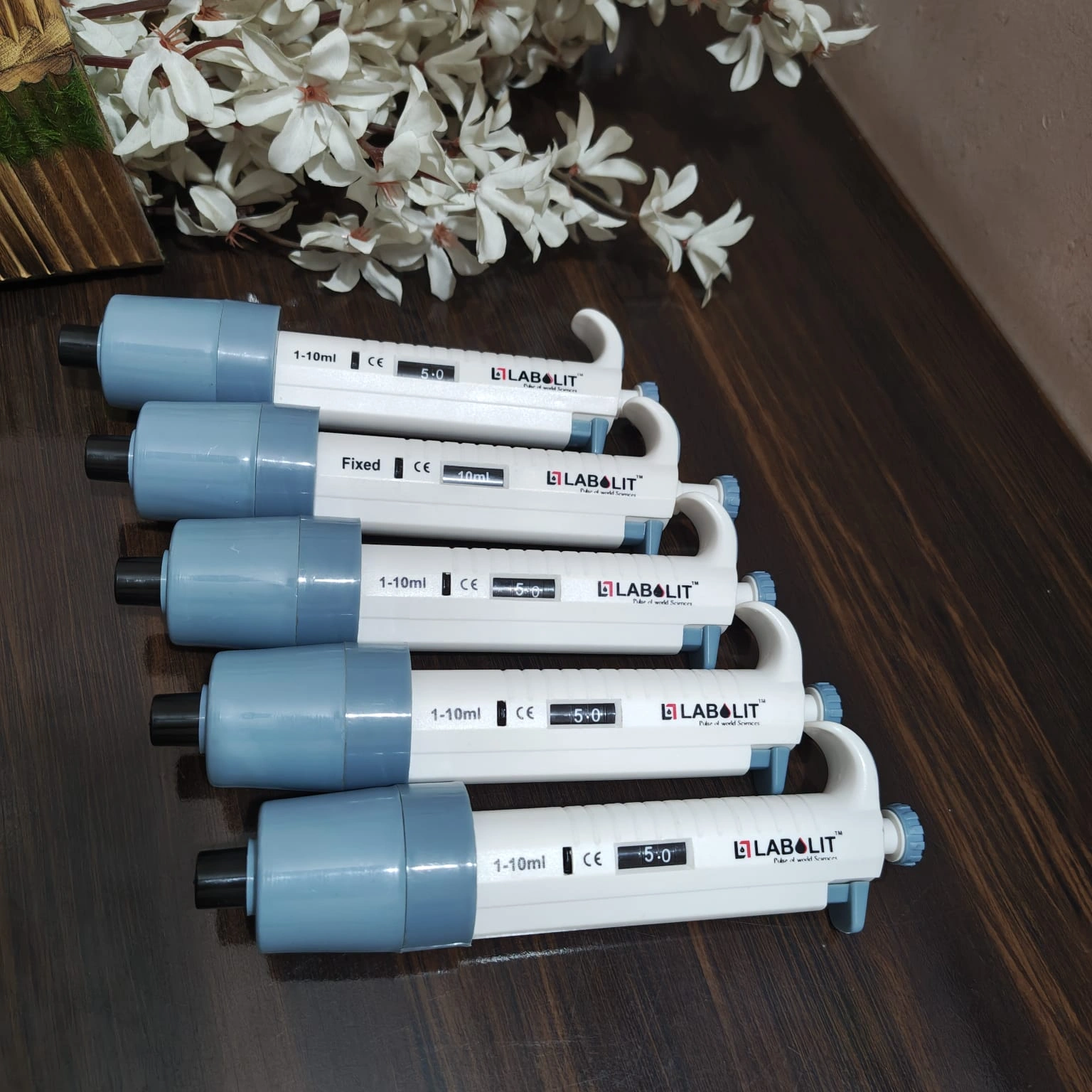
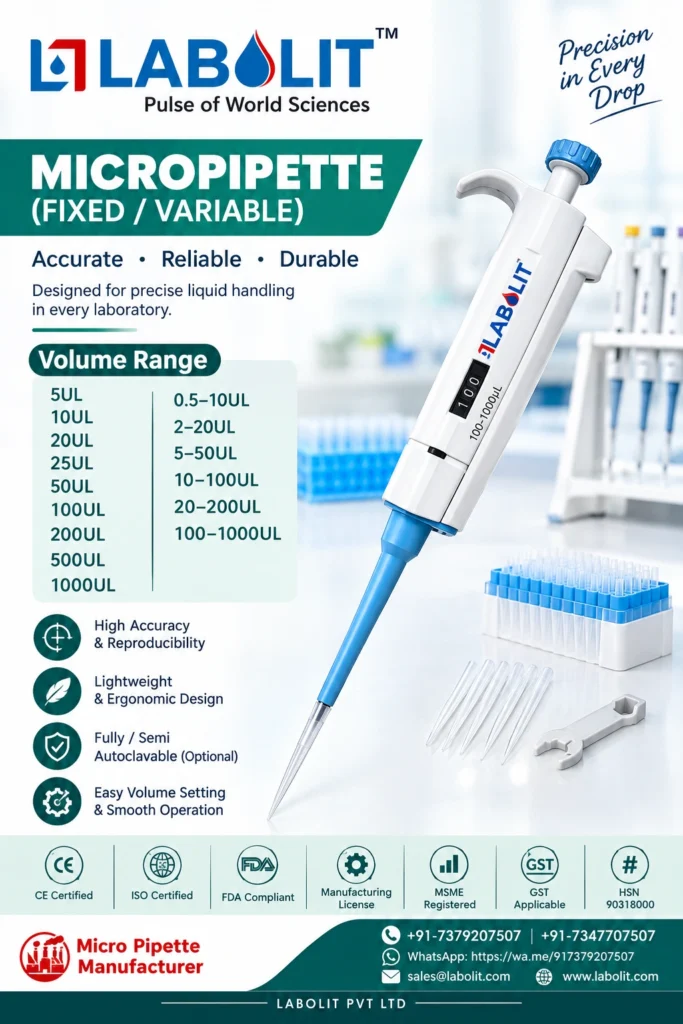
A plastic micropipette is a laboratory liquid-handling instrument designed to aspirate and dispense relatively small volumes of liquid.
Depending on the model, a micropipette may be available as:
The term “plastic” generally refers to the use of engineered polymer materials in part of the pipette construction or in disposable tips. It does not necessarily mean that every internal component of the instrument is made entirely from plastic.
High-quality laboratory micropipettes may use materials such as:
The exact materials vary according to the manufacturer and model.
Plastic materials can provide several useful characteristics for laboratory equipment.
Engineering plastics can help reduce the overall weight of a pipette.
A lightweight instrument can be more comfortable during repetitive pipetting tasks.
Modern plastic components can be molded into ergonomic shapes that fit comfortably in the user’s hand.
Certain laboratory-grade polymers provide good resistance to a variety of commonly handled laboratory chemicals.
The actual compatibility depends on the specific polymer and chemical.
Smooth external surfaces can make routine cleaning easier.
Injection molding and other manufacturing methods allow manufacturers to produce complex ergonomic components with consistent dimensions.
Suitable engineered plastics can contribute to economical production while maintaining appropriate mechanical performance.
It is important to distinguish between a plastic micropipette and a simple disposable transfer pipette.
A micropipette is a precision liquid-handling instrument with a defined operating mechanism and volume setting.
For precise laboratory measurements, a calibrated micropipette with a compatible pipette tip is generally the more appropriate instrument.
Most manual micropipettes use a piston-based mechanism.
The basic operation involves:
The exact operating principle varies according to pipette design.
Understanding the parts of a micropipette helps users operate and maintain the instrument correctly.
The plunger is pressed by the user during aspiration and dispensing.
Variable-volume models use a mechanism that allows the user to select the desired volume.
The selected volume is shown through a numerical display.
The main body provides the ergonomic grip and houses the operating mechanism.
Many micropipettes have a tip-ejection mechanism that allows used tips to be removed without touching them.
The shaft connects the main pipette body with the tip cone.
The tip is attached to the tip cone.
The piston moves to create the displacement required for aspiration and dispensing.
These components help maintain the required air seal.
The disposable tip is the component that directly contacts the liquid.
Plastic micropipettes can be categorized in several ways.
A single-channel micropipette contains one tip cone and transfers liquid through one channel.
It is suitable for:
Single-channel pipettes are available in many volume ranges.
A variable-volume micropipette allows the user to select different volumes within a defined range.
For example:
20–200 µL
This means the instrument is designed to operate within its specified 20 to 200 µL range.
Other commonly encountered laboratory ranges include:
The actual available ranges depend on the product.
A fixed-volume micropipette is designed for a specific volume.
Examples may include:
Fixed-volume models can be useful when a laboratory repeatedly performs the same liquid transfer.
Multichannel micropipettes contain multiple channels and can transfer liquid into several wells simultaneously.
Common configurations include:
They are particularly useful for microplate-based applications.
Applications include:
Pipette tips are an important part of any micropipette system.
Disposable plastic tips are commonly manufactured from laboratory-grade polymers, frequently polypropylene.
Depending on the application, tips may be:
The tip must be compatible with the micropipette.
The pipette tip forms the liquid-contact interface between the instrument and the sample.
Poor-quality or incompatible tips can contribute to:
For critical laboratory applications, users should select appropriate tips from a reliable source.
Different micropipette ranges require different tip capacities.
Examples include:
Commonly used for very small liquid volumes.
Widely used with micropipettes operating around the 20–200 µL range.
Used with larger-volume micropipettes, often around the 100–1000 µL range.
Larger pipette systems may use specialized tips for millilitre-scale liquid handling.
Tip dimensions and compatibility vary by manufacturer, so users should always confirm specifications before purchase.
Plastic micropipettes offer several practical benefits.
A lightweight construction can make repetitive pipetting more comfortable.
Modern designs can provide a comfortable grip and easy plunger operation.
A compact design makes the instrument convenient for routine laboratory use.
Plastic components can support cost-effective manufacturing.
Plastic-bodied micropipettes can be used across many general laboratory applications.
Smooth polymer surfaces are generally convenient for routine cleaning.
Plastic micropipettes are available in many volume ranges and configurations.
A micropipette’s accuracy does not depend simply on whether it contains plastic.
Accuracy depends on many factors, including:
A well-designed and properly calibrated micropipette can provide reliable liquid handling.
Calibration is an important part of maintaining micropipette performance.
Calibration determines whether the instrument delivers the intended volume within the required acceptance criteria.
A common calibration approach is the gravimetric method.
In a simplified explanation:
Professional calibration should follow an appropriate documented method and applicable requirements.
A variable-volume 20–200 µL micropipette is a popular laboratory range.
Representative calibration points may include:
The purpose is to evaluate performance across the operating range.
A calibration report may include:
The exact test method and acceptance limits should be based on the applicable standard, manufacturer specification, and laboratory procedure.
Accuracy and precision are both important.
How close the delivered volume is to the target.
How closely repeated measurements agree.
For example, a pipette might produce:
99.9 µL
100.0 µL
100.1 µL
for a 100 µL target.
The measurements are close to each other, demonstrating good repeatability. Whether the result meets a formal accuracy specification depends on the applicable acceptance criteria.
Correct technique is essential.
Choose a pipette whose operating range is appropriate for the desired volume.
Adjust the volume setting carefully.
Do not force the adjustment mechanism beyond its designed range.
Fit a compatible pipette tip securely.
Use the appropriate plunger stop.
Place the tip correctly into the liquid and release the plunger smoothly.
Move the pipette to the receiving vessel without unnecessary movement.
Press the plunger smoothly and consistently.
Use the tip-ejection mechanism and dispose of the tip appropriately.
Even a high-quality micropipette can produce poor results if used incorrectly.
Common mistakes include:
Operator training is therefore an important part of accurate liquid handling.
Regular maintenance helps protect performance.
Wipe the pipette according to the manufacturer’s instructions.
Check for cracks, contamination, or damage.
The plunger should operate smoothly.
Where accessible, inspect seals and O-rings according to the service procedure.
Unexpected liquid leakage can indicate a problem with the tip, seal, piston, or other components.
Calibration intervals should be determined according to laboratory requirements, usage, manufacturer’s recommendations, and historical performance.
Some micropipettes or specific components may be designed for autoclaving, while others may not be.
Autoclaving involves high-temperature steam sterilization, and not every plastic material or pipette component is suitable for it.
Therefore:
Never assume that a plastic micropipette is fully autoclavable simply because it is made from laboratory-grade plastic.
Always follow the manufacturer’s instructions regarding:
Plastic materials differ significantly in their chemical resistance.
Some chemicals may cause:
When working with aggressive solvents or corrosive chemicals, consult the manufacturer’s chemical compatibility information.
Do not assume that all plastic materials have the same resistance.
Molecular biology laboratories rely heavily on micropipettes.
Typical applications include:
Small-volume accuracy is particularly important in molecular biology because reagent concentrations can influence reaction performance.
Microbiology laboratories use micropipettes for:
Disposable plastic pipette tips can help reduce cross-contamination when used correctly.
Pharmaceutical research and quality-control laboratories use micropipettes in many processes.
Examples include:
Proper calibration and documentation can support laboratory quality systems.
Clinical laboratories may use micropipettes for:
In critical testing environments, pipette performance should be controlled through appropriate calibration, maintenance, and quality procedures.
Educational institutions use micropipettes to teach students about:
A durable and ergonomic micropipette can be especially useful in teaching environments where multiple users operate the equipment.
When purchasing a plastic micropipette, consider the following factors.
Choose the range according to your application.
A fixed-volume model may be appropriate for repetitive work, while a variable-volume model provides flexibility.
Single-channel pipettes are versatile. Multichannel pipettes can increase productivity for microplate applications.
Check the manufacturer’s published specifications.
Review repeatability specifications.
Choose a pipette that is comfortable for regular use.
Ensure that suitable tips are readily available.
Check whether sterilization is required and whether the specific model supports it.
Consider the availability of calibration and service support.
Review warranty coverage and service terms.
The price of a plastic micropipette in India can vary considerably.
Pricing depends on:
Bulk purchasing may have different commercial terms from individual purchases.
For laboratories purchasing multiple units, it is useful to compare not only the purchase price but also:
quality + accuracy + warranty + calibration support + tip availability + service + long-term operating cost.
India has a growing laboratory-equipment manufacturing sector serving:
When selecting a plastic micropipette manufacturer in India, buyers should evaluate:
Laboratory equipment distributors and brands may also require OEM or private-label micropipettes.
An OEM program may involve:
OEM requirements should be discussed with the manufacturer before placing an order.
Bulk buyers may include:
When purchasing in bulk, buyers should confirm:
Plastic micropipettes and glass pipettes serve different purposes.
Plastic micropipette systems are commonly valued for:
Glass pipettes may be selected for specific laboratory applications based on their design and chemical or thermal characteristics.
The best choice depends on the intended application.
Proper storage helps protect the instrument.
Recommended practices include:
A micropipette stand can be a useful accessory for keeping pipettes organized and accessible.
Common accessories include:
Using suitable accessories can improve workflow and help protect the instrument.
Disposable plastic tips create laboratory waste, so responsible waste management is important.
Laboratories should:
Contaminated tips must always be handled according to the applicable biosafety and waste-disposal procedures.
Safe operation is essential.
Users should:
The micropipette should be treated as laboratory equipment, not merely as a simple plastic tool.
A plastic micropipette is a precision liquid-handling instrument that uses engineered polymer materials in some or many of its components and is designed to transfer controlled volumes of liquid.
Yes, a properly designed, maintained, and calibrated micropipette can provide reliable accuracy and precision within its specified operating conditions.
Many disposable pipette tips are manufactured from polypropylene, although material selection varies by product and application.
Common ranges include 0.5–10 µL, 2–20 µL, 5–50 µL, 10–100 µL, 20–200 µL, 50–500 µL, and 100–1000 µL. Availability varies by manufacturer.
It is used for transferring liquid volumes within its specified 20–200 µL operating range, subject to the manufacturer’s specifications.
Some models or components can be autoclaved, but not all. Always check the manufacturer’s instructions.
Calibration frequency should be based on usage, application criticality, manufacturer’s recommendations, quality requirements, and previous performance.
A fixed-volume pipette is designed for a specific volume, while a variable-volume pipette allows volume selection within its specified range.
A single-channel micropipette transfers liquid through one tip at a time.
A multichannel micropipette transfers liquid through multiple channels simultaneously and is commonly used with microplates.
The tip forms the liquid-contact interface and must fit properly to support reliable aspiration and dispensing.
They may be suitable for many laboratory liquids, but chemical compatibility must be checked for the specific materials and chemicals involved.
Before purchasing, ask:
The performance of a micropipette is influenced by both the instrument and the operator.
Even a high-quality instrument can produce inconsistent results if:
Training users in correct pipetting technique is therefore just as important as purchasing good laboratory equipment.
Manufacturers and laboratories can use multiple approaches to support quality.
These may include:
For laboratory buyers, asking for appropriate product specifications and quality documentation can help with purchasing decisions.
Modern laboratories increasingly depend on precise liquid handling.
Micropipettes are used in workflows involving:
Research → Sample Preparation → Reagent Handling → Testing → Analysis → Quality Control
As laboratory testing becomes more sensitive and automated, reliable manual liquid-handling equipment remains important.
Plastic micropipettes offer an ergonomic and practical solution for many routine laboratory applications when properly selected and maintained.
A plastic micropipette is an important liquid-handling instrument used across research, healthcare, education, biotechnology, pharmaceutical, diagnostic, and industrial laboratories.
The most important factors when selecting a micropipette are not simply its appearance or price. Buyers should consider:
A reliable micropipette combined with suitable tips, correct operating technique, regular maintenance, and appropriate calibration can help laboratories achieve consistent liquid-handling performance.
For laboratories looking for a plastic micropipette manufacturer in India, comparing technical specifications, quality documentation, calibration support, warranty, and long-term availability is an important part of making the right purchasing decision.
LABOLIT PVT LTD manufactures and supplies laboratory liquid-handling products and scientific equipment for laboratories, research institutions, diagnostic facilities, educational organizations, healthcare facilities, and industrial users.
LABOLIT micropipette solutions include single-channel, fixed-volume, variable-volume, and multichannel micropipettes, along with compatible pipette tips and accessories.
For product inquiries, dealer requirements, bulk orders, OEM/private-label requirements, and laboratory equipment solutions:
LABOLIT PVT LTD
🌐 www.labolit.com
📞 +91-7379207507 | +91-7347707507
Plastic Micropipette, Plastic Micropipette Manufacturer, Plastic Micropipette Price, Plastic Micropipette in India, Plastic Micropipette Supplier, Laboratory Plastic Micropipette, Plastic Pipette, Micropipette, Micropipette Manufacturer in India, Micropipette Price in India, Single Channel Micropipette, Variable Volume Micropipette, Fixed Volume Micropipette, Multichannel Micropipette, Micropipette Tips, Micropipette Calibration, Micropipette Parts, Micropipette Stand, Laboratory Equipment Manufacturer in India, Liquid Handling Equipment Manufacturer.
