

Leading Micropipette & Scientific Lab, Medical instrument Manufacturer and Deler A Legacy Of Scientific Precision .



Leading Micropipette & Scientific Lab, Medical instrument Manufacturer and Deler A Legacy Of Scientific Precision .
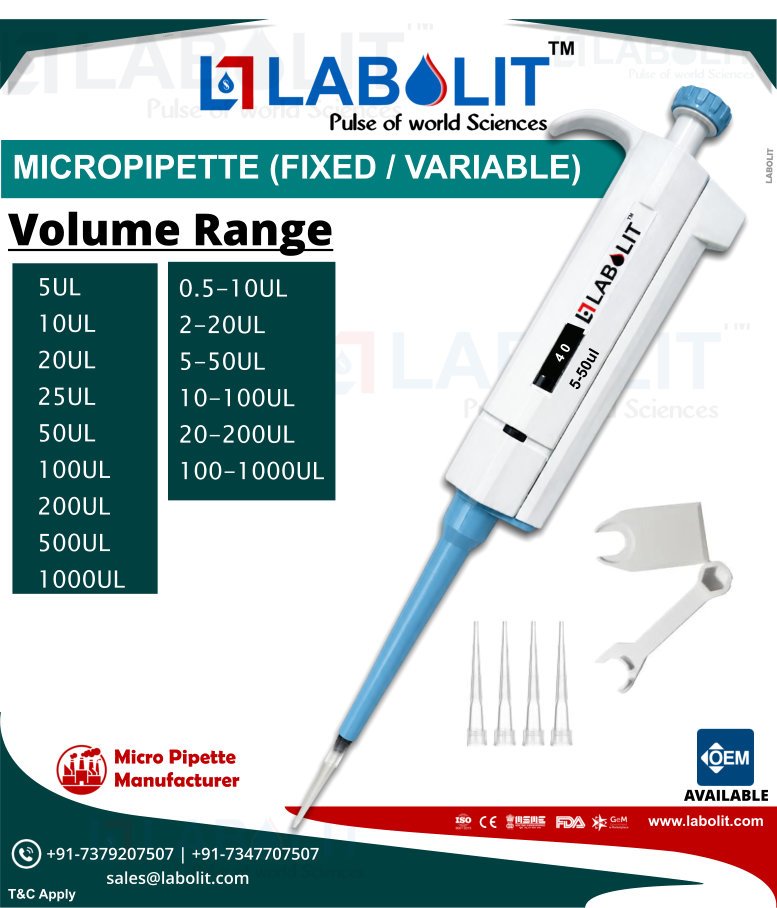
Uma Scientific, under its LABOLIT brand, manufactures and supplies laboratory liquid-handling products including variable volume micropipettes for different laboratory requirements. The product range is designed to support applications requiring controlled and precise liquid transfer across different volume ranges.
A variable volume micropipette is a precision laboratory instrument used to aspirate and dispense adjustable quantities of liquid, generally measured in microlitres (µL).
Unlike a fixed-volume pipette, a variable volume micropipette allows the user to select a desired volume within the specified operating range of the instrument.
For example, a pipette designed for 20–200 µL can be adjusted to dispense different volumes within that range, depending on the application.
Variable volume micropipettes are commonly used for:
The ability to adjust the volume makes one micropipette suitable for multiple related laboratory procedures.
Uma Scientific – LABOLIT offers variable volume micropipettes designed for laboratory liquid-handling requirements.
The manufacturer and supplier approach can include:
A micropipette provides controlled aspiration and dispensing of small liquid volumes.
For example, laboratory procedures may require:
A variable volume micropipette allows users to select the appropriate volume rather than requiring a separate fixed-volume pipette for every measurement.
This improves laboratory flexibility and can reduce the number of instruments required for routine liquid handling.
The main difference between these two pipette types is volume adjustment.
A variable volume micropipette allows the user to select a volume within the specified range.
Example:
20–200 µL
The user can set a required volume such as 25 µL, 50 µL, 100 µL, 150 µL, or 200 µL, subject to the pipette’s specifications.
A fixed volume micropipette is designed for one specific volume.
Example:
100 µL
The volume cannot normally be adjusted by the user.
Neither is universally better. The correct choice depends on the application.
Fixed-volume pipettes can be useful for repetitive workflows where exactly one volume is required continuously.
Different laboratory procedures require different volume capacities. Therefore, manufacturers produce pipettes in multiple ranges.
Common ranges include:
| Pipette Range | Typical Application |
|---|---|
| 0.1–2 µL | Very small-volume molecular applications |
| 0.5–10 µL | Molecular biology and reagent handling |
| 2–20 µL | Small-volume laboratory applications |
| 5–50 µL | General laboratory liquid handling |
| 10–100 µL | Routine laboratory work |
| 20–200 µL | General-purpose laboratory applications |
| 50–500 µL | Medium-volume liquid transfer |
| 100–1000 µL | Larger liquid transfer |
| 1000–5000 µL | Higher-volume liquid handling |
| 0.5–5 mL | Large-volume laboratory applications |
| 1–10 mL | Higher-capacity liquid transfer |
The exact usable range, accuracy, and precision should always be checked against the manufacturer’s specifications.
A mechanical variable volume micropipette generally operates using a piston-based liquid displacement mechanism.
The basic process involves:
The internal piston mechanism controls the displacement of air and liquid during aspiration and dispensing.
Proper pipetting technique is essential because user operation can affect accuracy and repeatability.
A typical variable volume micropipette includes several important components.
The plunger is pressed by the operator during aspiration and dispensing.
Many laboratory pipettes use a two-stage plunger mechanism to help control aspiration and blow-out.
The adjustment mechanism allows the operator to select the desired volume.
A clear volume display helps users verify the selected setting.
The volume display indicates the selected dispensing volume.
Correct reading of the volume display is essential before beginning a laboratory procedure.
The shaft connects the upper body mechanism to the tip cone.
The tip cone is the connection point between the micropipette and disposable pipette tip.
A tip ejector allows the used tip to be removed without directly touching it.
The piston forms an important part of the liquid displacement mechanism.
The spring mechanism supports controlled plunger movement.
Sealing components help maintain the appropriate internal conditions required for liquid aspiration and dispensing.
Variable volume micropipettes offer several advantages for modern laboratories.
The primary benefit is the ability to select different volumes within the specified operating range.
One pipette can support several related procedures requiring different liquid volumes.
Micropipettes enable controlled transfer of small liquid quantities.
Well-designed micropipettes can reduce hand fatigue during repetitive laboratory work.
Disposable tips help minimize cross-contamination between samples.
A properly maintained and calibrated micropipette can provide consistent results.
A clearly visible volume mechanism helps users set and verify the desired volume.
Variable volume micropipettes are useful across clinical, pharmaceutical, academic, industrial, and research laboratories.
When purchasing a variable volume micropipette, laboratories should evaluate more than just price.
Accuracy indicates how close the dispensed volume is to the selected or target volume.
Precision describes how consistently repeated measurements are delivered.
A lightweight and comfortable design is particularly important for laboratories performing high numbers of pipetting operations.
A volume-locking mechanism can help prevent accidental changes to the selected volume during operation.
The pipette should work reliably with suitable compatible tips.
Depending on the model, components may be semi-autoclavable or fully autoclavable.
Calibration capability and documentation are important for laboratories working under quality-controlled procedures.
The body and internal components should be manufactured using materials appropriate for laboratory use.
Autoclavability is an important consideration in laboratories where contamination control is critical.
A fully autoclavable micropipette is designed so that the specified pipette components can undergo autoclave sterilization according to the manufacturer’s instructions.
Autoclaving uses high-temperature steam under pressure to reduce microbial contamination.
However, users should always follow the manufacturer’s recommended autoclaving procedure, temperature, duration, and component limitations.
LABOLIT offers models designed for laboratory applications where autoclavability and hygienic operation are important considerations.
Some micropipette designs have selected components that can be autoclaved while the complete instrument may not be intended for full autoclaving.
These products can be appropriate for laboratories where routine cleaning and sterilization of specific components are required.
Before purchasing, users should confirm exactly which components are autoclavable.
A single-channel micropipette transfers liquid through one pipette tip at a time.
It is widely used for:
Single-channel models are versatile and are often considered an essential laboratory liquid-handling instrument.
A multichannel micropipette has multiple channels and can transfer liquid through multiple tips simultaneously.
Common configurations include:
Multichannel pipettes are particularly useful for microplate-based applications.
They can help improve workflow efficiency because several wells can be processed in one operation.
Applications include:
Molecular biology laboratories frequently work with very small quantities of reagents and samples.
Micropipettes may be used during:
For these applications, selecting an appropriate volume range and maintaining proper pipetting technique are essential.
Pharmaceutical laboratories use precision liquid-handling instruments throughout research, development, quality control, and testing.
Variable volume micropipettes may be used for:
Pharmaceutical laboratories should select instruments based on their validated procedures and applicable quality requirements.
Diagnostic laboratories use pipettes for handling samples and reagents.
Typical activities may include:
Accurate liquid handling is important because errors in sample or reagent volumes can affect test procedures.
Research laboratories often perform experiments requiring multiple liquid volumes.
A variable volume micropipette can provide flexibility for:
Researchers can select a suitable pipette range according to the volume required by their experimental protocol.
Educational laboratories also use micropipettes for practical training.
Students may learn:
For colleges and universities, durability, ease of use, training support, and cost-effectiveness are important purchasing considerations.
Hospitals and pathology laboratories may use micropipettes in diagnostic and research workflows.
The appropriate pipette should be selected based on:
Selecting the correct micropipette is important for laboratory performance.
Determine the typical liquid volume that needs to be transferred.
For example, if your application regularly requires 50–100 µL, a pipette covering that range may be suitable.
Avoid selecting a pipette simply because its maximum capacity is high.
For best performance, laboratories should choose a suitable pipette range for the actual volume being transferred.
Review the manufacturer’s accuracy and precision specifications for the required volume.
Use compatible tips designed for reliable sealing and liquid transfer.
If your application requires sterilization, select a model with appropriate autoclavability.
If the pipette will be used frequently, comfortable operation becomes especially important.
For quality-sensitive laboratories, calibration and maintenance support should be considered before purchase.
Calibration is an essential aspect of precision liquid handling.
Even a high-quality pipette can gradually change performance because of:
Regular calibration helps determine whether the pipette continues to perform within the required specifications.
Laboratories should establish calibration intervals based on usage, risk, quality requirements, and applicable procedures.
ISO 8655 is an important international standard series relating to piston-operated volumetric apparatus, including requirements and test methods relevant to pipettes.
When purchasing a precision micropipette, laboratories may review applicable manufacturer specifications and calibration documentation in relation to their quality-management requirements.
A calibration report can provide useful information about measured performance at specified test volumes.
For regulated or quality-sensitive environments, laboratories should define their own acceptance criteria and verification procedures.
Correct pipetting technique is essential.
Set the required volume using the adjustment mechanism.
Never operate outside the specified volume range.
Firmly attach a compatible disposable tip.
Avoid damaging the tip cone by excessive force.
For many applications, aspirating and dispensing the liquid once or more before the actual measurement can help condition the tip.
Press the plunger smoothly to the appropriate stop.
Place the tip at the appropriate depth in the liquid and slowly release the plunger.
Move to the receiving vessel and press the plunger smoothly.
Use the tip-ejector mechanism to discard the used tip safely.
Even a precision micropipette can produce inconsistent results if used incorrectly.
Common mistakes include:
Training users in proper pipetting technique is therefore as important as purchasing a good-quality pipette.
Regular maintenance can extend the useful life of a micropipette.
After use:
Check:
Use cleaning methods recommended by the manufacturer.
Avoid aggressive chemicals that may damage the body or internal components.
Perform calibration or verification according to laboratory requirements.
A micropipette and pipette tip work as a system.
Even a high-quality micropipette may not perform optimally with poor-quality or incompatible tips.
A suitable tip should provide:
Using compatible tips helps support reliable pipetting performance.
Micropipette tips are generally manufactured from laboratory-grade plastic materials such as polypropylene.
Tips are available in different sizes and formats.
Common considerations include:
For sensitive applications, laboratories may choose sterile or filtered tips depending on the procedure.
The price of a variable volume micropipette depends on several factors.
Important pricing factors include:
Therefore, laboratories should compare overall value rather than selecting a product solely on the lowest price.
For bulk purchases, distributors, hospitals, educational institutions, pharmaceutical companies, and research organizations can request quotations according to their required volume ranges and quantities.
Buying from a manufacturer based in India can provide several practical benefits.
Domestic manufacturing and distribution can simplify procurement.
Customers can communicate directly with the supplier regarding product specifications and requirements.
Manufacturers can support institutional and bulk orders.
Businesses requiring private-label products may be able to discuss OEM requirements.
Customers can obtain product information and usage guidance directly from the supplier.
Local supplier networks can help simplify service and maintenance communication.
Uma Scientific is a laboratory scientific equipment company associated with the LABOLIT brand.
The company focuses on laboratory liquid-handling products and scientific equipment for customers across India and other markets.
The LABOLIT micropipette range is designed for applications where controlled, convenient, and reliable liquid handling is required.
Product categories can include:
Different laboratories have different requirements, so a product portfolio can include multiple models.
LABOLIT model families referenced for laboratory applications include:
An economical option intended for laboratories looking for practical liquid-handling performance.
Designed as a general-purpose laboratory micropipette option.
A higher-level option for laboratories requiring enhanced usability and precision-oriented liquid handling.
Designed for demanding routine laboratory workflows.
A fully autoclavable model range intended for applications where sterilization and hygienic operation are important considerations.
A multichannel micropipette option designed for applications involving multiple simultaneous liquid transfers.
The exact specifications, volume ranges, accuracy, and precision should be confirmed from the current product datasheet before purchase.
OEM manufacturing can be useful for laboratory equipment distributors, scientific brands, importers, exporters, and businesses that want products under their own brand.
OEM requirements may include:
Uma Scientific / LABOLIT can discuss OEM requirements depending on the product model and order quantity.
For OEM buyers, it is recommended to confirm:
A reliable supplier should be able to provide consistent products, proper documentation, suitable packaging, and responsive communication.
A supplier may serve:
For institutional purchases, customers should provide the required volume ranges and quantities so the supplier can recommend suitable models.
Indian laboratory equipment manufacturers and suppliers increasingly serve international markets.
Variable volume micropipettes can be supplied to laboratories, distributors, and scientific equipment companies in international markets, subject to applicable export requirements.
For export enquiries, buyers may request:
International customers should confirm applicable import and regulatory requirements in their destination country.
Variable volume micropipettes have a wide range of laboratory applications.
Used for sample and reagent handling in biotechnology research.
Used for DNA, RNA, PCR, and other molecular workflows.
Used for culture-related liquid handling and laboratory testing.
Used for research, formulation studies, sample preparation, and testing.
Used for controlled liquid transfer in laboratory procedures.
Used for reagent and sample preparation.
Used in food analysis and laboratory testing workflows.
Used for sample and reagent handling.
Used in university and college laboratories.
Used in industrial and pharmaceutical QC laboratories.
PCR workflows often require small and carefully controlled quantities of reagents.
A suitable micropipette can be used for transferring:
Low-volume pipetting requires good technique and suitable equipment. Users should select a volume range appropriate for their specific PCR protocol.
ELISA workflows commonly involve repeated liquid transfers into microplates.
A multichannel micropipette can improve workflow efficiency when multiple wells need to be processed simultaneously.
Single-channel pipettes can also be used for individual sample or reagent transfers.
Laboratory personnel may perform hundreds of pipetting operations during a working day.
An ergonomic micropipette can help make repetitive work more comfortable.
Important ergonomic considerations include:
Ergonomic design does not replace correct technique, but it can improve user comfort during repetitive laboratory workflows.
Proper storage helps protect the instrument.
Recommended practices include:
A micropipette stand is useful for keeping pipettes organized and reducing accidental damage.
Variable volume micropipettes are used in many industries and sectors, including:
A professional micropipette manufacturer typically considers multiple stages of quality management.
These may include:
Materials and components should be checked before manufacturing.
Precision components are produced according to required specifications.
Components are assembled carefully to maintain consistent mechanical performance.
Pipettes can undergo functional checks for plunger movement, tip attachment, volume adjustment, and dispensing operation.
Selected products may be checked against defined performance requirements.
Products are inspected before packaging and shipment.
Micropipette performance can be influenced by multiple factors.
Liquid and ambient temperature can influence measurement performance.
Viscosity, density, volatility, and surface tension can affect aspiration and dispensing.
Operator technique has a major influence on repeatability.
Poorly fitting tips may cause leakage or inconsistent liquid transfer.
Pipettes that are not properly maintained or verified may gradually deviate from expected performance.
Worn internal components may affect operation.
Laboratory users can follow several general practices:
A laboratory purchasing team should consider the intended use before selecting a micropipette.
For general laboratory work, a range such as 20–200 µL or 100–1000 µL may be useful depending on the procedures.
For molecular applications, smaller volume ranges may be more appropriate.
For high-volume liquid handling, higher-capacity pipettes may be required.
There is no single micropipette range suitable for every application.
When searching for a variable volume micropipette manufacturer in India, customers should consider product quality, specifications, availability, support, and pricing.
Uma Scientific – LABOLIT supplies laboratory liquid-handling products for customers requiring reliable pipetting solutions.
The company can support requirements for:
Customers can contact Uma Scientific for current product specifications, volume ranges, pricing, bulk requirements, OEM possibilities, and availability.
LABOLIT micropipettes are positioned for laboratories looking for practical liquid-handling instruments.
Key considerations include:
The right model should always be selected according to the laboratory’s actual volume and application requirements.
Laboratories and distributors may require multiple pipettes across different volume ranges.
For bulk orders, buyers can specify:
Bulk procurement can help organizations standardize their laboratory liquid-handling equipment.
Scientific equipment distributors often require dependable supply and consistent product quality.
A manufacturer can support distributors with:
Distributors can offer LABOLIT micropipettes to laboratories, educational institutions, hospitals, pharmaceutical companies, and research organizations.
Before purchasing, compare manufacturers based on:
Does the manufacturer offer the volume range you need?
Are products manufactured and inspected using consistent quality procedures?
Are specifications and calibration-related documents available where required?
Can the supplier provide products when required?
Is technical and after-sales support available?
Does the price provide good value for the required specification?
If you need private-label products, does the manufacturer offer OEM support?
A variable volume micropipette is a laboratory instrument that allows users to select and transfer different liquid volumes within a specified operating range.
Variable volume pipettes allow volume adjustment, while fixed volume pipettes are designed for a predetermined volume.
Choose a range based on the actual liquid volumes required by your laboratory procedures.
Some models are designed to be autoclavable. Always verify the manufacturer’s specifications before autoclaving.
Micropipettes are used for accurate and controlled transfer of small quantities of liquid.
They are used in pharmaceutical, biotechnology, diagnostic, clinical, research, educational, food testing, microbiology, and other laboratories.
Yes. Micropipettes can be calibrated or verified using appropriate procedures and equipment.
The appropriate interval depends on usage, laboratory quality requirements, risk assessment, and applicable procedures.
Yes, if it is a variable volume model and the required volumes fall within its specified range.
They are useful for transferring liquids into multiple wells simultaneously, especially in microplate-based applications.
Use compatible tips designed to fit the specific micropipette securely and appropriately.
Laboratories are increasingly focused on accuracy, reproducibility, workflow efficiency, contamination control, and ergonomic operation.
As research and diagnostic workflows become more sophisticated, demand for reliable liquid-handling equipment is expected to remain important.
Manual micropipettes continue to play a major role because they are flexible and suitable for a wide variety of laboratory applications.
At the same time, automated and electronic liquid-handling systems are becoming more common in high-throughput laboratories.
Manufacturers are therefore continuing to focus on:
A variable volume micropipette is an essential laboratory instrument for controlled liquid handling. Its adjustable volume capability makes it suitable for a wide range of laboratory applications, from routine sample preparation to molecular biology, pharmaceutical research, biotechnology, diagnostics, microbiology, and academic research.
Selecting the correct pipette requires consideration of volume range, accuracy, precision, ergonomics, tip compatibility, autoclavability, maintenance, calibration, and application requirements.
When searching for a variable volume micropipette manufacturer in India, buyers should look beyond price and evaluate product quality, technical specifications, supply reliability, documentation, OEM capabilities, and customer support.
Uma Scientific – LABOLIT provides variable volume micropipettes and laboratory liquid-handling solutions for laboratories, distributors, dealers, institutions, pharmaceutical companies, research organizations, and other scientific users.
For current LABOLIT variable volume micropipette models, specifications, volume ranges, bulk orders, OEM requirements, dealer enquiries, and pricing, customers can contact Uma Scientific directly.
