

Leading Micropipette & Scientific Lab, Medical instrument Manufacturer and Deler A Legacy Of Scientific Precision .



Leading Micropipette & Scientific Lab, Medical instrument Manufacturer and Deler A Legacy Of Scientific Precision .
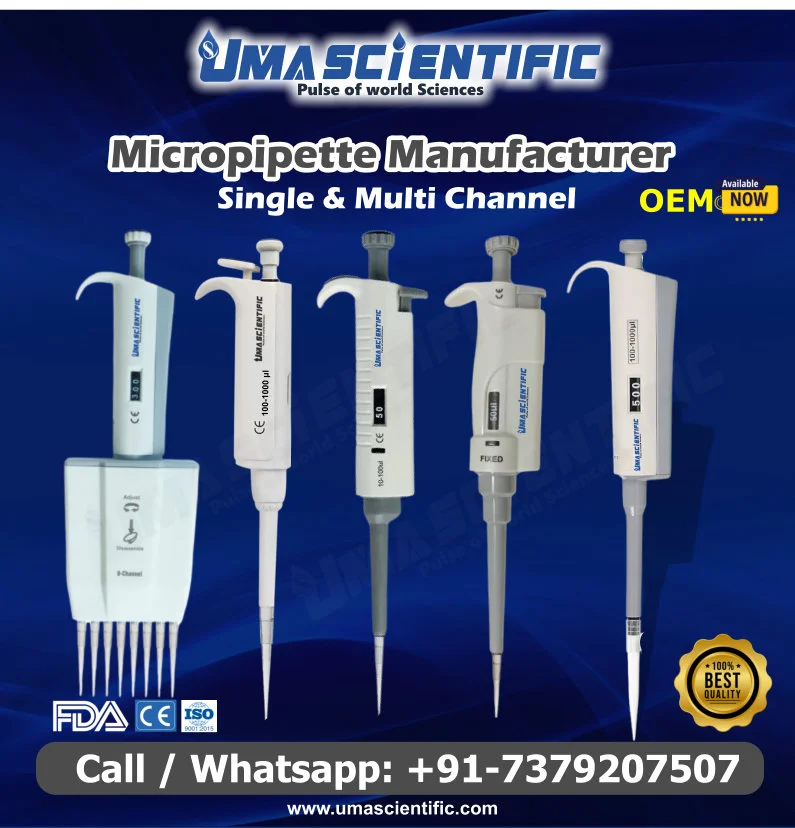
In the dynamic world of scientific research and diagnostics, precision is paramount. Every experiment, every diagnostic test, and every quality control measure hinges on the accurate handling of minute liquid volumes. At the heart of this meticulous work lies an indispensable laboratory instrument: the micropipette.
Micropipettes are the workhorses of any lab, enabling scientists to transfer liquids with unparalleled accuracy and reproducibility in the microliter (μL) and even nanoliter ($ nL $) ranges. From molecular biology to clinical diagnostics, their role is critical in ensuring reliable and consistent results. This guide will delve into the world of micropipettes, exploring their different types, the vast range of volumes they handle, key features to consider, and essential maintenance practices to ensure their optimal performance.Micropipette,” “10-100 ul price,” “Best Micropipette brand in India” are included naturally.
Micropipettes: Guide, Ranges & Price (0.1-10000 ul)
Explore a complete guide to micropipettes (fixed & variable), covering all ranges. Find quality options from India’s trusted names like Uma Scientific.
A micropipette is a laboratory tool designed to measure and transfer precise volumes of liquid, typically ranging from 0.1μL to 10,000μL (10 mL). Operating on the air displacement principle, these instruments use a piston to create a vacuum, which then aspirates and dispenses liquid samples into disposable tips. This mechanism ensures that the internal components of the pipette do not come into direct contact with the sample, minimizing contamination and maximizing accuracy.
The importance of an accurate micropipette cannot be overstated. Even the slightest error in liquid transfer can compromise experimental integrity, lead to skewed results, and necessitate costly repetitions. In fields like genomics, drug discovery, and clinical diagnostics, where even minute variations can have significant implications, precision pipetting is non-negotiable.
Accurate pipetting contributes to:
Micropipettes are broadly categorized based on their volume adjustability, each offering distinct advantages for different laboratory needs.
As the name suggests, fixed volume micropipettes are designed to dispense a single, pre-set volume of liquid. This volume cannot be adjusted by the user.
Key Characteristics:
Common Applications: Clinical diagnostics, routine testing, quality control, educational laboratories.
Variable volume micropipettes offer the flexibility to adjust the dispensed volume within a specified range. These are the most common type of micropipettes found in research and development laboratories due to their versatility.
Key Characteristics:
Common Applications: Molecular biology research, biochemistry, cell culture, pharmaceutical research, analytical chemistry, academic research.
While fixed and variable volume are primary classifications, micropipettes can also be categorized by their operational mechanism and number of channels:
Micropipettes are available in various ranges to cover the entire spectrum of microliter liquid handling, from the smallest to the largest volumes. Selecting the correct pipette for a given volume is crucial for achieving optimal accuracy. As a general rule, always choose the smallest pipette that can comfortably handle your desired volume to maximize accuracy.
Here’s a breakdown of common micropipette volume ranges:
Each range typically comes with corresponding color-coded tips to ensure proper fit and performance.
When investing in micropipettes for your laboratory, several features contribute to their performance, user comfort, and longevity:
Even the highest quality micropipette requires regular calibration and diligent maintenance to ensure its continued accuracy and extend its lifespan.
Micropipette calibration is the process of checking and adjusting an instrument to ensure it dispenses volumes within its specified tolerance limits. This is typically done gravimetrically, by weighing distilled water dispensed by the pipette and converting the weight to volume using water density tables.
When to Calibrate:
By adhering to these maintenance and calibration practices, you can significantly prolong the life of your micropipettes and ensure the integrity of your laboratory work.
Micropipettes are more than just instruments; they are crucial partners in the pursuit of scientific discovery and reliable diagnostics. Understanding their various types,
