

Leading Micropipette & Scientific Lab, Medical instrument Manufacturer and Deler A Legacy Of Scientific Precision .



Leading Micropipette & Scientific Lab, Medical instrument Manufacturer and Deler A Legacy Of Scientific Precision .

The price of a micropipette in Tanzania depends on several factors. These include the brand, model, volume range, single-channel or multi-channel configuration, autoclavability, accuracy, precision, material quality, warranty, calibration certificate, quantity ordered, shipping cost, import charges and supplier terms.
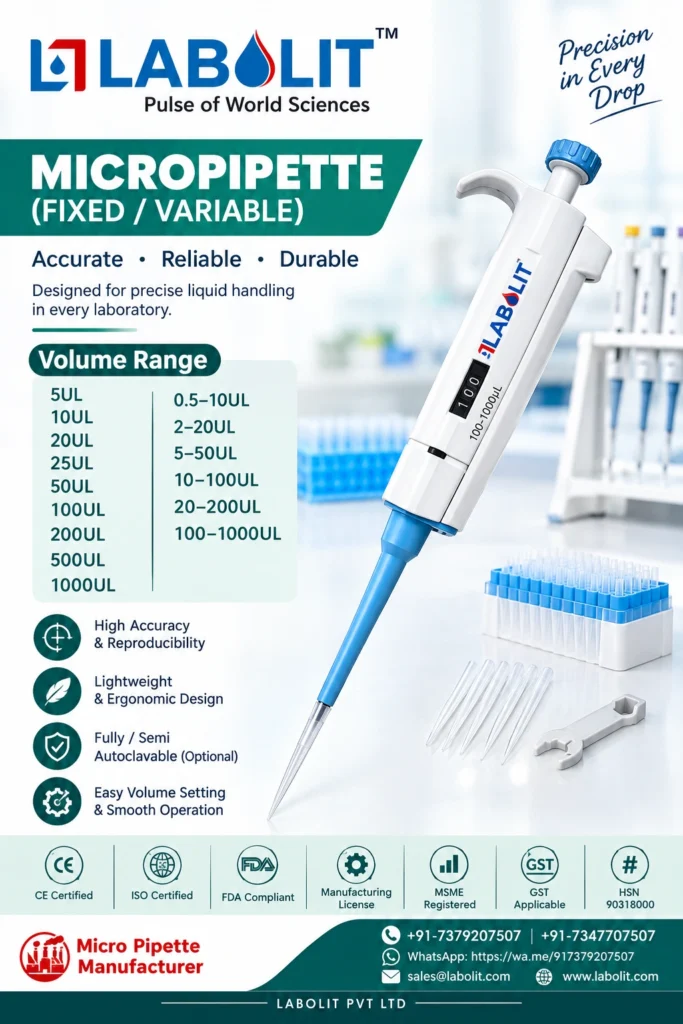
Common micropipette volume ranges include:
Micropipettes can also be divided into:
When searching for the best micropipette price in Tanzania, buyers should first identify the required volume range and application.
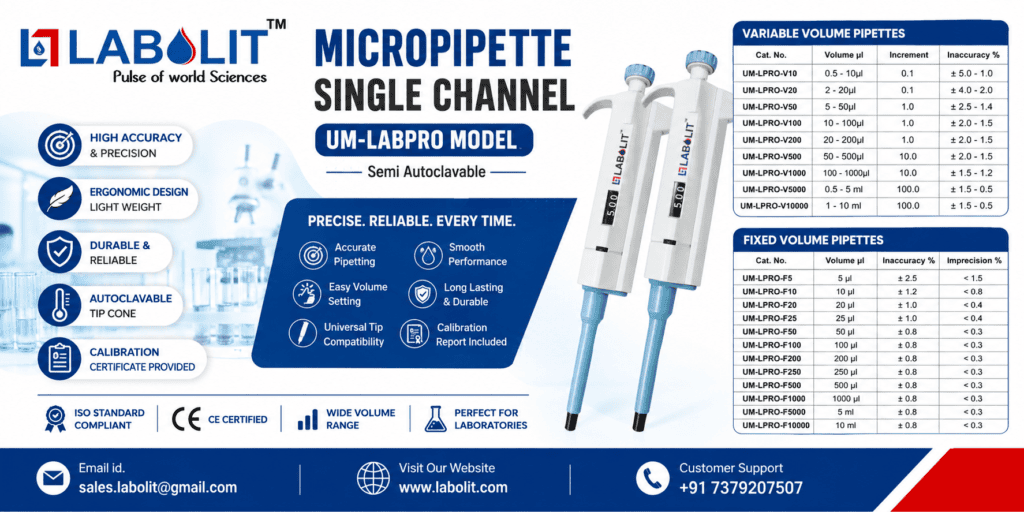
A general comparison can be made based on product category:
| Micropipette Type | Typical Volume Range | Relative Price |
|---|---|---|
| Basic fixed-volume micropipette | 5–1000 µL | Economical |
| Basic variable micropipette | 0.5–1000 µL | Economical to Mid-range |
| Premium variable micropipette | Various | Mid-range to Premium |
| Fully autoclavable micropipette | Various | Mid-range |
| 8-channel micropipette | Various | Mid-range to Premium |
| 12-channel micropipette | Various | Mid-range to Premium |
| Micropipette set | Multiple ranges | Depends on configuration |
For an accurate quotation, Tanzanian buyers should provide:
A micropipette is a precision laboratory instrument designed to measure and transfer very small quantities of liquid.
The volume is generally measured in microlitres, written as µL.
For example:
1 mL = 1000 µL
A laboratory technician can use a micropipette to transfer a specific quantity of liquid from one tube, container, plate or vessel to another.
Micropipettes are commonly used in:
Laboratory accuracy is extremely important.
A small volume error can affect experimental results, diagnostic procedures and research outcomes.
For this reason, laboratories in Tanzania need reliable pipettes that provide:
In cities such as Dar es Salaam, Dodoma, Arusha, Mwanza and Mbeya, laboratories serving hospitals, universities, research institutions and private diagnostic centres can benefit from selecting suitable micropipettes according to their actual laboratory workload.
A single-channel micropipette has one liquid dispensing channel.
It is one of the most commonly used pipette designs.
Single-channel micropipettes are suitable for:
A single-channel variable micropipette allows the operator to adjust the required volume within the specified range.
For example:
20–200 µL variable micropipette
can be adjusted to different volumes within its operating range according to the manufacturer’s specifications.
Multi-channel micropipettes are designed to transfer liquid into multiple wells or containers simultaneously.
Common configurations include:
They are particularly useful for:
For laboratories working with microplates, an 8-channel or 12-channel pipette can significantly improve workflow efficiency compared with transferring liquid one well at a time.
A fixed-volume micropipette is designed for one specific volume.
Examples include:
Fixed-volume pipettes can be useful when the same volume is repeatedly required in a laboratory procedure.
They can also be useful for routine laboratory work where volume adjustment is not required.
Variable-volume micropipettes allow the user to select the desired volume within a defined range.
Popular laboratory ranges include:
Variable micropipettes are versatile because one pipette can be used for multiple volumes within its specified range.
When selecting a variable micropipette, buyers should always check the manufacturer’s accuracy and precision specifications at the required volume.
A fully autoclavable micropipette is designed so that the pipette can be sterilized using an autoclave according to the manufacturer’s specified procedure.
Autoclaving is commonly used in laboratories where contamination control is important.
A buyer searching for:
fully autoclavable micropipette Tanzania
should check the manufacturer’s instructions regarding:
Many laboratory pipettes designed for autoclaving are specified for standard laboratory autoclave conditions. However, users should always follow the manufacturer’s instructions rather than assuming that every model has identical sterilization specifications.
Micropipette tips are an essential consumable used with micropipettes.
Common tip categories include:
The correct tip should be compatible with the micropipette.
Common volume categories include:
Other sizes may also be available depending on the application.
When ordering a micropipette in Tanzania, it is useful to ask whether compatible tips are available from the same supplier.
Choosing a micropipette only on the basis of price is not recommended.
Consider the following factors.
First determine the volume you normally transfer.
If your application requires 10 µL, a 100–1000 µL pipette is not appropriate.
If you regularly work at 500 µL, a low-volume pipette may not be suitable.
The selected pipette should have an appropriate operating range.
Accuracy describes how close the delivered volume is to the intended volume.
For analytical and diagnostic applications, accuracy is particularly important.
Precision refers to how consistently the pipette delivers the same volume across repeated operations.
A good micropipette should provide reliable repeatability when used correctly.
A laboratory technician may use a micropipette hundreds of times per day.
A comfortable design can reduce hand fatigue and improve workflow.
Look for:
If sterilization is important, choose a model specifically designed for autoclaving.
Do not assume that every micropipette is fully autoclavable.
Laboratories requiring high measurement reliability may need calibration verification or calibration services.
Ask the supplier about:
Warranty is another important factor.
Before ordering, confirm:
Dar es Salaam is one of Tanzania’s largest commercial and industrial centres and has a significant requirement for laboratory equipment.
Businesses searching for:
may include laboratories and institutions located around:
Dar es Salaam buyers may require micropipettes for hospitals, private diagnostic laboratories, universities, research laboratories, pharmaceutical companies and industrial testing facilities.
Dodoma is Tanzania’s capital and an important centre for government institutions, education, healthcare and research.
Search terms may include:
Areas and localities associated with Dodoma include:
Institutions in Dodoma can require pipettes for medical, research, university and educational laboratory applications.
Arusha is an important northern Tanzanian city and a major centre for tourism, education, healthcare, agriculture and business.
Popular search phrases include:
Localities and areas include:
Laboratories in Arusha can use micropipettes for clinical diagnostics, research, agriculture, food testing and educational purposes.
Mwanza is a major commercial centre in northern-western Tanzania and serves a large surrounding region.
People may search for:
Important areas include:
Medical laboratories, hospitals, universities and research institutions in Mwanza may require a wide range of laboratory pipettes.
Mbeya is a major city in southwestern Tanzania.
Relevant searches include:
Areas include:
Morogoro is an important educational, agricultural and commercial centre.
Search keywords include:
Areas include:
Tanga is a major coastal city and an important centre for industry, agriculture and healthcare.
Search phrases include:
Areas include:
Zanzibar is another important market for laboratory and scientific equipment.
Buyers may search:
Areas include:
Moshi is located in the Kilimanjaro region and is an important centre for education, healthcare, agriculture and tourism.
Search terms include:
Areas include:
Iringa is an important highland city with educational, healthcare and agricultural activities.
Potential searches include:
Areas include:
Tabora is a major inland Tanzanian centre.
Search terms include:
Areas include:
Kigoma serves western Tanzania and has important healthcare, education and laboratory requirements.
Searches include:
Areas include:
Mtwara is an important southern Tanzanian city.
Search keywords include:
Areas include:
Sumbawanga is a regional centre in southwestern Tanzania.
Relevant searches include:
Singida is another important Tanzanian regional centre.
Search phrases include:
Bukoba is a major centre in the Kagera region.
Potential keywords include:
Shinyanga is an important commercial and regional centre.
Relevant keywords include:
Musoma is an important city in northern Tanzania.
Search terms include:
Laboratories and healthcare facilities in Lindi can also require laboratory pipettes.
Relevant keywords include:
Songea is an important centre in southern Tanzania.
Search keywords:
Njombe is an important agricultural and regional centre.
Keywords include:
Buyers throughout Tanzania’s Coast Region may search for laboratory equipment near:
Useful search phrases include:
micropipette price Kibaha
micropipette supplier Bagamoyo
laboratory equipment Kibaha Tanzania
micropipette for sale Coast Region Tanzania
The Kilimanjaro region includes important areas such as:
Potential keywords include:
micropipette price Kilimanjaro Tanzania
micropipette supplier Moshi
laboratory micropipette Himo
micropipette for sale Hai Tanzania
Important locations include:
Buyers may search:
micropipette price Arusha Tanzania
micropipette supplier Usa River
laboratory equipment Karatu
micropipette for sale Monduli
Locations include:
Search examples:
micropipette price Mwanza Tanzania
micropipette supplier Ilemela
laboratory equipment Nyamagana
micropipette for sale Sengerema
Relevant locations include:
Potential searches:
micropipette price Mbeya Tanzania
micropipette supplier Tukuyu
laboratory equipment Kyela
micropipette for sale Mbarali
Important locations include:
Search terms:
micropipette price Morogoro Tanzania
micropipette supplier Kilosa
laboratory equipment Ifakara
micropipette for sale Mikumi
Locations include:
Search phrases:
micropipette price Tanga Tanzania
micropipette supplier Korogwe
laboratory equipment Lushoto
micropipette for sale Handeni
Locations include:
Keywords include:
micropipette price Dodoma Tanzania
micropipette supplier Chamwino
laboratory equipment Kondoa
micropipette for sale Kongwa
Zanzibar’s laboratory equipment market also includes Pemba.
Potential searches include:
There is no single fixed price for every micropipette.
The price can change based on:
Different manufacturers have different pricing structures.
A low-volume pipette and a high-volume pipette may have different prices.
Single-channel models are generally different in price from 8-channel and 12-channel models.
Higher-quality materials and ergonomic designs may increase the price.
Fully autoclavable models may cost more than basic models depending on design and manufacturer.
A longer warranty or replacement support can influence the overall price.
Calibration documentation and quality-control services may influence cost.
Bulk laboratory orders can have different pricing from single-piece purchases.
International freight, courier charges and local delivery affect the final landed cost.
Taxes, customs duties and other import-related charges may apply depending on the shipment and applicable Tanzanian regulations.
Tanzanian laboratories can source micropipettes from both local and international suppliers.
When importing from an international manufacturer, buyers should consider:
A low product price does not always mean a lower total cost.
The correct comparison is the total landed cost.
A suitable supplier should be able to provide complete product information.
Before placing an order, ask the supplier for:
For distributors, hospitals and large laboratories, it is also useful to request a quotation based on the required quantity.
Medical laboratories need reliable pipettes for many procedures.
Micropipettes can be used in:
The correct pipette should be selected according to the validated laboratory procedure.
Universities and colleges may require micropipettes for teaching and research laboratories.
Institutions in:
may require different micropipette models depending on laboratory programs.
Educational laboratories often benefit from economical, durable and easy-to-use manual pipettes.
Research laboratories may require more advanced specifications and calibration support.
Research laboratories often handle precise liquid volumes.
Applications can include:
For research applications, users should carefully compare the accuracy and precision specifications rather than choosing a pipette only on price.
Pharmaceutical laboratories can use micropipettes for:
In pharmaceutical applications, documentation and quality assurance are particularly important.
Food laboratories may use micropipettes for microbiological and analytical procedures.
Applications can include:
Laboratories should select the pipette and tips according to their validated procedures.
Veterinary diagnostic laboratories can also use micropipettes.
Applications may include:
Cities such as Arusha, Dar es Salaam, Dodoma, Mwanza and Morogoro may have significant demand for laboratory instruments serving veterinary, agricultural and research applications.
Proper maintenance helps preserve pipette performance.
Basic practices include:
Even a high-quality micropipette can produce poor results if used incorrectly.
Common mistakes include:
Always use compatible tips.
Never operate a micropipette outside its specified range.
Use the correct first-stop and second-stop technique where applicable.
Avoid unnecessary tilting during aspiration unless the manufacturer’s procedure specifies otherwise.
For contamination-sensitive procedures, use appropriate fresh tips.
Laboratories that require high accuracy should follow appropriate calibration and verification schedules.
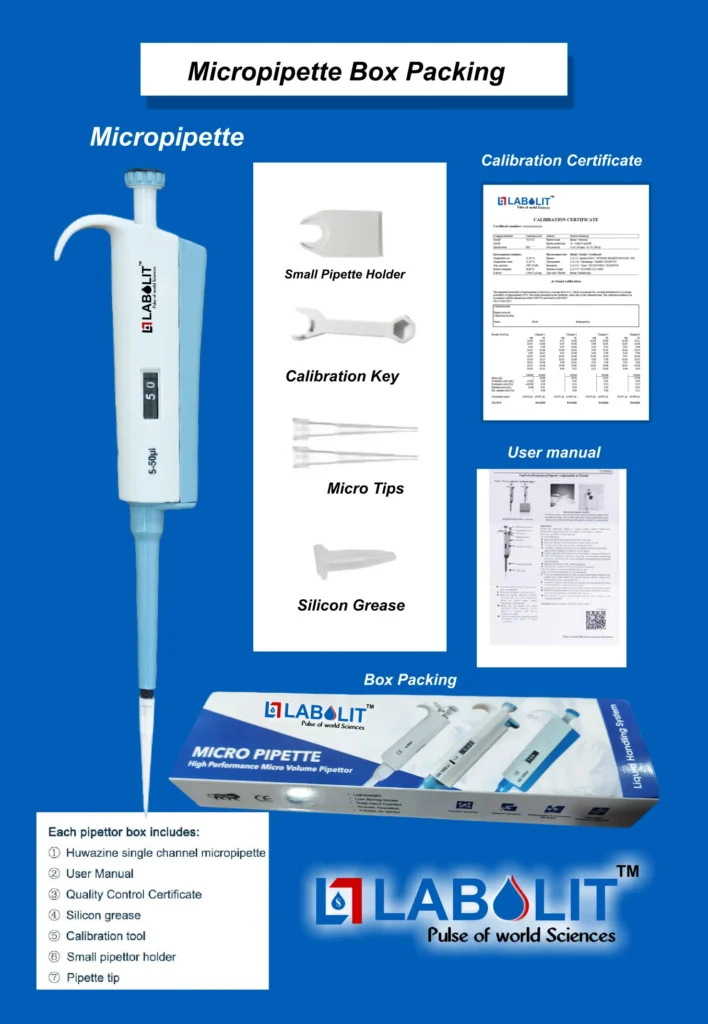
A complete pipetting solution may include:
When purchasing multiple pipettes, buying compatible tips at the same time can simplify procurement.
Instead of comparing only the headline price, compare:
| Factor | Why It Matters |
|---|---|
| Volume range | Determines application suitability |
| Accuracy | Affects measurement reliability |
| Precision | Affects repeatability |
| Channel type | Determines workflow |
| Autoclavability | Important for sterilization |
| Ergonomics | Important for frequent use |
| Warranty | Protects the investment |
| Calibration | Supports measurement assurance |
| Tip compatibility | Affects usability |
| Shipping | Affects landed cost |
| Quantity | Can affect quotation |
| After-sales service | Important for long-term use |
Laboratory equipment dealers in Tanzania may require micropipettes for distribution to:
Dealers should request distributor pricing and confirm:
Bulk buyers may include:
For large orders, the supplier may provide a special quotation based on quantity.
The buyer should provide an exact requirement such as:
20–200 µL variable micropipette – 50 pieces
or:
100–1000 µL variable micropipette – 100 pieces
This allows the supplier to prepare a more accurate commercial quotation.
India is an important source of laboratory equipment for international markets.
Manufacturers and exporters can supply manual micropipettes to Tanzania in different configurations.
A Tanzanian buyer searching for:
micropipette manufacturer India
micropipette exporter to Tanzania
Indian micropipette supplier Tanzania
micropipette price from India to Tanzania
can compare Indian manufacturers based on specifications, quality, price, documentation and export support.
LABOLIT PVT LTD / UMA Scientific can be considered by buyers looking for laboratory equipment and micropipette supply from India, subject to product availability and commercial quotation.
LABOLIT offers laboratory micropipette solutions in different volume ranges and configurations.
Available categories can include:
Typical volume requirements can include:
For Tanzania buyers, exact availability, price and shipping should be confirmed through a current quotation.

A good supplier should not only sell the product.
A professional supplier should help the buyer select the correct model.
For example, if a laboratory says it needs a pipette for 10 µL, the supplier should clarify:
This reduces the risk of purchasing an unsuitable instrument.
The price varies according to brand, volume range, channel configuration, quality, warranty, shipping and import costs. Contacting a supplier with the required volume and quantity is the best way to obtain a current quotation.
The best micropipette depends on the application. A 10–100 µL pipette may be appropriate for one application, while a 100–1000 µL model may be better for another.
Micropipettes can be sourced through laboratory equipment suppliers, medical equipment dealers and international laboratory equipment exporters serving Tanzania.
Yes. Micropipette tips are available through laboratory consumable suppliers. Always confirm compatibility with the selected micropipette.
Fully autoclavable models can be sourced depending on supplier and product availability. Always verify the manufacturer’s sterilization instructions.
Yes, international laboratory equipment suppliers can provide export quotations for Tanzania. The final landed cost depends on shipping, taxes, customs and other applicable charges.
Select the volume range according to your actual laboratory application. Avoid selecting a pipette only because it is cheaper.
Neither is universally better. Single-channel pipettes are versatile for individual samples, while multi-channel pipettes are useful for microplates and multiple simultaneous transfers.
A fixed-volume pipette is designed for one specified volume. A variable-volume pipette allows adjustment within its specified operating range.
Service life depends on product quality, frequency of use, maintenance, handling, cleaning, calibration and operating conditions.
For buyers searching online, relevant keywords can include:
For better search visibility, a Tanzania laboratory equipment website can target a combination of commercial, informational and local keywords.
Finding the best micropipette price in Tanzania is not simply about finding the lowest price.
The right purchase should balance:
Price + Quality + Accuracy + Precision + Warranty + Calibration + Tip Compatibility + Shipping + After-Sales Support
For small laboratories, a reliable single-channel variable micropipette may be sufficient.
For high-throughput laboratories, 8-channel or 12-channel micropipettes may improve productivity.
For laboratories requiring sterilization, a fully autoclavable micropipette may be the better choice.
For institutions purchasing in bulk, requesting a distributor or project quotation can help achieve better pricing.
For the latest product availability and Tanzania delivery quotation, buyers should provide the required micropipette volume range, quantity, channel type and delivery location to the supplier.
Micropipettes are essential instruments for modern laboratories in Tanzania. From clinical diagnostic laboratories in Dar es Salaam to university and research laboratories in Dodoma, Arusha, Mwanza, Morogoro and Mbeya, accurate liquid handling is an important part of laboratory work.
The ideal micropipette depends on the application, volume, accuracy requirement, frequency of use, sterilization requirement and budget.
If you are comparing micropipette prices in Tanzania, do not compare price alone. Compare the complete product specification, warranty, calibration support, compatible tips, shipping cost and after-sales service.
A professional supplier can help you select the appropriate model according to your laboratory requirement and provide a quotation based on the required quantity and delivery location.
LABOLIT – Laboratory Equipment & Scientific Instruments
For micropipette requirements, laboratory equipment, scientific instruments and export enquiries, contact the supplier for the latest product catalogue, specifications, availability and quotation for Tanzania.
