

Leading Micropipette & Scientific Lab, Medical instrument Manufacturer and Deler A Legacy Of Scientific Precision .



Leading Micropipette & Scientific Lab, Medical instrument Manufacturer and Deler A Legacy Of Scientific Precision .
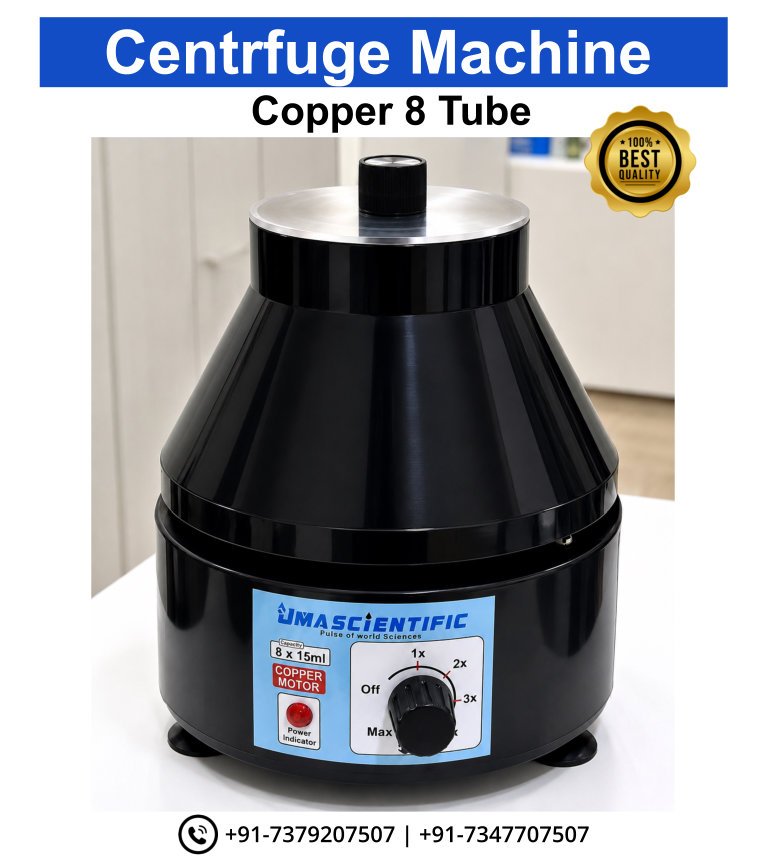
A centrifuge is a laboratory instrument used to separate components of a sample by applying centrifugal force. When a sample is rotated at high speed, heavier particles move outward toward the bottom or outer portion of the centrifuge tube, while lighter components remain closer to the center.
The separation depends primarily on differences in density, particle size, viscosity and the centrifugation conditions.
A typical centrifuge consists of:
The UMA SCIENTIFIC DR Centrifuge Machine uses a fixed-angle rotor designed to accommodate eight tubes of up to 15 mL capacity.
The UMA SCIENTIFIC DR Centrifuge Machine is a compact laboratory centrifuge designed for routine sample separation.
According to the product specifications shown in the supplied product material, the machine provides:
The machine is designed to provide a practical solution for laboratories that routinely process 15 mL centrifuge tubes and need a straightforward centrifugation system.
The DR Centrifuge Machine has a rotor designed to accommodate eight 15 mL tubes.
This configuration is useful for laboratories where multiple samples need to be processed during the same centrifugation cycle.
Instead of processing samples individually, users can place up to eight compatible tubes in the rotor and process them simultaneously, subject to proper balancing.
The centrifuge is specified with a maximum speed of 3500 RPM.
RPM means revolutions per minute and indicates how many times the rotor completes a full rotation in one minute.
A higher RPM generally produces greater centrifugal force, but RPM alone does not determine the actual separation force. The effective centrifugal force also depends on the rotor radius.
Therefore, laboratory users should consider RCF (Relative Centrifugal Force) along with RPM when selecting centrifugation conditions for a particular application.
One of the most common misunderstandings when purchasing a centrifuge is assuming that RPM and RCF are the same.
They are not.
RPM stands for:
Revolutions Per Minute
It indicates rotor speed.
RCF stands for:
Relative Centrifugal Force
It describes the force experienced by the sample relative to Earth’s gravitational acceleration.
The approximate relationship is:
RCF = 1.118 × 10⁻⁵ × r × RPM²
where:
This means that two centrifuges operating at the same RPM can generate different RCF values if their rotor radii are different.
For laboratory protocols, users should follow the recommended RPM or RCF specified by the sample or test procedure.
The DR Centrifuge Machine is specified with a copper motor.
The motor is the primary drive component responsible for rotating the centrifuge rotor.
Copper is widely used in electrical motor windings because of its good electrical conductivity.
The performance and service life of a centrifuge motor, however, depend on several factors, including:
Therefore, the motor should always be considered together with the overall centrifuge design rather than judged only by the material of the winding.
The DR Centrifuge Machine uses a fixed-angle rotor.
In a fixed-angle rotor, the centrifuge tubes remain positioned at a predetermined angle relative to the vertical axis.
During centrifugation, the particles move according to the centrifugal force generated by rotor rotation.
Fixed-angle rotors are widely used in laboratory centrifuges because they provide a stable and straightforward sample configuration.
The eight-position rotor in this machine is designed for 15 mL tubes.
Tube balancing is one of the most important operating requirements of any centrifuge.
When centrifugation begins, the rotor rotates at high speed. If the sample tubes are not balanced properly, uneven forces can develop.
This may result in:
For this reason, samples should always be arranged symmetrically.
For example, if four tubes are being centrifuged, they should generally be positioned opposite each other in a balanced arrangement, with comparable tube masses.
When fewer than eight positions are being used, the tubes should not simply be placed randomly.
The DR Centrifuge Machine is equipped with suction-type rubber feet.
These feet are designed to help keep the machine stable on a suitable laboratory work surface.
Stable positioning is particularly important for centrifuges because the rotor generates dynamic forces during operation.
The feet can help reduce unwanted movement of the machine when it is placed on a clean, level and suitable surface.
Users should still ensure that:
The DR Centrifuge Machine features an ABS body.
ABS, or Acrylonitrile Butadiene Styrene, is a commonly used engineering thermoplastic.
It is used in many laboratory and electrical equipment housings because it can provide:
The housing helps protect the internal components while providing a compact external structure.
The machine has an approximate weight of 3 kg, according to the supplied specifications.
Its compact design makes it practical for laboratories where bench space is limited.
A compact centrifuge can be useful for:
The exact suitability depends on the laboratory’s sample requirements and centrifugation protocols.
The working principle of a centrifuge is based on centrifugal force.
The basic operating process is:
Samples are collected in compatible centrifuge tubes.
The tube size and material should be suitable for the rotor.
The tubes are arranged in balanced positions inside the rotor.
The centrifuge lid is properly closed before operation.
The required centrifugation speed is selected according to the laboratory procedure.
The DR model shown in the supplied product information uses a speed-control system and has a rated maximum speed of 3500 RPM.
When the machine is switched on, the motor rotates the rotor.
As the rotor spins, centrifugal force causes particles and components with different densities to separate.
After completing the required centrifugation time, the rotor is allowed to stop before opening the lid and removing samples.
Centrifugation separates substances because particles of different densities respond differently to centrifugal force.
For example, in a blood sample, different components have different densities.
Under appropriate centrifugation conditions, heavier components tend to move farther outward while lighter components remain closer to the center.
The result can be a separation into different layers or fractions.
The exact separation depends on:
The DR Centrifuge Machine can be used for various routine laboratory applications where an 8 × 15 mL fixed-angle configuration is appropriate.
Potential applications include:
Centrifuges are commonly used during sample preparation and separation procedures in pathology laboratories.
Routine diagnostic workflows can require centrifugation of compatible samples according to established protocols.
Hospital laboratories use centrifuges for a variety of sample-processing requirements.
Compact centrifuges can be useful in clinics with basic laboratory facilities.
Researchers may use centrifugation as part of sample preparation, separation and purification workflows.
Colleges, universities and training laboratories can use centrifuges for teaching basic principles of laboratory separation.
Centrifugation is an important part of many biotechnology workflows.
Laboratories involved in pharmaceutical research and quality-control activities may use centrifugation as part of sample-processing procedures.
Centrifuges are widely associated with blood sample processing.
Depending on the specific tube type and laboratory procedure, centrifugation can assist in separating blood components.
However, users should always follow the applicable laboratory protocol and tube manufacturer’s instructions.
The centrifuge’s role is to provide controlled rotational force to enable the required separation.
The DR Centrifuge Machine’s 8 × 15 mL capacity can be useful where compatible sample tubes are required.
Serum and plasma preparation are common laboratory applications of centrifugation.
The required centrifugation conditions vary according to:
The DR centrifuge can be used where its speed, rotor configuration and tube capacity meet the applicable procedure.
Users should never assume that one centrifugation setting is suitable for every test.
Capacity is an important purchasing consideration.
A machine with eight 15 mL positions can process multiple samples at the same time.
For a laboratory that routinely handles several samples per batch, this can improve workflow efficiency compared with processing one tube at a time.
However, laboratories with higher sample volumes may need:
Therefore, capacity should always be selected based on actual workflow requirements.
The DR Centrifuge Machine offers several practical features for routine laboratory use.
The 8 × 15 mL configuration allows multiple samples to be processed in one cycle.
The machine provides a maximum rated speed of 3500 RPM for suitable routine applications.
The machine uses a copper motor according to the supplied specification.
The fixed-angle rotor provides a straightforward tube arrangement.
The relatively compact construction makes the unit convenient for laboratory benches.
The housing provides a lightweight and practical equipment enclosure.
Suction-type rubber feet help maintain stable positioning during operation.
The straightforward control arrangement is suitable for routine laboratory use.
The machine is supplied with master carton and Thermocol packaging as specified in the product material.
A common question is whether a copper-motor DR centrifuge and a brushless centrifuge are the same.
They are not necessarily the same.
The major difference is the motor technology.
The DR model shown in the supplied specification is described as having a copper motor and includes provision for servicing/changing carbon components.
A brushless centrifuge uses a different motor design that does not use conventional carbon brushes for commutation.
Typical characteristics may include:
Characteristics of the supplied model include:
The choice should depend on the laboratory’s budget, workload, maintenance requirements and application.
The motor is one of the most important components of a centrifuge.
A good centrifuge motor should provide stable rotor movement while operating within its specified conditions.
Important factors include:
A centrifuge should not be selected only by looking at the motor name. The rotor, controller, body, safety system and overall construction are equally important.
Pathology laboratories require reliable equipment for routine sample preparation.
A centrifuge can form an important part of a pathology workflow.
The DR model may be suitable for laboratories that need:
Before purchase, the laboratory should confirm that the machine’s maximum speed and rotor configuration meet the requirements of its procedures.
Diagnostic laboratories often process multiple samples throughout the day.
An eight-position centrifuge can be useful when the sample workload fits the available capacity.
The operator should ensure:
Hospitals may require centrifuges in pathology and diagnostic departments.
The appropriate centrifuge depends on the intended application.
For routine applications involving compatible 15 mL tubes, the DR model provides an eight-position configuration.
For specialized applications, however, laboratories may require different centrifuge technologies.
For example:
The correct instrument should be selected based on the actual laboratory procedure.
Research laboratories use centrifugation in many different workflows.
Centrifugation can be used for:
The DR model can be considered for routine applications where the required speed and tube capacity are compatible.
For advanced research requiring very high RCF, temperature control or specialized rotors, another centrifuge category may be more appropriate.
A general operating sequence can be followed, subject to the manufacturer’s operating instructions and laboratory SOP.
Inspect the machine and rotor.
Make sure:
Place sample tubes into the rotor.
Always balance the rotor.
Select the required speed according to the laboratory procedure.
Do not exceed the machine’s rated maximum speed.
Close the lid securely and start the centrifuge.
Do not move the machine.
Do not attempt to open the centrifuge while the rotor is spinning.
Allow the rotor to stop completely.
Open the lid only after rotation has stopped.
Remove samples carefully.
Safety is extremely important when operating any centrifuge.
An unbalanced rotor can cause vibration and equipment damage.
The lid should remain closed while the rotor is moving.
Cracked, damaged or unsuitable tubes should not be used.
Never exceed the rotor’s specified tube capacity or weight limits.
Use a stable, level work surface.
Inspect the rotor periodically for damage, corrosion or unusual wear.
Always follow the applicable laboratory safety procedure.
The rotor is one of the most critical safety components of a centrifuge.
Before regular operation, users should check for:
If damage is observed, the centrifuge should not be used until it has been inspected by a qualified person.
Regular maintenance helps maintain reliable performance.
Clean the exterior using an appropriate laboratory-safe cleaning method.
The centrifuge chamber should be kept clean and dry.
Remove spills promptly.
Samples that leak inside the rotor can cause contamination and potentially damage components.
Check that the suction-type feet remain clean and properly positioned.
Do not allow liquids to enter the electrical or motor components.
Inspect the power cable periodically for visible damage.
The product material specifically shows easy access for servicing/changing carbon.
This indicates that the motor system includes serviceable carbon components.
Carbon brushes are consumable motor components in certain motor designs.
Their life depends on factors such as:
When replacement is required, it should be performed by a qualified technician using appropriate replacement components.
Regular inspection can help identify problems before they become major issues.
Maintenance can include:
Laboratory equipment should be maintained according to the manufacturer’s recommendations and the laboratory’s maintenance schedule.
Some level of sound and vibration is normal in rotating laboratory equipment.
Excessive vibration, however, may indicate:
If unusual vibration or sound develops, stop the machine and investigate the cause.
The DR centrifuge’s suction-type feet are intended to help maintain stable positioning.
Before purchasing a centrifuge, laboratories should evaluate several factors.
What kind of sample will be processed?
Are 2 mL, 5 mL, 15 mL, 50 mL or other tubes required?
How many samples need to be processed per cycle?
What RPM or RCF does the application require?
Is a fixed-angle or swing-out rotor required?
Does the procedure require refrigeration?
Is a conventional or brushless motor preferred?
Is manual speed control sufficient, or is digital programming required?
How frequently will the machine be operated?
What level of servicing is acceptable?
Choosing a centrifuge that is too small can create unnecessary processing delays.
For example, if a laboratory regularly needs to process eight compatible 15 mL tubes, an 8-position centrifuge can process those samples in one batch.
On the other hand, if the laboratory routinely handles dozens of samples, a larger-capacity model may be more suitable.
Capacity should therefore be selected based on actual daily sample volume rather than simply choosing the largest machine available.
Another important purchasing consideration is rotor design.
The tubes remain at a fixed angle.
Advantages can include:
The tubes swing outward during centrifugation.
This type can be preferred for applications where a more horizontal separation path is desired.
Neither rotor type is universally better. The correct choice depends on the application.
The DR model shown here uses a fixed-angle rotor.
The 15 mL tube format is widely used in laboratory workflows.
It can be suitable for applications involving:
Actual application suitability must always be confirmed against the laboratory’s protocol.
The supplied specifications list:
230 V, 50 Hz
This makes the machine suitable for electrical systems using this supply specification.
Laboratories should ensure that:
Laboratory bench space is often limited.
A compact centrifuge can help laboratories maintain an organized workspace.
The DR model has an approximate package dimension of:
32.8 × 28.4 × 26.8 cm
The supplied material also lists an approximate item weight of:
3 kg
Actual operating footprint and packaging dimensions should be checked with the supplier before installation planning.
According to the supplied product information, the machine is:
Good packaging is important because laboratory equipment may be exposed to vibration and handling during transportation.
Before accepting a shipment, customers should inspect the outer packaging and machine for visible damage.
UMA SCIENTIFIC focuses on laboratory and scientific equipment designed for a wide range of laboratory requirements.
The company’s product portfolio includes laboratory instruments and equipment for:
The DR Centrifuge Machine is one of the laboratory centrifugation solutions offered under the UMA SCIENTIFIC range.
| Specification | Details |
|---|---|
| Product | DR Centrifuge Machine |
| Capacity | 8 × 15 mL tubes |
| Maximum Speed | 3500 RPM |
| Motor | Copper Motor |
| Rotor Type | Fixed Angle |
| Body | ABS |
| Feet | Suction-Type Rubber Feet |
| Power Supply | 230 V, 50 Hz |
| Approx. Weight | 3 kg |
| Package Dimensions | 32.8 × 28.4 × 26.8 cm |
| Packaging | Master Carton + Thermocol Protection |
Note: Specifications should be confirmed with UMA SCIENTIFIC before purchase, as product configurations may change.
The DR Centrifuge Machine is a compact laboratory centrifuge designed for routine sample separation. The supplied model has an 8 × 15 mL tube capacity and a maximum speed of 3500 RPM.
The specified capacity is 8 × 15 mL tubes.
The specified maximum speed is 3500 RPM.
Yes. The supplied product specification identifies the motor as a copper motor.
The machine uses a fixed-angle rotor.
The product information specifies a shock-resistant ABS body.
The supplied specification states 230 V, 50 Hz.
It can be suitable for routine pathology applications where the required sample type, tube size, speed and RCF are compatible with the laboratory protocol.
The supplied DR model is specified for 8 × 15 mL tubes. A different rotor or model would be required if 50 mL tubes are needed.
The supplied specification does not indicate refrigeration. It should therefore not be represented as a refrigerated centrifuge.
The supplied specification identifies it as a copper-motor model and shows servicing access for carbon components. It should not be marketed as brushless unless the actual motor configuration has been independently confirmed.
Suction-type rubber feet help provide stability on suitable laboratory surfaces and can help minimize unwanted movement during operation.
To maintain your centrifuge in good working condition:
Several mistakes can reduce centrifuge performance or create safety risks.
This is one of the most common errors.
The machine should never be operated beyond its specified rating.
Tubes must be compatible with the rotor and centrifugation conditions.
Never attempt to access a moving rotor.
Unexpected vibration should always be investigated.
Sample residue can cause contamination and component deterioration.
The machine should be positioned on a suitable stable surface.
The primary purpose of a centrifuge is to support sample separation.
The DR Centrifuge Machine provides a practical combination of:
This combination makes it appropriate for many routine laboratory requirements.
Every laboratory should have a Standard Operating Procedure for centrifugation.
An SOP may specify:
The centrifuge operator should follow the applicable SOP rather than relying on general settings.
The UMA SCIENTIFIC DR Centrifuge Machine is a compact laboratory centrifuge designed for routine sample separation applications.
With an 8 × 15 mL tube capacity, 3500 RPM maximum speed, copper motor, fixed-angle rotor, ABS body and suction-type rubber feet, it offers a practical configuration for laboratories requiring a straightforward centrifugation solution.
The most important factors when selecting and operating a centrifuge are not simply RPM or motor type. Laboratories should consider RCF, rotor configuration, tube compatibility, capacity, sample type, workload, safety and maintenance requirements.
For laboratories working with compatible 15 mL tubes and requiring a maximum speed of 3500 RPM, the UMA SCIENTIFIC DR Centrifuge Machine can be considered as a practical option for routine laboratory centrifugation.
UMA SCIENTIFIC supplies laboratory and scientific equipment for laboratories, hospitals, diagnostic centers, research institutions, educational organizations, pharmaceutical companies and biotechnology facilities.
For product enquiries, quotations, dealer requirements and bulk orders:
UMA SCIENTIFIC
Website: www.umascientific.com
Email: sale.umascientific@gmail.com
DR Centrifuge Machine, DR Centrifuge Machine India, Laboratory Centrifuge Machine, Centrifuge Machine Manufacturer India, Centrifuge Machine Supplier India, 3500 RPM Centrifuge Machine, 8 x 15 ml Centrifuge Machine, 15 ml Centrifuge Machine, Copper Motor Centrifuge, Laboratory Centrifuge Supplier, Pathology Centrifuge Machine, Diagnostic Centrifuge Machine, Clinical Centrifuge Machine, Hospital Centrifuge Machine, Fixed Angle Centrifuge, ABS Body Centrifuge Machine, Blood Sample Centrifuge Machine, Medical Laboratory Centrifuge, Scientific Equipment India, UMA Scientific Centrifuge Machine.
