

Leading Micropipette & Scientific Lab, Medical instrument Manufacturer and Deler A Legacy Of Scientific Precision .



Leading Micropipette & Scientific Lab, Medical instrument Manufacturer and Deler A Legacy Of Scientific Precision .
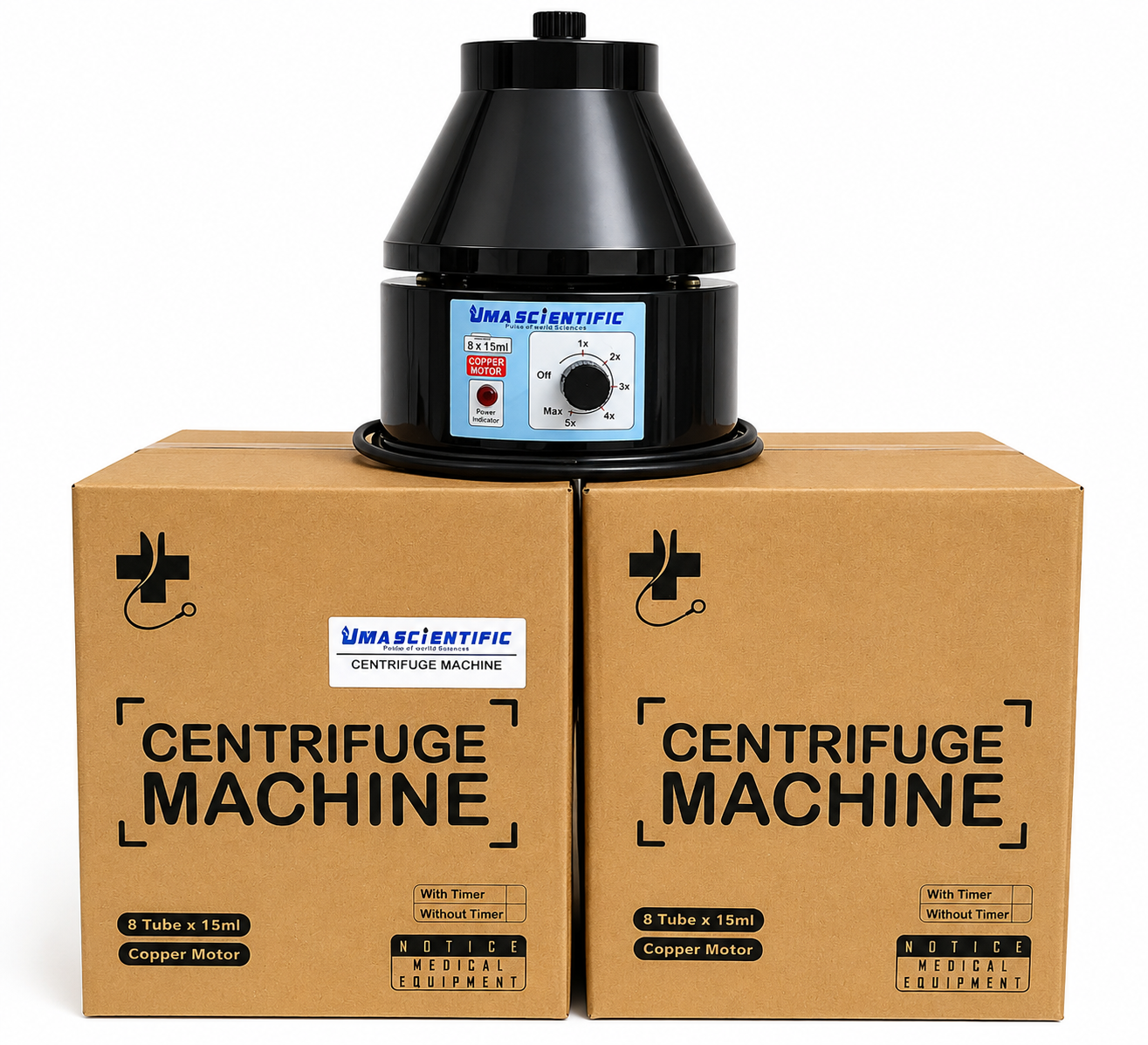
A centrifuge machine is one of the most important laboratory instruments used for separating components of liquids and biological samples according to their density. From medical laboratories and pathology centers to hospitals, diagnostic laboratories, research institutions, pharmaceutical companies and educational laboratories, centrifuges play an essential role in modern scientific and clinical workflows.
The Doctor Model Centrifuge Machine by Uma Scientific is designed as a professional laboratory centrifuge solution for users who require dependable performance in routine laboratory and clinical environments. Manufactured in India, the machine combines practical laboratory design with robust construction and user-friendly operation.
A centrifuge machine is laboratory equipment that uses centrifugal force to separate substances with different densities.
When a sample tube is rotated rapidly, heavier particles move outward toward the bottom of the tube while lighter components remain closer to the upper portion. This physical principle allows laboratory professionals to separate different components of a sample.
Depending on the application, centrifuges can be used for:
Centrifuges are available in many configurations, including small benchtop centrifuges, clinical centrifuges, high-speed centrifuges, refrigerated centrifuges, microcentrifuges and specialized research centrifuges.
The term Doctor Model Centrifuge Machine is commonly used in the laboratory equipment market for compact clinical or routine laboratory centrifuges designed for medical and diagnostic applications.
A Doctor Model centrifuge is generally designed to provide:
The exact specifications, rotor capacity, maximum speed and control configuration can vary by manufacturer and model.
Uma Scientific offers the Doctor Model Centrifuge Machine as part of its laboratory equipment range, designed for users who need a practical and dependable centrifuge for routine applications.
India has developed a strong manufacturing ecosystem for laboratory and scientific equipment. Choosing an Indian-manufactured centrifuge can provide several practical benefits, including easier communication with the supplier, product availability, technical support, spare-part access and after-sales assistance.
A premium-quality Indian centrifuge should be evaluated based on actual specifications rather than simply the phrase “Made in India.”
Important factors include:
Uma Scientific focuses on laboratory and scientific equipment for customers across India and selected international markets.
A centrifuge is frequently used in laboratory workflows where consistent sample separation is important. Therefore, quality and reliability should be prioritized.
A premium centrifuge can provide benefits such as:
A well-designed machine should operate smoothly with appropriate balancing and mechanical construction.
Consistent rotational performance helps laboratories achieve repeatable separation conditions.
A robust body and properly designed internal components can support regular laboratory use.
Simple controls and practical tube loading can make daily operation easier.
Proper lid design, secure rotor installation and appropriate electrical protection are important for safe centrifuge operation.
A reliable machine can provide better value over its operating life when properly maintained.
The centrifuge works on the principle of centrifugal force.
When a sample tube rotates around a central axis, centrifugal force acts on particles suspended in the sample.
Particles with greater density generally migrate outward more strongly than particles with lower density.
For example, when blood is centrifuged under appropriate conditions, its components can separate into different layers.
The actual separation depends on several factors:
For scientific comparison, laboratories often use RCF (Relative Centrifugal Force) rather than RPM alone.
One of the most important concepts when selecting or operating a centrifuge is the difference between RPM and RCF.
RPM means Revolutions Per Minute.
It describes how many times the rotor completes one revolution in one minute.
RCF means Relative Centrifugal Force.
It describes the actual centrifugal acceleration experienced by the sample relative to Earth’s gravitational acceleration.
RCF depends on both:
A commonly used relationship is:
RCF = 1.118 × 10⁻⁵ × r × RPM²
where:
This is why two centrifuges operating at the same RPM may produce different centrifugal forces if their rotor radii are different.
For applications requiring standardized separation conditions, laboratories should use the specified RCF or verify the correct relationship between RPM and RCF for the particular rotor.
A centrifuge consists of multiple mechanical and electrical components.
The motor provides the rotational power required to spin the rotor.
Motor quality is important for smooth and reliable operation.
The rotor holds the centrifuge tubes and rotates around the central axis.
Rotor configuration determines tube capacity and the type of centrifugation that can be performed.
Tube holders support the sample tubes during centrifugation.
The lid provides physical protection during operation.
A properly designed lid also helps prevent accidental access to the rotating rotor.
The control system allows the operator to select or manage operating parameters such as speed and time, depending on the model.
The timer controls the duration of centrifugation.
The outer body protects internal components and provides structural support.
Depending on the design, centrifuges may include features such as lid locks or other mechanisms intended to prevent operation under unsafe conditions.
A premium Doctor Model centrifuge can be selected for laboratories requiring a compact and practical centrifugation solution.
Typical features to evaluate include:
Exact specifications should always be confirmed from the manufacturer’s current technical datasheet before purchase.
One of the most common laboratory uses of centrifuges is blood sample processing.
Under appropriate laboratory protocols, centrifugation can help separate components such as:
The exact centrifugation conditions depend on the test, tube type, specimen type and laboratory protocol.
Incorrect centrifugation conditions can affect sample quality. Therefore, users should follow the applicable test manufacturer’s instructions and laboratory SOPs.
Serum separation is a common requirement in diagnostic laboratories.
After blood collection and appropriate clotting procedures, the sample may be centrifuged to separate serum from cellular components.
The required:
should be determined according to the relevant laboratory procedure.
A reliable centrifuge helps laboratories perform these routine processes consistently.
Centrifugation is also widely used for plasma preparation.
The exact conditions depend on:
A centrifuge should therefore be selected according to the laboratory’s intended application rather than simply maximum RPM.
Pathology laboratories require reliable equipment for routine sample processing.
A Doctor Model centrifuge can be useful for suitable laboratory procedures involving:
The centrifuge should be operated according to the laboratory’s validated SOPs and applicable safety requirements.
Diagnostic laboratories depend on consistent sample preparation.
A centrifuge can support workflows involving:
The appropriate centrifuge configuration depends on the sample type and laboratory requirements.
Hospitals may use centrifuges in:
A compact Doctor Model centrifuge can be useful where routine sample processing is required and laboratory space is limited.
Medical colleges and teaching laboratories require equipment for both educational and laboratory applications.
A centrifuge can help students understand:
A simple, durable and easy-to-operate model can be particularly useful in educational environments.
Research laboratories may use centrifuges for a wide range of sample-processing activities.
Applications can include:
Research laboratories should select a centrifuge based on required RCF, rotor configuration, tube capacity, temperature requirements and sample characteristics.
Pharmaceutical laboratories use centrifugation in different research and quality-control processes.
Possible applications include:
The appropriate centrifuge depends on the exact application and validated laboratory procedure.
Biotechnology laboratories frequently perform sample preparation and separation.
Depending on the workflow, centrifuges can be used for:
Specialized applications may require high-speed or refrigerated centrifuges rather than a routine Doctor Model.
Centrifugation can be used in appropriate laboratory procedures to concentrate urinary sediment for microscopic examination.
The exact centrifugation conditions should be based on the laboratory’s validated procedure.
Centrifuge capacity is an important purchasing consideration.
Capacity can refer to:
For example, a centrifuge designed for multiple 15 mL tubes will have a different application profile from a microcentrifuge designed for small-volume tubes.
Before ordering, customers should confirm:
Centrifuges designed for 15 mL tubes are widely used in laboratories.
They can be useful for:
The actual tube compatibility should be confirmed with the manufacturer’s specifications.
Motor construction is an important consideration in centrifuge selection.
In the laboratory equipment market, customers may encounter centrifuges advertised with copper motors or copper-winding motors.
Copper has excellent electrical conductivity and is widely used in electrical motor windings.
However, customers should not evaluate a centrifuge solely based on the word “copper.”
Overall performance depends on:
A transparent manufacturer should provide accurate specifications rather than making unsupported performance claims.
Centrifuges may use different motor technologies.
Brushed motors use brushes and a commutator as part of their operating mechanism.
Advantages can include relatively simple construction and cost-effective design.
Brushes may wear over time and can require maintenance depending on the motor design and usage.
Brushless motors use electronic commutation and do not require conventional mechanical brushes.
Potential advantages include:
The appropriate motor depends on the centrifuge design and application.
Rotor balancing is critical for centrifuge safety and performance.
An improperly balanced rotor can cause:
Users should always balance tubes according to the manufacturer’s instructions.
When centrifuging an even number of tubes, tubes of appropriate matching mass should generally be positioned symmetrically.
For odd numbers of samples, appropriate balancing methods must be followed according to the rotor design.
Never operate a centrifuge with an improperly balanced rotor.
Safety should always be a priority.
Check:
Never:
Wait until the rotor has completely stopped before opening the lid.
Follow laboratory procedures for handling potentially infectious or hazardous samples.
Not every tube is suitable for every centrifuge.
Tube compatibility depends on:
Using an unsuitable tube can lead to tube deformation, leakage or failure during centrifugation.
Always verify compatibility before use.
Regular maintenance can help extend the service life of a centrifuge.
Clean the rotor according to manufacturer recommendations.
Do not use cracked, damaged or excessively worn tubes.
Check for corrosion, cracks or other visible damage.
Spills should be cleaned promptly using an appropriate procedure.
Ensure the lid operates properly.
Unexpected vibration should be investigated.
Electrical and mechanical servicing should be performed by qualified personnel.
Common causes can include:
If abnormal vibration occurs, stop the centrifuge and investigate according to the manufacturer’s safety procedures.
Choosing the best centrifuge requires evaluating the application.
Determine whether the machine will be used for:
Know the required tube dimensions and volume.
RCF is often more useful than RPM when comparing centrifugation conditions.
Choose a rotor that matches the number and type of samples.
Select a machine that meets the required operating speed and RCF.
Determine whether a digital or mechanical timer is appropriate.
A secure lid and suitable safety mechanisms are important.
Look for robust construction suitable for regular laboratory use.
Warranty coverage can provide additional purchasing confidence.
Reliable after-sales service can be important for laboratory equipment.
A Doctor Model centrifuge is generally intended for routine laboratory applications.
A high-speed centrifuge is designed for applications requiring significantly higher centrifugal forces.
Therefore:
Doctor Model: Routine clinical and laboratory applications.
High-Speed Model: Specialized research and applications requiring higher RCF.
The correct choice depends on the laboratory’s requirements.
A Doctor Model centrifuge is typically suitable for routine applications where refrigeration is not required.
A refrigerated centrifuge is designed to control sample temperature during centrifugation.
Refrigeration may be important for temperature-sensitive applications.
If a laboratory does not require temperature control, a standard centrifuge may be a more practical choice.
A benchtop centrifuge is designed to fit on a laboratory work surface.
Advantages include:
Doctor Model centrifuges can be particularly suitable for laboratories looking for compact equipment.
For daily use, laboratories should prioritize reliability.
A premium machine should provide a combination of:
Daily-use laboratory equipment must be designed to withstand repeated operation.
A Made in India centrifuge machine can offer several advantages for Indian laboratories.
Indian manufacturers and suppliers can often provide faster access to products.
Communication and service coordination can be easier.
Local sourcing can simplify spare-part availability.
Indian manufacturers may be able to accommodate certain institutional or OEM requirements.
Domestic manufacturing can reduce some logistics-related costs compared with imported equipment.
Customers should still compare specifications and quality carefully before purchasing.
When searching for a centrifuge machine manufacturer in India, buyers should evaluate the company based on:
Uma Scientific provides laboratory equipment and scientific instruments to customers in India and other markets.
A good centrifuge supplier should be able to provide:
Institutional and bulk customers may also request quotations based on quantity and specifications.
The price of a centrifuge machine depends on its specifications.
Factors affecting price include:
A premium Doctor Model may cost more than a basic entry-level centrifuge because of differences in construction, components and performance.
For current pricing, customers should request a quotation based on the exact model and configuration.
Instead of comparing only price, create a technical comparison.
Compare:
| Parameter | Machine A | Machine B |
|---|---|---|
| Maximum Speed | Check specification | Check specification |
| Maximum RCF | Check specification | Check specification |
| Capacity | Check specification | Check specification |
| Rotor Type | Check specification | Check specification |
| Tube Compatibility | Check specification | Check specification |
| Timer | Check specification | Check specification |
| Motor | Check specification | Check specification |
| Safety Features | Check specification | Check specification |
| Warranty | Check specification | Check specification |
| Service | Check supplier | Check supplier |
This approach helps laboratories select equipment based on actual requirements.
A professional supplier can provide more than the machine itself.
Important benefits can include:
This can be particularly important for hospitals, diagnostic laboratories, institutions and research organizations.
Government laboratories may require equipment for:
Purchasing decisions may involve technical specifications, tender requirements, documentation, warranty and after-sales support.
Educational laboratories often require simple and robust equipment.
A compact centrifuge can help students learn fundamental laboratory principles such as:
For educational environments, ease of use and safety are especially important.
Food-testing laboratories may use centrifugation for suitable sample preparation and analytical workflows.
Depending on the application, centrifuges may be used in:
The appropriate centrifuge should be selected according to the validated analytical method.
Veterinary diagnostic laboratories also perform sample-processing procedures where centrifugation may be required.
Potential applications include preparation of:
The required centrifugation conditions should always follow the applicable veterinary diagnostic protocol.
Good equipment performance depends on both machine quality and user practices.
To maintain consistent performance:
Usually associated with imbalance, rotor issues or mechanical problems.
Could indicate mechanical wear or an installation problem.
Possible causes include electrical supply, lid safety mechanisms or internal faults.
Possible causes include motor, control or mechanical issues.
May be caused by damaged tubes, incorrect caps or improper tube installation.
When a centrifuge behaves abnormally, users should stop operation and consult the manufacturer’s troubleshooting or service instructions.
The motor is the heart of the centrifuge.
A high-quality motor should support:
Motor specifications should always be evaluated along with the overall mechanical and electrical design.
Rotor quality directly affects centrifuge performance and safety.
A suitable rotor should have:
Never use a rotor beyond its rated operating specifications.
Different centrifuges may use different control systems.
Manual controls can be:
Digital controls may provide:
The appropriate option depends on laboratory requirements.
Warranty is an important purchasing consideration.
Before purchasing, customers should confirm:
Warranty terms can vary by manufacturer and model.
The Doctor Model centrifuge is positioned as a practical laboratory centrifuge for routine applications.
Customers can evaluate the machine based on:
For current specifications and pricing, customers should contact Uma Scientific with their laboratory requirements.
A Doctor Model centrifuge is generally a compact centrifuge designed for routine clinical and laboratory applications. Exact specifications vary by manufacturer.
Yes. Centrifuges are commonly used in appropriate laboratory procedures for separating blood components such as serum and plasma.
Indian manufacturers produce laboratory centrifuges across different quality levels. Buyers should evaluate technical specifications, manufacturing quality, warranty and service rather than relying only on country of origin.
RPM measures rotor revolutions per minute, while RCF represents the relative centrifugal force applied to the sample.
Very important. Incorrect balancing can cause vibration, mechanical stress and safety problems.
No. Tubes must be compatible with the rotor, centrifuge and required centrifugal force.
Service frequency depends on usage, manufacturer recommendations and laboratory requirements. Regular inspection should be part of laboratory maintenance.
Price varies according to model, specifications, rotor, motor, capacity and features. Contact the supplier for the latest quotation.
It can be suitable for appropriate routine laboratory applications when its specifications meet the hospital laboratory’s requirements.
Before purchasing a centrifuge machine, confirm the following:
A centrifuge machine is a fundamental laboratory instrument for controlled sample separation. For medical laboratories, pathology centers, diagnostic facilities, hospitals, pharmaceutical companies, biotechnology laboratories, research institutions and educational laboratories, selecting a reliable centrifuge is essential for efficient sample processing.
The Premium Doctor Model Centrifuge Machine from Uma Scientific is designed as a practical solution for routine laboratory applications where reliable centrifugation, convenient operation and robust construction are important.
When selecting the best-quality centrifuge machine made in India, customers should evaluate the complete product rather than focusing on a single feature. Motor quality, rotor construction, capacity, RCF, RPM, tube compatibility, safety, balancing, warranty and after-sales support all contribute to the overall value of a centrifuge.
A premium laboratory centrifuge should be reliable, easy to operate, appropriately specified and supported by a professional supplier.
Uma Scientific – Laboratory Equipment Manufacturer & Supplier in India
For laboratories looking for a Doctor Model centrifuge machine, premium centrifuge machine, laboratory centrifuge, medical centrifuge, pathology centrifuge, blood centrifuge, 15 mL centrifuge, Made in India centrifuge machine or centrifuge machine manufacturer in India, Uma Scientific offers laboratory equipment solutions for different applications and requirements.
