

Leading Micropipette & Scientific Lab, Medical instrument Manufacturer and Deler A Legacy Of Scientific Precision .



Leading Micropipette & Scientific Lab, Medical instrument Manufacturer and Deler A Legacy Of Scientific Precision .
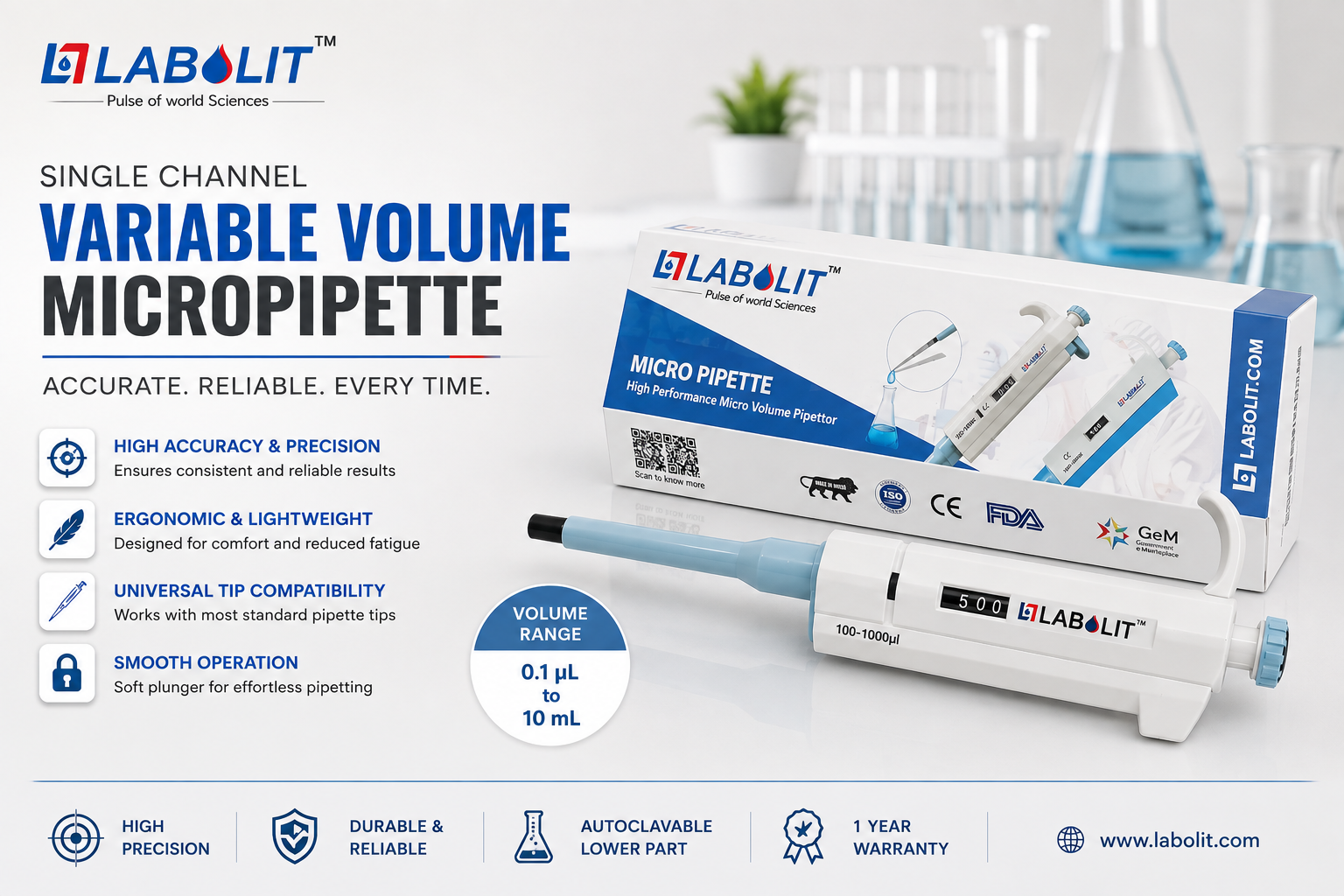
A variable volume micropipette allows the operator to select the required volume within the specified range rather than being restricted to one fixed volume. This flexibility makes it suitable for laboratories where multiple liquid volumes need to be handled during routine testing and research.
“Single channel” means that the pipette handles liquid through one tip at a time. “Variable volume” means that the user can adjust the volume setting within the operating range of the particular micropipette.
For example, depending on the model, a micropipette may be designed for ranges such as:
The correct pipette range should always be selected according to the required application and liquid volume.
LABOLIT is a laboratory equipment brand manufactured by Uma Scientific. The LABOLIT product range is developed for laboratories looking for practical, accurate and economical liquid-handling solutions.
The single channel variable volume micropipette range is suitable for:
The major advantage of a variable volume micropipette is flexibility.
A fixed volume pipette is designed for one specific volume, whereas a variable volume pipette can be adjusted within its specified range.
For laboratories performing different tests throughout the day, this can reduce the need for multiple fixed-volume instruments.
The operator can select the required volume according to the pipette’s specified range.
A properly maintained and calibrated micropipette supports consistent liquid transfer.
A well-designed pipette can help reduce hand fatigue during repetitive laboratory work.
The volume-setting mechanism allows the user to select the desired volume.
Micropipettes generally work with suitable disposable pipette tips designed for the particular pipette model.
Single channel variable volume micropipettes can be used across research, diagnostics, pharmaceuticals, education and industrial laboratories.
A variable-volume pipette can perform multiple volume-handling tasks within its operating range, making it a practical addition to laboratory equipment.
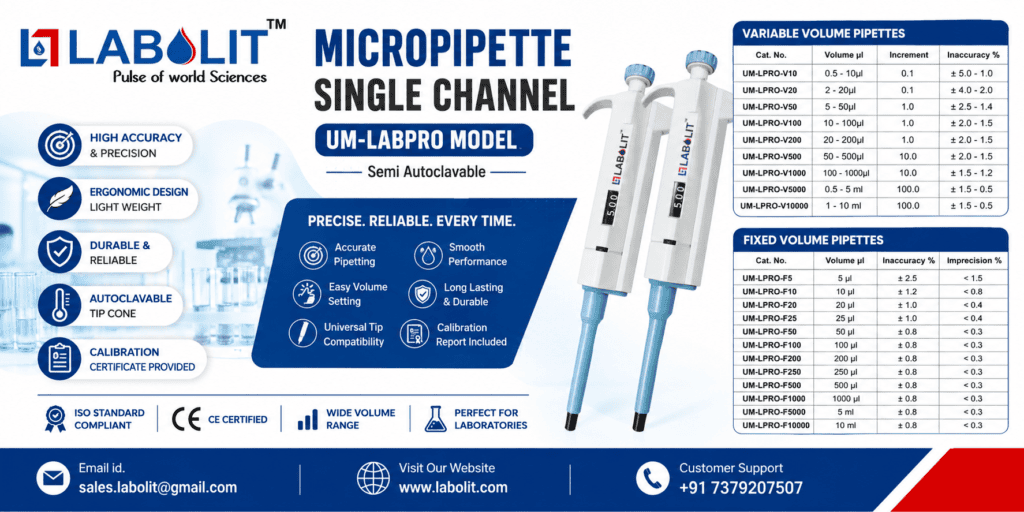
Different laboratory applications require different volume ranges. LABOLIT single channel variable volume micropipettes can be selected according to the required capacity.
Designed for very small-volume liquid handling applications where precise control of microlitre quantities is required.
Potential applications include:
Suitable for small-volume applications in molecular biology, microbiology, biotechnology and research laboratories.
A popular range for many routine laboratory procedures involving small liquid volumes.
Suitable for general laboratory liquid handling and reagent preparation.
Commonly used in diagnostic, pharmaceutical, biotechnology and research laboratories.
One of the widely used general-purpose ranges for routine laboratory applications.
Suitable for applications requiring larger microlitre volumes.
Useful for transferring relatively larger liquid volumes in laboratories.
Designed for applications requiring millilitre-scale liquid handling.
Larger-volume pipetting solutions can be useful for laboratory procedures requiring controlled transfer of larger liquid quantities.
The operating principle of a traditional air-displacement micropipette is based on movement of a piston inside the pipette.
When the plunger is pressed, the piston moves and displaces air. When the plunger is released, the resulting pressure difference allows liquid to enter the pipette tip.
The basic procedure consists of:
The exact operating technique depends on the pipette design, liquid characteristics and laboratory procedure.
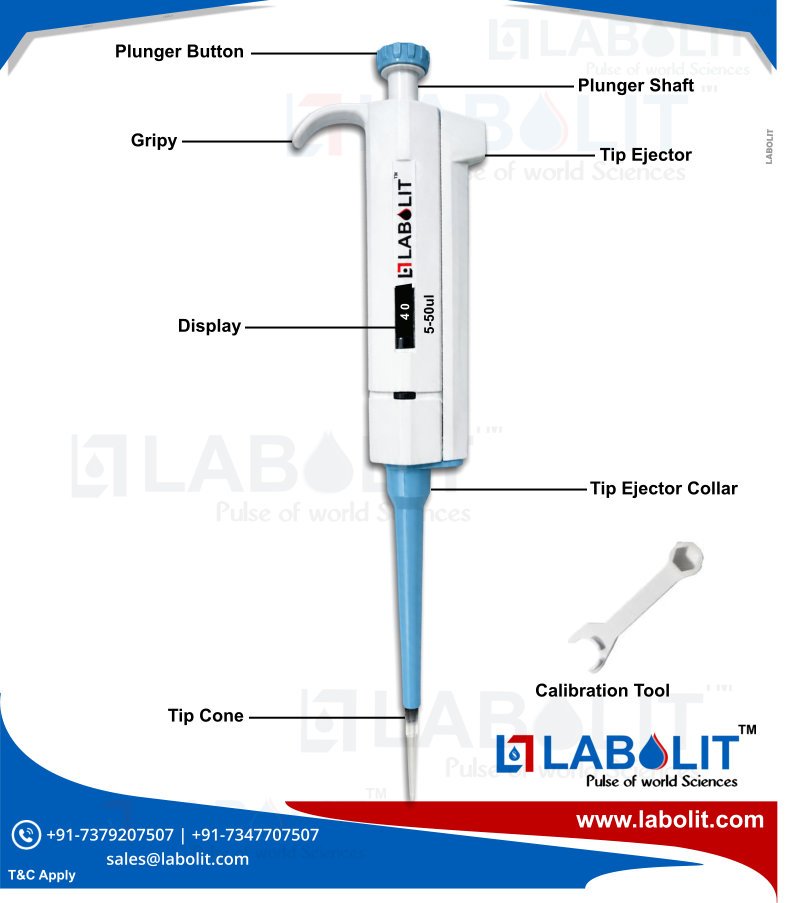
A typical single channel variable volume micropipette includes several important components.
The plunger is operated by the user’s thumb and controls aspiration and dispensing.
This mechanism allows the user to select the required volume.
The display indicates the selected volume.
The tip cone connects the micropipette to the disposable pipette tip.
The ejector allows convenient removal of the used tip.
The piston is an important component responsible for creating the pressure change required for liquid aspiration and dispensing.
The body provides the ergonomic structure for comfortable handling.
The finger hook can provide additional support while operating the pipette.
LABOLIT micropipettes are designed with practical features for laboratory users.
Precision liquid handling is essential for research and testing. A properly calibrated micropipette can help laboratory users achieve consistent results.
Laboratory personnel often perform repetitive pipetting tasks. An ergonomic design can make routine operation more comfortable.
A lightweight construction can help reduce hand fatigue during extended laboratory procedures.
The adjustable volume mechanism allows the user to set the required volume within the model’s specified operating range.
Depending on the model, LABOLIT micropipettes are designed for compatibility with commonly available laboratory pipette tips.
Smooth plunger operation can help the operator control aspiration and dispensing more comfortably.
The micropipette body is designed for regular laboratory use.
Proper cleaning, inspection, calibration and storage help maintain micropipette performance.
Single channel variable volume micropipettes are used in numerous laboratory applications.
Pharmaceutical laboratories use micropipettes for reagent preparation, analytical procedures, research and development, quality control and sample handling.
Biotechnology laboratories use micropipettes for DNA, RNA, protein and cell-related procedures.
Micropipettes are commonly used for transferring reagents and samples in molecular biology workflows.
Laboratory professionals use micropipettes for culture-related procedures, reagent preparation and sample processing.
Micropipettes can be used for controlled liquid transfer during laboratory diagnostic procedures.
Pathology laboratories require accurate liquid-handling equipment for different sample-processing procedures.
Research laboratories often work with multiple liquid volumes, making variable-volume pipettes highly useful.
Food and beverage testing laboratories use liquid-handling equipment during chemical, microbiological and analytical testing.
Environmental testing laboratories can use micropipettes for water, soil and other sample analysis procedures.
Schools, colleges and universities use micropipettes for practical laboratory education and scientific training.
Forensic laboratories may use precision liquid-handling equipment in analytical and biological procedures.
Both single channel and multichannel micropipettes have important applications.
A single channel micropipette transfers liquid through one tip.
It is ideal when:
A multichannel micropipette transfers liquid through multiple tips simultaneously.
It is particularly useful for:
For general-purpose laboratory liquid handling, the single channel variable volume micropipette remains one of the most versatile choices.
A variable volume micropipette allows the user to select different volumes within the specified range.
A fixed volume micropipette is designed for one predetermined volume.
The best choice depends on the laboratory’s workflow.
Accuracy and precision are two important concepts in liquid handling.
Accuracy refers to how close the dispensed volume is to the intended volume.
Precision refers to how consistently the pipette produces similar results across repeated measurements.
A laboratory should consider:
For critical applications, regular calibration and performance verification should be carried out according to applicable laboratory procedures and standards.
Micropipette calibration is important for maintaining reliable liquid-handling performance.
Calibration may involve gravimetric or other appropriate testing procedures depending on the laboratory’s requirements.
Calibration should consider:
Laboratories with demanding accuracy requirements should establish an appropriate calibration schedule.
ISO 8655 is an important international standard associated with piston-operated volumetric apparatus and requirements related to piston-operated pipettes.
Laboratories selecting micropipettes should review the manufacturer’s specifications, calibration information and applicable compliance documentation.
For regulated or highly controlled laboratory applications, buyers should request the relevant technical documents from the supplier before purchase.
Choosing the correct micropipette depends on several factors.
Select a pipette range that covers the required working volume.
For best performance, the selected volume should be appropriate for the pipette’s operating range rather than routinely operating at an unsuitable extreme.
Different liquids can have different viscosity, volatility, surface tension and density characteristics.
Use compatible, high-quality pipette tips designed for the selected micropipette.
For laboratories performing hundreds or thousands of pipetting operations, ergonomics become particularly important.
If sterilization is required, select a model specifically designed for the required sterilization method.
For research, diagnostic and regulated applications, calibration and documentation requirements should be considered before purchasing.
Correct technique is essential for reliable liquid handling.
Choose a micropipette whose volume range is appropriate for the required volume.
Rotate the volume adjustment mechanism until the desired volume is displayed.
Do not force the adjustment mechanism beyond the specified range.
Attach a compatible disposable pipette tip securely.
Press the plunger to the appropriate first stop before aspirating.
Place the tip into the liquid at the appropriate depth and release the plunger smoothly.
Move the tip to the receiving vessel and press the plunger smoothly.
Use the tip ejector to remove the disposable tip safely.
After use, store the micropipette appropriately to protect it from damage and contamination.
Avoiding common mistakes can improve pipetting performance.
Never force the pipette beyond its specified volume range.
Impact can damage internal components.
The tip cone should be kept clean and protected.
Controlled aspiration and dispensing generally provide better handling.
Poorly fitting tips may affect performance.
Laboratories with critical accuracy requirements should maintain an appropriate calibration program.
A suitable pipette stand or holder can help protect the instrument when it is not being used.
Routine maintenance can extend the working life of a laboratory micropipette.
Recommended practices include:
A micropipette and its tip work as a system.
The tip should fit properly and should be suitable for the pipette and application.
Poor-quality or incompatible tips can contribute to:
Laboratories should select suitable tips according to the micropipette model and liquid-handling requirements.
Pharmaceutical laboratories require reliable laboratory equipment for research, formulation development, quality control, analytical testing and other activities.
LABOLIT single channel variable volume micropipettes can be used for appropriate liquid-handling tasks in:
Major pharmaceutical hubs across India include Hyderabad, Ahmedabad, Mumbai, Pune, Bengaluru, Chennai, Vadodara, Indore, Delhi NCR and several other industrial locations.
India’s biotechnology sector includes research institutes, biotech companies, diagnostic laboratories and academic research centers.
Variable volume micropipettes are useful in workflows involving:
Diagnostic laboratories depend on reliable liquid-handling instruments for various testing workflows.
Single channel micropipettes can be suitable for applications where controlled transfer of small liquid volumes is required.
They are used in laboratories associated with:
Uma Scientific is an India-based scientific equipment company associated with the LABOLIT brand of laboratory micropipettes.
Customers looking for a single channel variable volume micropipette manufacturer in India, micropipette supplier in India, micropipette exporter from India, or laboratory micropipette distributor in India can evaluate LABOLIT products according to their required volume range and application.
The company can serve laboratory customers, institutions, dealers, distributors and industrial buyers across India.
LABOLIT micropipettes can be supplied to customers across major Indian markets, subject to product availability, commercial terms and delivery requirements.
Pan-India markets include:
This broad market coverage allows laboratories, dealers and distributors to source laboratory liquid-handling products from an Indian supplier.
LABOLIT single channel variable volume micropipettes can be promoted and supplied across India’s states and union territories.
Major cities and industrial markets include Visakhapatnam, Vijayawada, Guntur, Nellore, Tirupati, Kurnool, Rajahmundry, Kakinada, Kadapa, Anantapur, Ongole, Eluru, Srikakulam, Vizianagaram, Machilipatnam and Amaravati.
Micropipettes are relevant for pharmaceutical, diagnostic, educational, biotechnology and research laboratories in Andhra Pradesh.
Important markets include Itanagar, Naharlagun, Pasighat, Tawang, Bomdila, Ziro, Tezu, Namsai, Roing and Along.
Major cities include Guwahati, Dibrugarh, Silchar, Jorhat, Tezpur, Nagaon, Tinsukia, Sivasagar, Bongaigaon, Diphu, North Lakhimpur and Kokrajhar.
Guwahati is an important northeastern market for laboratory and scientific equipment.
Major markets include Patna, Gaya, Muzaffarpur, Bhagalpur, Darbhanga, Purnia, Begusarai, Bihar Sharif, Ara, Katihar, Munger, Chhapra, Hajipur, Sasaram, Samastipur, Sitamarhi, Motihari and Bettiah.
Major cities include Raipur, Bhilai, Durg, Bilaspur, Korba, Raigarh, Jagdalpur, Rajnandgaon, Ambikapur, Dhamtari and Mahasamund.
Major markets include Panaji, Margao, Vasco da Gama, Mapusa, Ponda and Bicholim.
Gujarat is a major pharmaceutical, chemical and industrial market.
Important cities include Ahmedabad, Surat, Vadodara, Rajkot, Gandhinagar, Bhavnagar, Jamnagar, Anand, Bharuch, Vapi, Valsad, Navsari, Mehsana, Morbi, Nadiad, Junagadh, Gandhidham, Ankleshwar and Sanand.
Major markets include Gurugram, Faridabad, Panipat, Ambala, Hisar, Karnal, Rohtak, Sonipat, Yamunanagar, Panchkula, Bhiwani, Sirsa, Rewari, Bahadurgarh, Kaithal, Kurukshetra and Palwal.
Gurugram, Faridabad and other industrial regions have extensive laboratory and pharmaceutical requirements.
Major cities and industrial locations include Shimla, Solan, Baddi, Nalagarh, Mandi, Kullu, Dharamshala, Kangra, Una, Hamirpur, Bilaspur, Nahan and Paonta Sahib.
Baddi is particularly important for pharmaceutical manufacturing and laboratory requirements.
Major markets include Ranchi, Jamshedpur, Dhanbad, Bokaro, Deoghar, Hazaribagh, Giridih, Ramgarh, Dumka, Chaibasa and Phusro.
Karnataka is one of India’s major scientific, biotechnology and pharmaceutical markets.
Cities include Bengaluru, Mysuru, Mangaluru, Hubballi, Dharwad, Belagavi, Ballari, Davanagere, Tumakuru, Shivamogga, Kalaburagi, Raichur, Udupi, Hassan, Mandya, Vijayapura, Chitradurga, Kolar, Bengaluru Rural and Hosur-region markets.
Bengaluru is a major biotechnology, research and laboratory equipment market.
Major cities include Thiruvananthapuram, Kochi, Kozhikode, Thrissur, Kollam, Kannur, Alappuzha, Palakkad, Kottayam, Malappuram, Kasaragod, Pathanamthitta, Idukki and Ernakulam.
Major markets include Bhopal, Indore, Jabalpur, Gwalior, Ujjain, Sagar, Rewa, Satna, Ratlam, Dewas, Khandwa, Burhanpur, Chhindwara, Vidisha, Mandsaur, Neemuch and Singrauli.
Maharashtra is one of India’s largest markets for laboratory and scientific equipment.
Major cities include Mumbai, Pune, Nagpur, Nashik, Thane, Navi Mumbai, Aurangabad/Chhatrapati Sambhajinagar, Kolhapur, Solapur, Amravati, Nanded, Jalgaon, Akola, Latur, Sangli, Satara, Ahmednagar/Ahilyanagar, Ratnagiri, Dhule, Chandrapur, Wardha, Bhiwandi and Vasai-Virar.
Important markets include Imphal, Thoubal, Churachandpur, Bishnupur, Ukhrul and Senapati.
Major markets include Shillong, Tura, Jowai, Nongpoh, Williamnagar and Nongstoin.
Major markets include Aizawl, Lunglei, Champhai, Kolasib, Serchhip and Saiha.
Major markets include Kohima, Dimapur, Mokokchung, Tuensang, Wokha, Mon and Zunheboto.
Major cities include Bhubaneswar, Cuttack, Rourkela, Berhampur, Sambalpur, Balasore, Puri, Baripada, Jharsuguda, Angul, Bhadrak, Dhenkanal, Koraput, Rayagada, Jeypore and Balangir.
Major markets include Ludhiana, Amritsar, Jalandhar, Patiala, Bathinda, Mohali, Chandigarh-region markets, Hoshiarpur, Pathankot, Moga, Firozpur, Sangrur, Khanna, Batala and Abohar.
Major cities include Jaipur, Jodhpur, Udaipur, Kota, Ajmer, Bikaner, Alwar, Bharatpur, Bhilwara, Sikar, Sri Ganganagar, Pali, Barmer, Chittorgarh, Kishangarh, Tonk, Bundi, Beawar, Hanumangarh and Dausa.
Major markets include Gangtok, Namchi, Gyalshing, Mangan, Rangpo and Singtam.
Tamil Nadu is a major pharmaceutical, healthcare, engineering and research market.
Major cities include Chennai, Coimbatore, Madurai, Tiruchirappalli, Salem, Tiruppur, Erode, Vellore, Thoothukudi, Tirunelveli, Dindigul, Thanjavur, Hosur, Nagercoil, Cuddalore, Karur, Sivakasi, Namakkal, Kanchipuram, Chengalpattu, Kumbakonam and Pudukkottai.
Chennai and Coimbatore are especially important markets for scientific and laboratory equipment.
Major cities include Hyderabad, Warangal, Nizamabad, Karimnagar, Khammam, Ramagundam, Nalgonda, Adilabad, Mahbubnagar, Siddipet and Sangareddy.
Hyderabad is one of India’s leading pharmaceutical and biotechnology hubs.
Major markets include Agartala, Udaipur, Dharmanagar, Kailasahar, Belonia and Ambassa.
Uttar Pradesh is a major market for laboratory, educational, healthcare, pharmaceutical and industrial scientific equipment.
Important cities include Lucknow, Kanpur, Agra, Varanasi, Prayagraj, Ghaziabad, Noida, Greater Noida, Meerut, Bareilly, Moradabad, Aligarh, Gorakhpur, Mathura, Firozabad, Saharanpur, Jhansi, Muzaffarnagar, Rampur, Shahjahanpur, Ayodhya, Sitapur, Lakhimpur Kheri, Rae Bareli, Unnao, Sultanpur, Barabanki, Bahraich, Gonda, Basti, Azamgarh, Jaunpur, Mirzapur, Ballia, Ghazipur, Mau, Mainpuri, Etawah, Farrukhabad, Hapur, Bulandshahr, Amroha, Bijnor, Sambhal, Hardoi, Fatehpur, Banda and Chitrakoot.
Lucknow is the home market of Uma Scientific.
Major markets include Dehradun, Haridwar, Roorkee, Haldwani, Rudrapur, Kashipur, Nainital, Rishikesh, Rudraprayag, Almora, Pithoragarh and Kotdwar.
Major cities include Kolkata, Howrah, Durgapur, Asansol, Siliguri, Kharagpur, Bardhaman, Malda, Berhampore, Haldia, Darjeeling, Jalpaiguri, Raiganj and Kalyani.
Kolkata is an important eastern Indian market for laboratory and scientific equipment.
Major laboratory markets include New Delhi, Delhi, Rohini, Dwarka, Saket, Okhla, Mayur Vihar, Pitampura, Naraina and nearby NCR markets.
Major markets include Srinagar, Jammu, Anantnag, Baramulla, Kathua, Udhampur, Rajouri, Pulwama, Sopore and Kupwara.
Important markets include Leh and Kargil.
Chandigarh is an important healthcare, education and research market and also serves the surrounding Punjab and Haryana regions.
Major markets include Puducherry, Karaikal, Mahe and Yanam.
Important market includes Port Blair.
Major markets include Silvassa, Daman and Diu.
Important administrative and commercial locations include Kavaratti and other island communities, subject to logistics and delivery availability.
For customers searching online for a single channel variable volume micropipette near me, important Indian commercial and scientific markets include:
Delhi NCR, Mumbai, Pune, Ahmedabad, Vadodara, Surat, Hyderabad, Bengaluru, Chennai, Kolkata, Jaipur, Lucknow, Kanpur, Noida, Ghaziabad, Gurugram, Chandigarh, Indore, Bhopal, Nagpur, Nashik, Kochi, Thiruvananthapuram, Coimbatore, Madurai, Visakhapatnam, Vijayawada, Bhubaneswar, Patna, Ranchi, Guwahati, Raipur, Dehradun, Haridwar, Ludhiana, Amritsar, Jalandhar, Jaipur, Jodhpur and other industrial and educational centers.
Educational institutions use micropipettes for practical training and laboratory education.
They can be used in:
LABOLIT micropipettes can therefore be considered by universities, colleges, schools, technical institutes and research organizations according to their technical requirements.
Hospital laboratories may require liquid-handling instruments for clinical and research workflows.
The appropriate micropipette should be selected according to the laboratory’s procedure, volume requirement, contamination-control practices and documentation requirements.
Government laboratories, research institutes and public-sector organizations may require laboratory instruments through procurement systems, institutional purchase procedures and tenders.
LABOLIT laboratory equipment can be marketed to government laboratories, universities, research institutes and other eligible organizations across India.
Government buyers may procure eligible laboratory equipment through the Government e-Marketplace (GeM) according to applicable procurement rules and product listings.
Organizations should verify current product availability, specifications, seller details and applicable procurement conditions on the GeM platform before purchasing.
Dealers and distributors play an important role in supplying laboratory equipment to local customers.
A laboratory equipment distributor can supply micropipettes to:
LABOLIT can be positioned as a laboratory micropipette brand for distributors seeking Indian-manufactured and supplied laboratory liquid-handling products.
In addition to the Indian market, Indian laboratory equipment manufacturers and suppliers can serve international customers.
Laboratory equipment exports require appropriate documentation, packaging, shipping arrangements and compliance with destination-country requirements.
Uma Scientific can support inquiries for laboratory equipment from international buyers, distributors and importers subject to product availability and export requirements.
LABOLIT single channel variable volume micropipettes are relevant to numerous industries and institutions.
Used for laboratory testing, research and quality-control applications.
Used for molecular and biological laboratory procedures.
Used in appropriate diagnostic and research laboratory workflows.
Used in food and beverage laboratory testing.
Used for controlled liquid transfer during laboratory analysis.
Used in water and environmental analysis laboratories.
Used for practical education and scientific research.
Used for laboratory experiments and sample preparation.
Purchasing from an Indian manufacturer or supplier can provide several practical advantages.
Customers should compare specifications, documentation, quality, warranty, calibration support and after-sales service before making a purchase.
OEM requirements are common in laboratory equipment distribution.
OEM customers may require:
OEM requirements should be discussed with the manufacturer before order confirmation.
Before purchasing, customers should provide:
This information helps the supplier recommend the appropriate product.
It is a laboratory liquid-handling instrument that uses one channel and allows the operator to select different liquid volumes within a specified operating range.
A variable volume micropipette allows volume adjustment within its specified range, whereas a fixed volume micropipette is designed for one predetermined volume.
A suitable range may include a 0.5–10 µL or another appropriate pipette range depending on the required application and manufacturer’s specifications.
A 10–100 µL or 20–200 µL range may be appropriate depending on the application and required performance.
A 100–1000 µL micropipette is commonly selected for liquid volumes around 1000 µL, subject to the manufacturer’s operating specifications.
The pipette instrument is reusable, while disposable pipette tips are generally replaced between samples or procedures according to laboratory protocols.
Yes. Micropipettes can be calibrated and performance-tested according to suitable procedures and applicable standards.
The appropriate calibration interval depends on usage, laboratory quality systems, risk assessment, application requirements and applicable standards. Laboratories should establish their own calibration schedule.
Some micropipettes or specific components are designed to be autoclavable. Users should follow the exact manufacturer’s instructions for the model being used.
They are used for accurate transfer of small quantities of liquids in research, diagnostics, pharmaceuticals, biotechnology, microbiology, molecular biology, food testing, environmental analysis and education.
LABOLIT focuses on practical laboratory liquid-handling solutions for customers across India.
The brand provides a range of laboratory micropipettes designed for different volume requirements.
Key considerations include:
The price of a single channel variable volume micropipette depends on:
Instead of selecting a micropipette only on price, laboratories should compare accuracy, precision, construction, volume range, tip compatibility, calibration, warranty and after-sales support.
For current pricing, customers should contact Uma Scientific with their required volume range and quantity.
The “best” micropipette depends on the laboratory application.
A suitable micropipette should provide an appropriate combination of:
LABOLIT single channel variable volume micropipettes are designed as practical solutions for laboratories looking for reliable liquid-handling equipment.
Customers may search for this product using different terms, including:
The demand for laboratory equipment continues to grow across India’s pharmaceutical, healthcare, biotechnology, education, research, agriculture, food, chemical and industrial sectors.
LABOLIT single channel variable volume micropipettes can be promoted across metropolitan cities, state capitals, industrial areas, pharmaceutical clusters, educational hubs, research centers and regional markets throughout India.
From Delhi to Mumbai, Bengaluru to Chennai, Hyderabad to Kolkata, Ahmedabad to Pune, Lucknow to Jaipur, Kochi to Guwahati, laboratories require dependable liquid-handling solutions.
The objective of a professional laboratory equipment supplier is not simply to sell a pipette but to help customers select the appropriate product for their application.
A Single Channel Variable Volume Micropipette is an essential laboratory instrument for accurate and controlled liquid handling. Its adjustable volume range makes it more flexible than a fixed-volume pipette for laboratories performing different types of procedures.
LABOLIT single channel variable volume micropipettes from Uma Scientific are designed for applications across pharmaceutical laboratories, biotechnology companies, diagnostic centers, hospitals, research institutes, universities, colleges, food laboratories, chemical laboratories and industrial quality-control laboratories.
With multiple volume ranges, ergonomic operation, practical construction and support for laboratory applications, LABOLIT micropipettes are suitable for customers throughout India.
Whether you are searching for a single channel variable volume micropipette manufacturer in India, micropipette supplier in Delhi, micropipette supplier in Mumbai, micropipette supplier in Bengaluru, micropipette supplier in Hyderabad, micropipette supplier in Chennai, micropipette supplier in Ahmedabad, micropipette supplier in Pune, micropipette supplier in Kolkata, micropipette supplier in Lucknow, or a laboratory micropipette supplier anywhere in India, LABOLIT can be considered for your laboratory liquid-handling requirements.
For bulk orders, institutional requirements, dealer enquiries, distributor opportunities and OEM requirements, contact Uma Scientific – LABOLIT with your required volume range and quantity.
LABOLIT™ – Pulse of World Sciences
Manufacturer & Supplier: Uma Scientific
Product: Single Channel Variable Volume Micropipette
Website: www.labolit.com
