

Leading Micropipette & Scientific Lab, Medical instrument Manufacturer and Deler A Legacy Of Scientific Precision .



Leading Micropipette & Scientific Lab, Medical instrument Manufacturer and Deler A Legacy Of Scientific Precision .
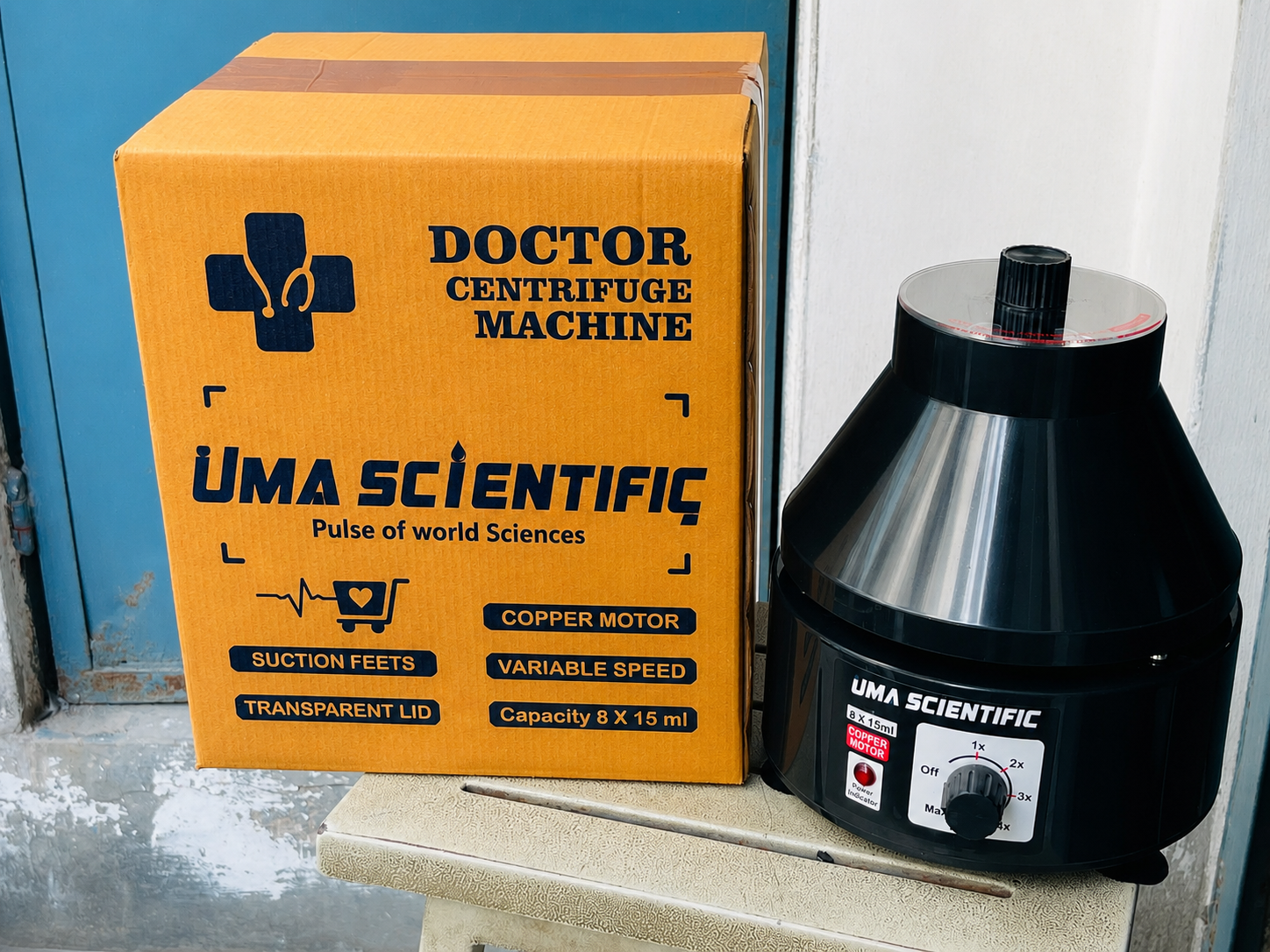
A reliable centrifuge machine can help laboratory professionals separate blood components, precipitates, cells, particles, and other suspended materials efficiently and consistently. The selection of a centrifuge depends on several factors, including sample type, tube capacity, required speed, rotor design, temperature requirements, application, laboratory workload, and safety requirements.
This comprehensive guide explains what a centrifuge machine is, how it works, different types of centrifuges, applications, rotor types, important specifications, safety precautions, maintenance, selection guidelines, laboratory uses, and the advantages of sourcing centrifuge machines from a reliable centrifuge machine manufacturer and supplier in India.
A centrifuge machine is a laboratory instrument that uses centrifugal force to separate substances in a sample.
When a sample tube is rotated at high speed, centrifugal force causes components with different densities to move at different rates. Heavier particles generally move toward the bottom or outer region of the rotating container, while lighter components remain closer to the top or central region.
The separation process depends on factors such as:
Centrifuges are available in many configurations, from compact laboratory centrifuges for routine sample preparation to high-speed and refrigerated systems for advanced research.
Choosing the right centrifuge machine manufacturer in India is important because a centrifuge is a mechanical laboratory instrument that must operate safely and consistently at high rotational speeds.
A professional manufacturer or supplier should provide products with appropriate:
UMA Scientific supplies laboratory centrifuge machines for a variety of laboratory environments and works with customers seeking dependable scientific equipment.
The company serves customers across India and can support laboratory equipment requirements for institutions, hospitals, pharmaceutical organizations, diagnostic centres, research facilities, dealers, distributors, and other professional users.
The basic principle of centrifugation is relatively simple.
A sample is placed into a suitable centrifuge tube. The tube is then positioned in a rotor. When the centrifuge starts, the rotor rotates around a central axis.
The rotation produces centrifugal acceleration. Components within the sample respond differently depending on their physical characteristics.
Dense particles tend to move outward and sediment more rapidly, while lighter components remain in the upper portion of the sample.
After the centrifugation cycle is completed, the machine stops and the separated layers or pellet can be examined or transferred for further laboratory processing.
The exact separation behaviour depends on the sample, rotor, speed, duration, temperature, and tube geometry.
Centrifuge performance is often described using two different concepts:
RPM indicates how many times the rotor completes a full revolution in one minute.
For example, a centrifuge operating at 3000 RPM rotates the rotor 3000 times per minute.
However, RPM alone does not fully describe the centrifugal force applied to a sample because the rotor radius also matters.
RCF describes the relative centrifugal acceleration experienced by the sample compared with Earth’s gravitational acceleration.
RCF is commonly expressed as × g.
Two centrifuges operating at the same RPM can produce different RCF values if their rotor radii are different.
Therefore, laboratories should consider both rotor geometry and required centrifugal force when selecting a centrifuge.
Centrifugation is an essential sample-preparation technique in many laboratory procedures.
A centrifuge can help:
The exact application depends on the centrifuge configuration and laboratory protocol.
Different laboratory applications require different centrifuge configurations.
Common types include:
The most suitable model depends on the application, sample volume, tube capacity, speed requirement, and laboratory workflow.
A general-purpose laboratory centrifuge is designed for routine sample preparation.
These machines can be used in:
The specific tube capacity and maximum speed vary according to the model.
Clinical centrifuges are commonly used in healthcare and diagnostic environments.
They may be used for processing:
Clinical laboratories should select centrifuges according to their testing protocols, tube requirements, sample volumes, and safety procedures.
Pathology laboratories frequently require centrifugation as part of sample preparation.
A pathology centrifuge may be used for:
A compact laboratory centrifuge can be particularly useful in smaller pathology laboratories where space is limited.
A benchtop centrifuge is designed to be placed on a laboratory workbench.
Advantages can include:
Benchtop centrifuges are widely used in research, diagnostics, education, biotechnology, and pharmaceutical laboratories.
A mini centrifuge is a compact instrument designed for small-volume applications.
Mini centrifuges can be useful for:
Their compact size makes them suitable for laboratories with limited bench space.
Microcentrifuges are designed for small-volume tubes such as microcentrifuge tubes.
They are commonly used in:
The appropriate rotor and tube type should always be selected according to the application.
High-speed centrifuges are designed to provide higher rotational speeds and centrifugal forces than many routine laboratory centrifuges.
They may be used for specialized research applications where higher centrifugal force is required.
High-speed applications require particular attention to:
Users must never exceed the manufacturer’s rated speed for a rotor.
A refrigerated centrifuge incorporates temperature control to help maintain sample temperature during centrifugation.
Temperature-controlled centrifugation can be important for samples that are sensitive to heat generated during high-speed operation.
Applications may include:
The required temperature range should be selected according to the laboratory application.
Blood centrifuges are commonly used in clinical and diagnostic laboratories for processing blood samples.
Depending on the procedure, centrifugation can help separate blood into components such as:
The correct centrifugation conditions depend on the laboratory protocol and sample type.
PRP stands for Platelet-Rich Plasma.
Centrifugation is used in certain protocols to separate blood components and prepare platelet-rich fractions.
A centrifuge used for PRP-related procedures must be selected according to the specific protocol, tube type, rotor design, required RCF, and application.
Medical and clinical users should always follow applicable professional protocols and regulations.
Research laboratories may require centrifuges with more advanced control and rotor options.
Research centrifuges can support applications involving:
The ideal machine depends on the research protocol.
The rotor is one of the most important components of a centrifuge.
Common rotor designs include:
In a fixed-angle rotor, the tubes remain at a fixed angle relative to the vertical axis during centrifugation.
Fixed-angle rotors can be useful for applications requiring effective pelleting.
The rotor angle, tube capacity, maximum speed, and RCF should be considered when selecting a machine.
A swing-out rotor allows sample tubes to move outward toward a horizontal position as the rotor accelerates.
Swing-out rotors can be useful for applications where a relatively horizontal separation path is desirable.
They are commonly used for certain clinical, blood, and general laboratory applications.
Microtube rotors are designed for smaller tubes.
They are commonly used in molecular biology and biotechnology laboratories.
The number of positions depends on the rotor design.
Centrifuge capacity refers to the number and volume of tubes that can be processed in a rotor.
Examples of laboratory capacities may include configurations such as:
Actual capacity varies by model.
A laboratory should select capacity based on its daily sample volume.
An 8-tube centrifuge can be suitable for laboratories that process smaller batches of samples.
It can provide:
For example, an 8-tube configuration can be useful for certain 15 mL tube applications when the rotor is specifically designed for that tube size.
15 mL centrifuge tubes are widely used in research, biotechnology, microbiology, and clinical laboratory workflows.
When selecting a centrifuge for 15 mL tubes, users should verify:
Never assume that a centrifuge can safely accommodate a particular tube simply because the tube appears physically compatible.
Blood sample processing is one of the most common centrifuge applications in diagnostic laboratories.
Depending on the protocol, centrifugation may separate blood into different fractions.
The laboratory should determine:
The centrifugation protocol should be established by the responsible laboratory professional.
Centrifuges are used across numerous sectors.
Medical laboratories use centrifuges for sample preparation and separation.
Applications may include:
Pharmaceutical laboratories use centrifuges in:
The centrifuge selected should be appropriate for the sample and process.
Biotechnology laboratories use centrifugation for:
Research institutions use centrifuges across many scientific disciplines.
Applications can include:
Educational laboratories can use centrifuges for practical training and demonstrations.
Students can learn:
Hospital laboratories may use centrifuges for diagnostic sample processing.
The required model depends on the hospital’s laboratory workload and diagnostic procedures.
Pathology laboratories frequently use centrifugation for blood and other sample preparation.
Compact and routine laboratory centrifuges are often useful for pathology environments.
Food and beverage laboratories may use centrifuges during:
The centrifuge must be selected according to the specific testing procedure.
Environmental laboratories may use centrifugation to assist with sample preparation and separation before analysis.
Applications can include water, soil, and other environmental sample processing.
Forensic laboratories may use centrifuges for certain sample preparation and separation procedures.
Because forensic samples can be limited or valuable, careful handling and validated laboratory protocols are important.
When purchasing a centrifuge machine, buyers should review the technical specifications carefully.
Important specifications may include:
Not every centrifuge needs every feature. The specifications should match the intended application.
Both RPM and RCF are important, but they describe different aspects of centrifugation.
RPM describes rotor speed.
RCF describes the actual relative centrifugal acceleration experienced by the sample.
Because rotor radius affects RCF, researchers should use the centrifugation parameter specified by their protocol rather than selecting a machine based only on RPM.
For reproducible laboratory work, the required RCF is often a more useful parameter for comparing centrifuges.
Centrifuge speed is generally expressed in RPM.
Different applications require different speeds.
Routine sample separation may require relatively moderate speeds, while specialized applications may require higher speeds.
The machine’s maximum speed should never be treated as the recommended speed for every sample.
Always follow the validated laboratory protocol and rotor specifications.
A timer allows users to control the centrifugation duration.
Depending on the centrifuge model, the timer may provide different operating ranges.
Timer control can improve repeatability because the centrifugation cycle can be performed for a consistent period.
The correct duration should always be determined by the application.
Modern laboratory centrifuges may feature digital displays for parameters such as:
A digital interface can make operation and monitoring more convenient.
Safety should be one of the highest priorities when selecting and operating a centrifuge.
Potential safety features include:
A lid-locking mechanism can help prevent the lid from opening while the rotor is spinning.
An imbalance can produce vibration and potentially damage the rotor or machine.
An imbalance detection system can help protect the instrument.
Some centrifuges incorporate protection against operation above the specified speed.
The machine should stop safely when the programmed cycle is completed or if a safety condition occurs.
The rotor must be designed for the intended operating speed and load.
Balancing is one of the most important centrifuge operating procedures.
When tubes are not balanced correctly, the rotor can experience excessive vibration.
Potential consequences include:
Tubes should be balanced according to the centrifuge manufacturer’s instructions.
Balancing should consider both the position of the tubes and their mass.
A basic balancing procedure is:
For specialized rotors, follow the manufacturer’s specific balancing instructions.
The centrifuge tube must be compatible with the rotor and centrifugation conditions.
Important factors include:
Using unsuitable tubes can create safety risks.
Regular maintenance can help extend centrifuge life and maintain safe operation.
Maintenance may include:
Maintenance should always follow the manufacturer’s recommendations.
The rotor is a critical safety component.
Users should regularly inspect the rotor for:
A damaged rotor should not be used.
Rotor service life and inspection requirements depend on the design, material, operating conditions, and manufacturer’s instructions.
Laboratory centrifuges should be cleaned according to laboratory procedures and manufacturer recommendations.
If a sample spills inside the centrifuge:
The cleaning agent should be compatible with the centrifuge’s materials.
Like any laboratory instrument, a centrifuge may experience operational problems.
Possible causes include:
Possible causes include:
Possible causes may include:
Possible causes include:
Users should consult the product manual or qualified service personnel when troubleshooting.
The price of a centrifuge machine in India depends on its specifications and intended application.
Factors affecting price include:
A basic laboratory centrifuge may be significantly less expensive than a high-speed refrigerated research centrifuge.
Therefore, buyers should compare machines based on application and specifications rather than price alone.
Choosing the best centrifuge requires understanding the laboratory’s requirements.
Determine whether the centrifuge will be used for:
Identify the size and number of tubes processed during each cycle.
Choose a fixed-angle, swing-out, microtube, or other suitable rotor.
Use the application protocol to determine the required centrifugal force.
Verify that the centrifuge and rotor are compatible with the intended tubes.
If the sample is temperature-sensitive, consider a refrigerated centrifuge.
Look for appropriate lid locking, imbalance protection, and other relevant safety systems.
Benchtop centrifuges can be suitable when bench space is limited.
A reliable supplier should provide clear warranty and service information.
Diagnostic laboratories require reliable instruments for regular sample processing.
UMA Scientific can support laboratory equipment requirements for diagnostic and pathology environments.
When purchasing a centrifuge for diagnostics, laboratories should consider:
Pharmaceutical companies may require centrifuges for research, quality control, formulation development, and laboratory testing.
For pharmaceutical environments, selection should consider:
Research laboratories often need flexible equipment that can accommodate different protocols.
A research centrifuge may need:
The correct machine depends on the specific research application.
A dependable centrifuge machine supplier in India should offer more than a product catalogue.
Customers may require:
UMA Scientific works with laboratories and scientific equipment buyers seeking laboratory centrifuges and related equipment.
Scientific equipment dealers and distributors often require reliable manufacturers and suppliers who can maintain consistent product availability.
A dealer-oriented supply program can include:
The exact commercial terms depend on the product, order quantity, and customer requirements.
OEM centrifuge manufacturing can be useful for companies that want to sell centrifuges under their own brand.
Depending on the project, OEM arrangements may involve:
OEM buyers should discuss technical specifications, MOQ, packaging, branding, lead time, quality requirements, and warranty before finalizing an order.
Hospitals often have multiple laboratory departments.
A centrifuge can be used for routine sample preparation in diagnostic laboratories.
Before purchasing, hospital procurement teams should evaluate:
Universities and colleges may use centrifuges in teaching and research laboratories.
Applications can include:
A compact benchtop centrifuge can be suitable for teaching laboratories where space and budget are important considerations.
Biotechnology applications can require reliable centrifugation for sample preparation.
Potential applications include:
The appropriate rotor and centrifugation conditions should be selected according to the laboratory protocol.
Blood-related laboratories may require centrifugation for specific sample-processing procedures.
The machine should be selected according to:
For specialized blood-bank applications, users should select equipment that meets the applicable institutional and regulatory requirements.
Routine laboratory centrifuges can be used for:
The exact operating conditions should always be based on the validated procedure.
A properly selected centrifuge can offer several operational benefits.
Centrifugation can provide faster separation than many gravity-based methods.
Controlled speed and time can help laboratories reproduce centrifugation conditions.
Multiple samples can often be processed in one cycle.
Centrifugation can reduce the need for manual separation steps.
Centrifuges can support numerous scientific and diagnostic workflows.
Benchtop and mini centrifuges can fit into smaller laboratories.
Safety should always be prioritized.
Important practices include:
UMA Scientific focuses on laboratory scientific equipment and supports customers requiring practical laboratory solutions.
The company supplies equipment for:
Its product portfolio includes centrifuge machines and other laboratory equipment such as micropipettes, bottle top dispensers, microscopes, dry bath incubators, magnetic stirrers, pH meters, vortex shakers, hot plates, and related laboratory instruments.
UMA Scientific offers centrifuge solutions intended for different laboratory requirements.
Depending on the model, centrifuges may be designed around features such as:
Exact specifications vary by model. Buyers should request the latest technical datasheet before placing an order.
The growth of laboratory equipment manufacturing in India provides laboratories with more domestic sourcing options.
Buying laboratory equipment from Indian manufacturers and suppliers can provide advantages such as:
UMA Scientific serves customers in India and can support laboratory equipment procurement requirements.
UMA Scientific is based in Lucknow, Uttar Pradesh, and serves laboratory equipment customers in India.
The company can support centrifuge machine requirements for customers seeking:
Customers can contact UMA Scientific for current models, specifications, availability, and quotations.
Laboratories across India may require centrifuge machines for new laboratory setup, equipment replacement, expansion, or institutional procurement.
UMA Scientific works with customers across different regions and can support requirements for laboratories in cities and states throughout India, subject to product availability and shipping arrangements.
Customers can request a quotation by providing:
For a faster quotation, buyers should provide the following information:
Product: Centrifuge Machine
Application: Diagnostic / Research / Pharmaceutical / Educational / Industrial
Tube Size: For example, 15 mL or another required format
Capacity: Required number of tubes
Required Speed or RCF: As specified by the laboratory protocol
Temperature: Ambient or refrigerated
Quantity: Number of machines required
Location: Delivery city and state
Documentation: Calibration, warranty, technical documents, or other requirements
This information allows the supplier to recommend an appropriate configuration.
A centrifuge is used to separate components of a sample based on differences in density using centrifugal force.
RPM means revolutions per minute and indicates how quickly the rotor rotates.
RCF means relative centrifugal force and describes the centrifugal acceleration applied to the sample relative to gravity.
Balancing helps prevent excessive vibration, protects the rotor and machine, and supports safe and consistent operation.
Yes, suitable centrifuges are commonly used for blood sample processing. The rotor, tube type, RCF, and protocol must be appropriate for the application.
A benchtop centrifuge is designed to sit on a laboratory workbench and is commonly used for routine laboratory applications.
A refrigerated centrifuge provides temperature control during centrifugation and can be useful for temperature-sensitive samples.
A fixed-angle rotor holds tubes at a predetermined angle during centrifugation.
A swing-out rotor allows tubes to move toward a horizontal position as the rotor spins.
A centrifuge with a rotor specifically rated for the required 15 mL tube type and dimensions should be selected.
The cycle time depends entirely on the laboratory protocol and sample type.
Consider sample type, tube size, capacity, required RCF, speed, rotor type, temperature requirements, safety features, and laboratory workload.
Prices vary according to speed, capacity, rotor, temperature control, controls, safety features, construction, brand, and other specifications. Request a current quotation for an exact price.
Yes. Centrifuges are used in pharmaceutical research, quality control, sample preparation, and other laboratory procedures.
Yes. Centrifuges are widely used in pathology and diagnostic laboratories for sample preparation.
UMA Scientific supplies laboratory scientific equipment, including centrifuge machines, for professional laboratory applications.
Selecting a laboratory equipment supplier is a long-term decision.
UMA Scientific aims to provide customers with:
For customers purchasing centrifuges, the company can provide information about available models, rotor configurations, specifications, pricing, and delivery.
A centrifuge machine is an essential laboratory instrument used for sample separation across medical, diagnostic, pharmaceutical, biotechnology, research, educational, food, industrial, and other scientific applications.
The right centrifuge should be selected according to the laboratory’s specific requirements rather than simply choosing the highest-speed or lowest-priced machine.
Important factors include:
Whether you require a compact laboratory centrifuge, a centrifuge for blood sample processing, a machine for research applications, an 8-tube or other tube-capacity configuration, or bulk centrifuge machines for institutional or distribution requirements, selecting the correct specification is essential for safe and effective laboratory operation.
UMA Scientific
Manufacturer & Supplier of Laboratory Scientific Equipment
Centrifuge Machine | Laboratory Equipment | Scientific Instruments
Mobile: +91-7379207507 / +91-7347707507
Website: www.umascientific.com
For centrifuge machine specifications, current prices, bulk orders, dealer requirements, distributor enquiries, and OEM opportunities, contact UMA Scientific.
Centrifuge Machine | Centrifuge Machine Manufacturer | Centrifuge Machine Supplier – UMA Scientific
