

Leading Micropipette & Scientific Lab, Medical instrument Manufacturer and Deler A Legacy Of Scientific Precision .



Leading Micropipette & Scientific Lab, Medical instrument Manufacturer and Deler A Legacy Of Scientific Precision .
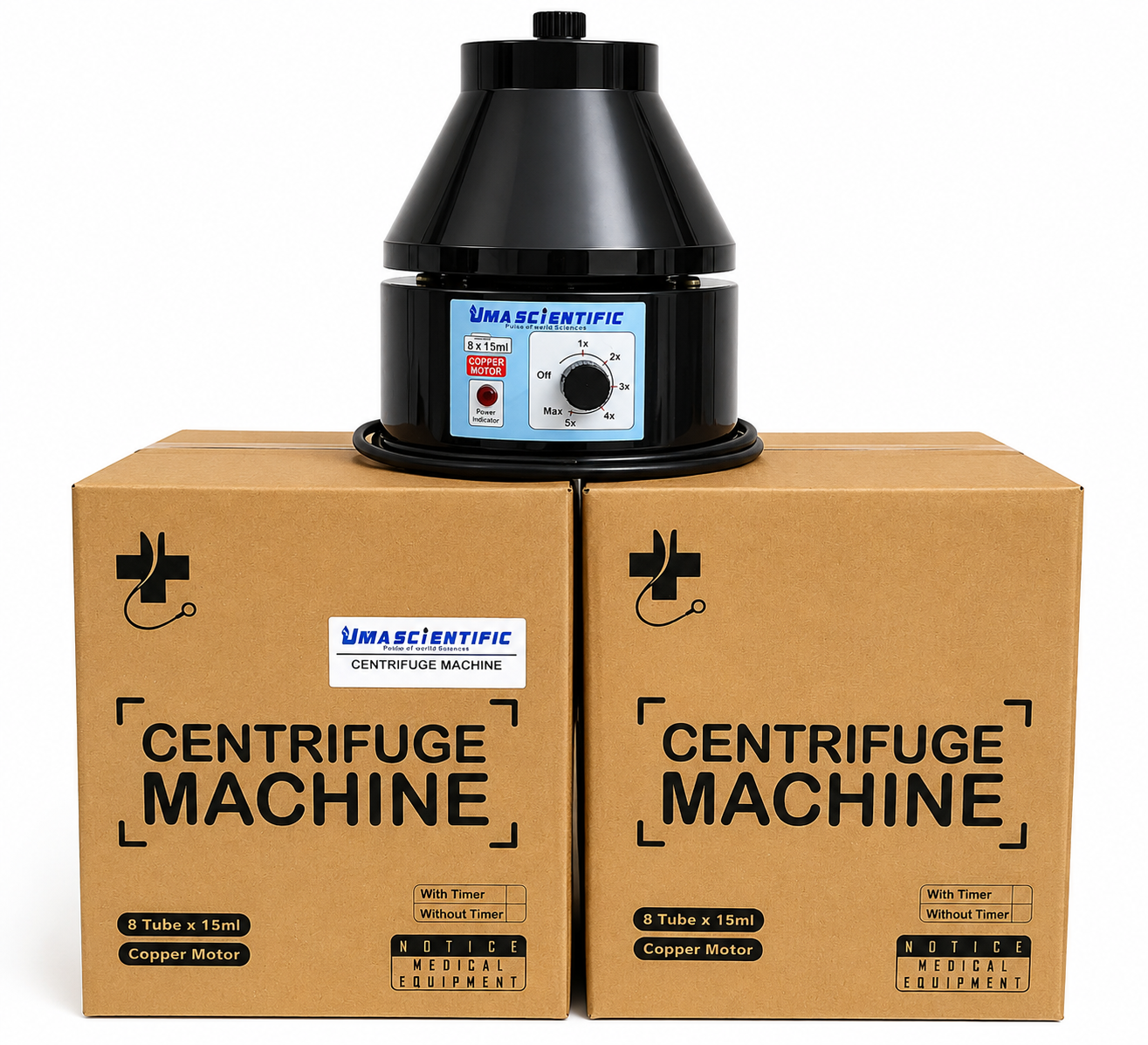
At Uma Scientific, we are a manufacturer and supplier of laboratory and scientific equipment, offering premium-quality centrifuge machines designed for routine laboratory applications. Our focus is on providing reliable equipment with practical features, sturdy construction and consistent performance for laboratory users.
Our Dr Centrifuge Machine is designed for applications where controlled centrifugal separation is required. The machine features an 8 × 15 mL tube capacity, up to 3500 RPM operating speed, copper motor, fixed-angle rotor and suction-type feet designed to provide stable operation on laboratory surfaces.
A centrifuge machine is a laboratory instrument that separates substances in a sample by applying centrifugal force.
This principle allows laboratories to separate different components of mixtures efficiently.
For example, centrifugation can be used for:
A centrifuge machine is therefore an essential instrument wherever laboratory samples require controlled separation.
As a manufacturer, our objective is to provide laboratory equipment that combines:
Our centrifuge machines are designed with the requirements of routine laboratory users in mind.
We understand that laboratory equipment must be dependable because laboratory workflows often involve repeated daily operation. Therefore, our approach focuses on practical construction and functional performance rather than unnecessary complexity.
The Dr Centrifuge Machine from Uma Scientific is a compact laboratory centrifuge designed for routine sample separation.
The model shown in our product specification features:
Product: Dr Centrifuge Machine
Capacity: 8 × 15 mL tubes
Maximum Speed: 3500 RPM
Motor: Copper motor
Rotor: Fixed-angle rotor
Body: Shock-resistant ABS body
Power Supply: 230 V, 50 Hz
Stability: Suction-type rubber feet
Approx. Item Weight: 3 kg
The machine is suitable for laboratories that require a compact centrifuge with straightforward operation.
One of the important features of this centrifuge is its 8 × 15 mL tube capacity.
The rotor is designed with eight positions, allowing users to process multiple tubes during a centrifugation cycle.
Multiple tube capacity can improve workflow efficiency because several samples can be processed together instead of operating the centrifuge repeatedly for individual samples.
The 15 mL tube format is commonly used for a variety of routine laboratory sample-processing requirements.
The actual suitability of a particular tube, sample and application should always be checked against the laboratory’s operating procedure and the manufacturer’s instructions.
The Dr Centrifuge Machine is specified for operation up to 3500 RPM.
RPM means revolutions per minute and indicates how many times the rotor rotates in one minute.
The speed selected during centrifugation depends on the sample, tube type, rotor and laboratory procedure.
It is important to understand that RPM alone does not completely describe centrifugal force. The effective centrifugal force also depends on the rotor radius. For applications where centrifugal force is critical, users should refer to the applicable RCF (Relative Centrifugal Force) specification rather than selecting a process based only on RPM.
The Dr Centrifuge Machine is equipped with a copper motor.
The motor is one of the most important components of a centrifuge because it provides the rotational power required to drive the rotor.
A properly designed motor system contributes to reliable operation during repeated laboratory use.
At Uma Scientific, we focus on practical motor and mechanical construction suitable for routine laboratory centrifugation.
The centrifuge uses a fixed-angle rotor configuration.
In a fixed-angle rotor, tubes are positioned at a predetermined angle relative to the vertical axis.
During rotation, the centrifugal force causes particles in the sample to move toward the outer region of the tube.
Fixed-angle rotor systems are commonly used for routine laboratory separation procedures.
The appropriate rotor configuration should always be selected according to the intended application, sample type and laboratory protocol.
Laboratory centrifuges operate at high rotational speeds, so stability is an important consideration.
The Dr Centrifuge Machine incorporates suction-type rubber feet designed to help keep the equipment stable on suitable laboratory surfaces.
Proper placement of the centrifuge on a stable, level and suitable work surface is important.
Users should also ensure that:
Correct operating practices are essential for safe and reliable centrifugation.
The centrifuge features a shock-resistant ABS body.
ABS is a commonly used engineering thermoplastic that can provide a practical combination of durability, weight and ease of cleaning when properly designed.
A compact ABS housing also helps make the centrifuge suitable for laboratories where bench space is limited.
The body design of a laboratory centrifuge should provide adequate protection for internal components while allowing users convenient access to controls and sample areas.
The basic working principle of centrifugation is based on rotational motion and centrifugal force.
The general process is:
The laboratory sample is placed into appropriate centrifuge tubes.
The tubes are placed into the rotor.
Tubes should be arranged symmetrically so that the rotor remains balanced.
For example, if two tubes are used, they should normally be positioned opposite each other with equivalent loading, according to the manufacturer’s instructions.
The centrifuge lid is securely closed before operation.
The appropriate speed is selected according to the laboratory procedure.
The motor rotates the rotor and generates centrifugal force.
Different components of the sample separate according to their physical characteristics, particularly density and sedimentation behavior.
After the centrifugation cycle is complete and the rotor has completely stopped, samples can be removed according to laboratory safety procedures.
Balancing is one of the most important practices when operating a centrifuge.
An unbalanced rotor can create excessive vibration and mechanical stress.
Incorrect balancing may affect:
For this reason, users should always follow the manufacturer’s balancing instructions.
When using an even number of tubes, samples should generally be positioned opposite one another with comparable loading.
If the laboratory uses fewer tubes, suitable balancing arrangements should be followed according to the rotor design.
Never assume that an arbitrary arrangement is safe at high speed.
Centrifuges are used across many laboratory environments.
Pathology laboratories use centrifugation for different sample preparation and separation procedures.
Depending on the testing workflow, centrifugation may be used for processing blood or other laboratory samples before analysis.
Diagnostic centers frequently require centrifuges as part of routine sample-processing workflows.
A compact 8 × 15 mL centrifuge can be useful where multiple small-volume tubes need to be processed in a single cycle.
Hospitals with in-house laboratory facilities may use centrifuges for routine sample preparation.
The appropriate centrifuge specification depends on the type of laboratory testing being performed.
Research laboratories use centrifugation for a wide range of sample-processing applications.
The exact centrifuge requirements can vary significantly depending on research protocols.
Some applications require low-speed centrifugation, while others may require much higher RCF values or specialized rotors.
Pharmaceutical laboratories may use centrifugation during research, development and quality-control processes.
The specific centrifuge requirements depend on the formulation, sample and analytical procedure.
Biotechnology applications may involve centrifugation for cell, particulate or other sample-processing steps.
Researchers should select a centrifuge based on required speed, RCF, tube capacity, rotor design and application requirements.
Educational institutions use laboratory centrifuges for demonstrations, practical classes and laboratory training.
A compact centrifuge can be suitable for routine educational laboratory applications where appropriate procedures are followed.
Centrifugation can also be used in food and beverage laboratory workflows for sample preparation and separation.
The specific equipment requirements depend on the testing procedure.
Industrial laboratories may use centrifugation for sample processing, quality testing and research applications.
Uma Scientific can provide laboratory equipment for a variety of institutional and industrial requirements.
Selecting a suitable centrifuge can provide several practical advantages.
An 8-position rotor allows multiple tubes to be processed together.
A compact laboratory centrifuge can help save valuable bench space.
Straightforward controls can make routine operation convenient for laboratory personnel.
Suction-type feet can help improve stability on suitable surfaces.
The copper motor is designed to provide the rotational power required for centrifugation.
The fixed-angle rotor is suitable for various routine separation procedures, depending on the laboratory protocol.
The ABS body provides a practical lightweight housing for routine laboratory use.
When purchasing laboratory equipment, customers often compare products based on construction, performance, specifications, after-sales support and overall value.
At Uma Scientific, we aim to manufacture and supply equipment that meets practical laboratory requirements.
Our centrifuge machine product line is developed with attention to:
We also understand that different laboratories have different requirements. Therefore, selecting the correct centrifuge model is important rather than simply choosing the highest RPM machine.
Before purchasing a centrifuge machine, consider the following factors.
Determine how many samples need to be processed in each cycle.
If your laboratory commonly processes eight 15 mL tubes, an 8 × 15 mL centrifuge may be an appropriate option.
Different centrifuges accommodate different tube formats.
Always check the rotor specifications before purchasing.
Determine the required operating speed based on your laboratory procedure.
Remember that RPM is not the same as RCF.
For technical applications, compare the maximum RCF available from the centrifuge and rotor.
RCF is often more meaningful than RPM when reproducing centrifugation protocols.
Common rotor configurations include fixed-angle and swing-out designs.
The appropriate configuration depends on the separation procedure.
The motor should be suitable for the expected workload and operating conditions.
The Dr Centrifuge Machine by Uma Scientific is equipped with a copper motor.
Check the base design and ensure the centrifuge can be installed securely on a suitable laboratory bench.
Consider the materials used for the body, rotor and other major components.
Choose equipment that can be maintained conveniently and supported by the supplier or manufacturer.
After-sales service is an important consideration when purchasing laboratory equipment.
A reliable supplier should be able to provide product information, operating guidance and support for genuine technical requirements.
Proper maintenance helps keep laboratory equipment in good working condition.
Clean the rotor regularly according to the manufacturer’s recommended procedure.
Damaged, cracked or unsuitable tubes should not be used.
Inspect the rotor periodically for signs of damage, corrosion or abnormal wear.
Wipe the external surface using an appropriate cleaning method.
Inspect the suction-type rubber feet periodically to ensure they remain in suitable condition.
Never exceed the specified tube capacity or recommended loading.
Always balance the tubes before starting the centrifuge.
Use the centrifuge according to the manufacturer’s instructions and laboratory SOP.
Safety should always be the first priority when operating laboratory centrifuges.
Important precautions include:
There are many laboratory equipment suppliers in India, so choosing the right manufacturer is important.
Uma Scientific focuses on providing laboratory and scientific equipment for professional users.
We manufacture and supply laboratory equipment under the Uma Scientific brand.
We focus on practical product construction and quality-oriented manufacturing.
Our equipment is intended for a broad range of laboratory environments.
As a manufacturer and supplier, we aim to offer competitive pricing for institutional, laboratory and bulk requirements.
We can discuss OEM and bulk requirements depending on the product and order quantity.
Uma Scientific serves customers across India through its sales and distribution network.
We provide product-related assistance for customers purchasing our laboratory equipment.
Pathology laboratories require dependable equipment because sample processing is an important part of the overall diagnostic workflow.
The Dr Centrifuge Machine provides an 8 × 15 mL capacity and 3500 RPM maximum speed, making it a practical option for routine centrifugation where these specifications meet the laboratory’s requirements.
The compact design can also be useful where laboratory bench space is limited.
However, laboratories should always select equipment based on their specific testing protocols and required centrifugal force.
Diagnostic centers may process multiple samples during daily operations.
An 8-position centrifuge can help laboratories process several tubes in one cycle.
The compact design, simple speed control and fixed-angle rotor make the Dr Centrifuge Machine suitable for routine applications where the specified capacity and speed are appropriate.
For specialized diagnostic procedures, users should verify the required RCF, rotor compatibility and tube specifications before purchase.
Hospitals with diagnostic laboratory departments may require centrifuges for routine sample preparation.
Uma Scientific’s laboratory centrifuge can be considered for applications requiring:
The final selection should always be based on the hospital laboratory’s SOP and testing requirements.
Laboratory education requires instruments that are practical and easy to operate.
Centrifuges can be used in educational laboratories for teaching concepts related to:
The Dr Centrifuge Machine can be considered for educational laboratories where its specifications meet the intended practical requirements.
Laboratory centrifuges are available with different control systems.
A manual centrifuge generally uses mechanical controls for speed and/or timing depending on the model.
Advantages can include:
Microprocessor-controlled centrifuges may provide digital control of parameters such as speed and time, depending on the model.
Advantages can include:
The best choice depends on the laboratory’s application, budget and required control features.
Customers sometimes ask about the difference between a traditional or copper-motor centrifuge and a brushless centrifuge.
A brushless centrifuge uses a brushless motor, while the Dr Centrifuge Machine shown here uses a copper motor.
Brushless motor systems can offer advantages such as reduced brush wear and potentially lower maintenance requirements.
A copper-motor centrifuge, however, can be a practical choice for routine applications when the machine is appropriately designed and maintained.
The right choice should be based on the application, operating requirements, expected workload, control system and budget.
The motor converts electrical energy into mechanical rotational motion.
In a centrifuge, the motor must provide sufficient torque to rotate the rotor and samples.
The Dr Centrifuge Machine is equipped with a copper motor and designed for operation up to 3500 RPM.
For routine laboratory applications, customers should consider the complete machine specification rather than evaluating the motor material alone.
Important factors include:
The rotor is one of the most critical components of a centrifuge.
It directly holds the sample tubes and rotates at high speed.
A properly designed rotor should be appropriate for:
The Dr Centrifuge Machine uses a fixed-angle rotor with eight positions for 15 mL tubes.
Users should never modify the rotor or use incompatible tubes.
A common mistake when selecting centrifuge machines is comparing products only by RPM.
RPM describes rotational speed, but RCF describes the relative centrifugal force generated at a particular rotor radius and speed.
The relationship is commonly expressed as:
RCF = 1.118 × 10⁻⁵ × r × RPM²
Where:
This means that two centrifuges operating at the same RPM can generate different RCF values if their rotor radii are different.
Therefore, laboratories should compare RCF when a protocol specifies centrifugal force.
The centrifuge tube is an important part of the centrifugation system.
Users should ensure that tubes are:
Never use a tube simply because it physically fits into the rotor.
Its material and mechanical rating must also be appropriate for the application.
Laboratory equipment requires appropriate packaging to reduce the possibility of damage during transportation.
The product specification shown for the Dr Centrifuge Machine indicates packaging in a specially designed thermocol box with an outer master carton.
Good packaging is especially important for scientific equipment because components such as rotors, motors and control systems must be protected during handling and shipment.
Uma Scientific takes packaging and dispatch considerations seriously when supplying laboratory equipment.
Laboratory space can be limited, especially in diagnostic centers, small pathology laboratories, colleges and research facilities.
A compact centrifuge can provide useful sample-processing capability without requiring a large installation area.
The Dr Centrifuge Machine has a compact form factor and approximately 3 kg item weight, according to the supplied specification.
This makes it convenient for laboratories that need a portable or space-efficient centrifuge for suitable routine applications.
Uma Scientific supplies laboratory equipment to customers across India.
Our customer base can include:
For bulk requirements, institutional procurement and other special requirements, customers can contact our sales team.
Laboratories, distributors, dealers, institutions and organizations may require centrifuges in larger quantities.
Uma Scientific can discuss bulk requirements based on:
Customers requiring bulk laboratory equipment can contact our sales team for product availability and commercial details.
OEM stands for Original Equipment Manufacturer.
For eligible products and orders, OEM requirements can be discussed with Uma Scientific.
OEM customers may require:
OEM terms, minimum order quantities and customization options depend on the product and order requirements.
Quality in laboratory equipment is not limited to appearance.
A useful laboratory centrifuge requires appropriate engineering of multiple components, including:
Uma Scientific focuses on delivering practical laboratory equipment with attention to construction and usability.
Our objective is to provide customers with laboratory equipment that offers a suitable combination of quality, functionality and value.
A centrifuge machine is used to separate components of a sample using centrifugal force.
The specified capacity is 8 × 15 mL tubes.
The specified maximum speed is 3500 RPM.
Yes. The Dr Centrifuge Machine specification includes a copper motor.
It uses a fixed-angle rotor.
It can be suitable for routine pathology laboratory applications where the required tube capacity, speed and centrifugal force match the laboratory procedure.
Yes, it can be considered for suitable routine diagnostic laboratory applications.
Yes, the Dr Centrifuge Machine is designed as a compact laboratory centrifuge.
Balancing helps reduce unwanted vibration and mechanical stress during operation.
No. Users should use tubes that are compatible with the rotor and rated for the intended operating conditions.
When purchasing a centrifuge machine, don’t select a product only by looking at price.
Consider:
Manufacturer reputation → Product specifications → Rotor capacity → RPM → RCF → Motor → Construction → Safety → Warranty/support → Spare parts → Packaging → Application suitability
Uma Scientific provides laboratory equipment for professional and institutional users.
Before placing an order, customers should communicate their exact application so that the appropriate model and rotor configuration can be recommended.
Purchasing directly from a manufacturer or established laboratory equipment company can provide several advantages.
A manufacturer generally has better product knowledge and can provide technical information about the equipment.
Potential advantages include:
At Uma Scientific, our team works with laboratory customers to understand their equipment requirements and provide suitable solutions.
Uma Scientific is not limited to centrifuge machines. We offer a broad range of laboratory and scientific equipment for different applications.
Our product categories include laboratory instruments and equipment such as:
This broad product portfolio allows laboratories and institutions to source multiple types of equipment from one laboratory equipment supplier.
The Uma Scientific Dr Centrifuge Machine combines a compact laboratory design with an 8 × 15 mL rotor capacity, 3500 RPM speed, copper motor, fixed-angle rotor, ABS body and suction-type rubber feet.
It is intended for routine centrifugation applications where these specifications meet the user’s requirements.
A centrifuge should always be selected according to the actual laboratory procedure. For specialized applications, users should verify RCF, rotor compatibility, tube specifications and other technical requirements before purchase.
A centrifuge machine is an essential laboratory instrument for sample separation and preparation. Choosing the correct centrifuge can improve laboratory workflow and provide reliable performance for routine sample-processing applications.
Uma Scientific is a manufacturer and supplier of laboratory and scientific equipment in India, with a focus on quality-oriented products and practical laboratory solutions.
Our Dr Centrifuge Machine offers:
For pathology laboratories, diagnostic centers, hospitals, research laboratories, educational institutions and other suitable laboratory environments, the Dr Centrifuge Machine can be considered when its specifications meet the required application.
If you are looking for a premium-quality centrifuge machine manufacturer in India, laboratory centrifuge supplier, Dr centrifuge machine supplier, or 8 × 15 mL centrifuge machine, Uma Scientific can provide laboratory equipment solutions according to your requirements.
UMA SCIENTIFIC
Laboratory & Scientific Equipment Manufacturer & Supplier
Email: sales.umascientific@gmail.com
Website: www.umascientific.com
Product: Dr Centrifuge Machine
Capacity: 8 × 15 mL
Speed: 3500 RPM
Motor: Copper Motor
Rotor: Fixed Angle
Centrifuge Machine Manufacturer in India, Centrifuge Machine Supplier in India, Laboratory Centrifuge Machine, Premium Centrifuge Machine, Dr Centrifuge Machine, Dr Centrifuge Machine Manufacturer, 8 x 15 mL Centrifuge Machine, 3500 RPM Centrifuge, Copper Motor Centrifuge Machine, Pathology Centrifuge Machine, Diagnostic Centrifuge Machine, Hospital Centrifuge Machine, Laboratory Equipment Manufacturer India, Scientific Equipment Manufacturer India, Uma Scientific Centrifuge Machine, Best Centrifuge Machine Supplier India, Laboratory Centrifuge Supplier, Centrifuge Machine for Pathology Lab, Centrifuge Machine for Diagnostic Lab, Centrifuge Machine for Hospital, Centrifuge Machine for Research Laboratory, Fixed Angle Centrifuge Machine, Premium Laboratory Equipment India.
