

Leading Micropipette & Scientific Lab, Medical instrument Manufacturer and Deler A Legacy Of Scientific Precision .



Leading Micropipette & Scientific Lab, Medical instrument Manufacturer and Deler A Legacy Of Scientific Precision .
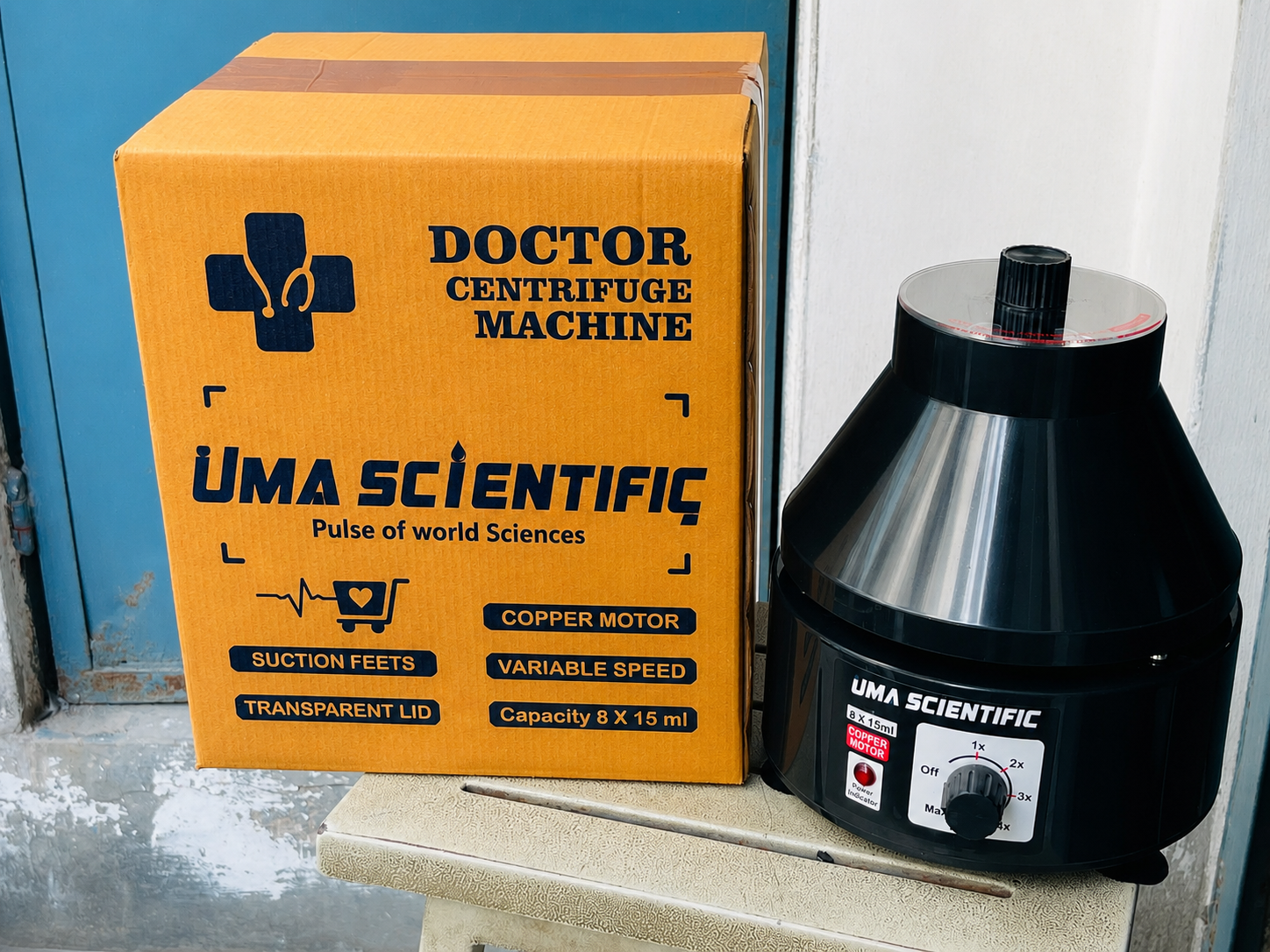
A centrifuge machine is a laboratory instrument used to separate components of a liquid suspension by applying centrifugal force.
When a sample is rotated at high speed, particles with different densities move at different rates. Denser components generally move toward the bottom or outer region of the rotating sample container, while lighter components remain closer to the center.
This separation process allows laboratory professionals to isolate or concentrate specific components of a sample.
Centrifuges are commonly used for:
India has a growing laboratory equipment manufacturing and scientific instrumentation sector.
A professional centrifuge machine manufacturer in India can provide laboratory centrifuges designed for domestic laboratory requirements while also supporting distributors, dealers, institutions, and export customers.
Uma Scientific focuses on laboratory and scientific equipment and provides centrifuge machine solutions for different laboratory applications.
The company can supply laboratory centrifuges for:
Many laboratory samples contain multiple components that need to be separated before analysis.
For example, blood consists of several components, including cells and liquid portions. Centrifugation can help separate these components so that the required portion can be collected for further testing.
Similarly, centrifugation is used to separate:
Without an appropriate centrifuge, many laboratory procedures would become slower and more difficult.
A centrifuge works according to the principle of centrifugal force.
The sample is placed inside a tube, and the tube is positioned in a rotor.
When the rotor rotates:
The exact separation behavior depends on factors such as:
Two important terms used when discussing centrifuges are RPM and RCF.
RPM describes how many times the rotor rotates in one minute.
For example:
3000 RPM
means that the rotor completes 3000 revolutions per minute.
However, RPM alone does not completely describe the centrifugal force applied to a sample.
RCF is commonly expressed as ×g.
It represents the centrifugal acceleration applied to the sample relative to Earth’s gravitational acceleration.
RCF depends on:
Therefore, two centrifuges operating at the same RPM can produce different RCF values if their rotor sizes are different.
For laboratory applications, users should select the appropriate centrifugal force according to the sample and procedure.
A laboratory centrifuge contains several important components.
The motor drives the rotor and provides the required rotational speed.
The rotor holds the sample tubes.
Different rotor configurations are available for different applications.
Tube holders secure sample tubes during centrifugation.
The lid covers the rotor chamber during operation.
Depending on the model, controls may allow users to set:
Many laboratory centrifuges include safety mechanisms designed to prevent operation when the lid is not properly closed.
The external body protects internal components and provides structural stability.
There are many types of centrifuges available for different laboratory requirements.
A general-purpose laboratory centrifuge is commonly used for routine sample separation.
Applications include:
A doctor centrifuge machine is commonly used in clinical and pathology laboratory applications.
It can be used for procedures involving:
The exact tube capacity and speed depend on the model.
An 8-tube centrifuge is designed to accommodate eight tubes in the appropriate rotor configuration.
It can be suitable for:
The appropriate tube size should always be confirmed before purchase.
Centrifuges designed for 15 mL tubes are widely used in laboratories.
They may be useful for:
Tube compatibility should be checked according to the manufacturer’s specifications.
High-speed centrifuges are designed for applications requiring higher centrifugal forces.
They can be used in:
High-speed applications require appropriate rotors and tubes rated for the intended operating conditions.
A microcentrifuge is designed for small-volume tubes, commonly used in molecular biology and research laboratories.
Typical applications include:
A refrigerated centrifuge controls the temperature of samples during centrifugation.
This is useful when samples are sensitive to temperature increases.
Applications can include:
Blood centrifuges are commonly used in clinical and diagnostic laboratories.
They can be used to separate blood components for subsequent analysis.
Applications may include:
Pathology laboratories frequently require centrifuges for routine sample preparation.
Important considerations include:
A suitable centrifuge can help laboratories maintain an efficient sample-processing workflow.
Diagnostic laboratories may process a large number of samples each day.
A reliable centrifuge can help streamline:
For high-throughput laboratories, capacity and workflow speed are particularly important.
Pharmaceutical laboratories use centrifuges in research, development, quality control, and analytical procedures.
Applications may include:
Pharmaceutical laboratories should select equipment according to their specific procedures and internal quality requirements.
Biotechnology laboratories rely heavily on centrifugation.
Applications can include:
Depending on the application, biotechnology laboratories may require specialized microcentrifuges, high-speed centrifuges, or refrigerated centrifuges.
Research laboratories often require flexible centrifugation solutions.
A research facility may use multiple centrifuges depending on:
Researchers should choose a centrifuge based on actual experimental requirements rather than simply selecting the machine with the highest RPM.
When selecting a centrifuge machine, several features should be evaluated.
A dependable motor is important for consistent operation.
The rotor should operate smoothly with properly balanced loads.
Users should be able to set the required operating parameters conveniently.
A timer allows users to control the duration of centrifugation.
The lid should provide appropriate protection during operation.
The machine should be suitable for routine laboratory use.
The centrifuge chamber should be easy to clean and maintain.
The rotor is one of the most important components of a centrifuge.
Different rotors are designed for different sample containers and applications.
Common rotor types include:
The correct rotor depends on:
Always verify rotor compatibility before purchasing tubes or accessories.
A fixed-angle rotor holds tubes at a fixed angle relative to the vertical axis.
It can be useful for applications requiring pellet formation and certain laboratory separation procedures.
A swing-out rotor allows sample containers to move outward during rotation.
This design is often used for applications where a more horizontal separation path is desired.
Proper balancing is essential for safe centrifuge operation.
Tubes should be balanced according to the manufacturer’s instructions.
An unbalanced rotor can cause:
Always follow the centrifuge manufacturer’s loading and balancing instructions.
Motor construction can be an important consideration when selecting laboratory equipment.
Centrifuge machines with suitable motor construction can provide reliable performance for routine operation.
When comparing centrifuges, buyers should look beyond marketing claims and ask for specific technical information about:
If a supplier claims a particular motor material or construction, customers should verify it from the manufacturer’s specifications.
The term fully copper motor centrifuge is commonly used in the laboratory equipment market to describe a motor using copper windings.
Copper has good electrical conductivity and is widely used in electric motors.
However, buyers should not evaluate a centrifuge only by whether it is marketed as a copper-motor machine.
Other important parameters include:
Centrifuge machines are available with different maximum speeds.
The required speed depends on the application.
A routine pathology centrifuge may not require the same speed as a molecular biology research centrifuge.
Therefore, choosing a centrifuge with the correct speed range is more important than simply choosing the highest RPM.
Capacity refers to how many tubes the centrifuge can process in a single run.
Examples may include:
A laboratory processing many samples may benefit from a larger-capacity centrifuge.
Consider:
For a small clinic, an 8-tube centrifuge may be practical.
For a larger diagnostic laboratory, a higher-capacity machine may improve workflow efficiency.
15 mL centrifuge tubes are common in research and laboratory environments.
Before purchasing a centrifuge, check:
Using the correct rotor and tube configuration is important for safe operation.
Regular maintenance can help prolong equipment life.
Remove spills promptly using a cleaning procedure suitable for the machine.
Check regularly for:
Make sure holders are clean and undamaged.
The safety lid should close correctly.
Unexpected noise or vibration should be investigated.
Maintenance schedules should follow the manufacturer’s recommendations.
Possible causes include:
Possible causes may include:
Possible causes may include:
For persistent issues, stop operation and contact qualified service personnel.
Laboratory centrifuges operate at high rotational speeds and should be treated as safety-critical equipment.
Users should:
Not every tube is suitable for every centrifuge.
Tube material, dimensions, rotor design, and speed rating must be compatible.
Using an unsuitable tube can lead to:
Always check the manufacturer’s specifications.
The terms manufacturer and supplier are sometimes used interchangeably, but they can have different meanings.
A manufacturer produces the equipment or works directly with the manufacturing process.
A supplier may manufacture products, distribute products, import products, or provide a combination of these services.
For buyers, the most important factors are:
Purchasing from an Indian manufacturer or domestic supplier can provide several advantages.
Customers can communicate directly with the supplier.
Domestic shipping can simplify procurement.
Service and warranty coordination may be easier.
Indian manufacturers and suppliers can support institutional and distributor requirements.
Depending on the manufacturer, customized requirements may be possible.
Domestic supply can reduce certain import-related costs.
Uma Scientific is based in Lucknow, Uttar Pradesh, and supplies laboratory scientific equipment to customers in India.
Its laboratory equipment portfolio includes centrifuge machines and other scientific instruments used across different laboratory environments.
The company can support customers such as:
Laboratory centrifuges are required throughout India.
A domestic centrifuge supplier can support customers in major markets including:
Delivery time and availability depend on the specific model, quantity, stock position, and destination.
South India has a strong demand for laboratory and scientific equipment due to its pharmaceutical, biotechnology, healthcare, educational, and research sectors.
Customers in:
can source centrifuge machines from Indian laboratory equipment suppliers.
Maharashtra is one of India’s major pharmaceutical, healthcare, biotechnology, and industrial laboratory markets.
Laboratories in Mumbai, Pune, Nashik, Nagpur, and other cities may require centrifuges for:
Uttar Pradesh has a large network of hospitals, universities, diagnostic laboratories, pharmaceutical organizations, educational institutions, and research facilities.
Uma Scientific, based in Lucknow, provides laboratory equipment solutions for customers in Uttar Pradesh and other Indian regions.
Hospital laboratories may use centrifuges for routine sample processing.
Applications can include:
Hospital laboratories should select centrifuges according to their workload, tube requirements, speed requirements, and laboratory procedures.
Pathology laboratories need reliable equipment because sample processing is a critical part of diagnostic workflows.
A centrifuge for pathology applications should be:
Colleges, universities, and training laboratories often require affordable and easy-to-use centrifuges.
Educational applications may include:
Student laboratories may prioritize simple controls, robust construction, safety, and economical operation.
Pharmaceutical laboratories can use centrifuges during:
For regulated environments, procurement teams may also require technical documentation and quality records.
Food and beverage laboratories perform testing that may involve centrifugation.
Applications can include:
Research laboratories may require specialized centrifuges depending on the experiment.
Important parameters include:
Researchers should select a machine based on their experimental protocol.
Modern laboratory centrifuges may include digital controls and displays.
Depending on the model, digital controls can allow users to set:
Digital operation can improve convenience and repeatability.
Basic centrifuges can be suitable for routine applications where simple operation is sufficient.
Digital centrifuges may provide more convenient control over operating parameters.
The choice depends on laboratory requirements, budget, workload, and desired functionality.
The price of a centrifuge machine depends on several factors.
A basic laboratory centrifuge may have a different price from a refrigerated or high-speed centrifuge.
Higher tube capacity may increase cost.
Higher-speed models can require more advanced components.
Rotor design and capacity affect pricing.
Digital or programmable controls may affect the price.
Motor construction and performance can influence the cost.
Adapters, rotors, tube holders, and other accessories can affect the final quotation.
After-sales support and warranty coverage are also relevant when comparing total value.
Do not compare machines only by price.
Instead, compare:
A slightly higher-priced machine may provide better long-term value if it offers appropriate performance and support.
Bulk centrifuge requirements may come from:
For bulk procurement, buyers should provide:
This helps the supplier prepare an accurate quotation.
OEM or private-label laboratory equipment can be useful for companies developing their own scientific equipment brand.
Depending on the product and commercial arrangement, OEM requirements may include:
OEM terms should be finalized with the manufacturer or supplier before production.
Before purchasing a centrifuge, make a checklist.
What type of sample will you process?
Will you use 5 mL, 10 mL, 15 mL, 50 mL, microtubes, or another format?
How many tubes are required per run?
What RPM is needed?
What centrifugal force does the application require?
Does the sample require refrigerated centrifugation?
Which rotor configuration is appropriate?
What lid-locking and safety features are available?
What warranty does the supplier provide?
Is technical support available?
When searching for the best centrifuge machine manufacturer in India, consider the following:
Understand whether the company manufactures the equipment or supplies it through another channel.
A broad range can make it easier to find the correct model.
Ask about manufacturing and testing procedures.
A professional supplier should be able to explain the machine’s specifications and operation.
Check warranty duration and coverage.
Communication before and after purchase is important.
Technical specifications, manuals, and relevant documentation should be available as required.
The supplier should be able to meet your quantity and delivery requirements.
Uma Scientific provides laboratory scientific equipment and supports customers looking for reliable laboratory solutions.
Important areas for customers include:
For buyers seeking a laboratory equipment supplier in India, Uma Scientific can be considered for centrifuge and related laboratory equipment requirements.
Distributors and dealers need dependable supply because they represent laboratory equipment brands to end customers.
A suitable manufacturer or supplier should offer:
Long-term distributor relationships can help expand laboratory equipment availability across India.
Indian laboratory equipment manufacturers and suppliers can also serve international markets.
Export customers may require:
Export requirements should be confirmed according to the destination country and transaction.
Quality should be evaluated throughout the equipment lifecycle.
A reliable centrifuge should provide stable operation when used within its rated specifications.
Important quality factors include:
Laboratories should follow the manufacturer’s operating instructions and recommended maintenance schedule.
Higher RPM is not automatically better.
The required RCF and application should be considered.
The machine should accommodate the required tube size and quantity.
Safety is essential for high-speed rotating equipment.
Always clarify warranty terms before purchase.
Local technical support can be valuable.
Only compatible tubes should be used.
The demand for laboratory equipment in India is growing across healthcare, pharmaceuticals, biotechnology, research, education, food testing, and industrial sectors.
Modern centrifuges are increasingly focused on:
As laboratories become more sophisticated, centrifugation will continue to be an important sample-processing technology.
A centrifuge is used to separate components of a sample based on density by applying centrifugal force.
A laboratory or clinical centrifuge with a suitable rotor and tube capacity can be used for blood separation. The correct model depends on the specific procedure and tube requirements.
RPM means revolutions per minute and indicates the rotational speed of the rotor.
RCF means Relative Centrifugal Force and indicates the centrifugal acceleration applied to the sample.
No. RCF depends on both rotor speed and rotor radius, so the same RPM can produce different RCF values on different rotors.
Capacity depends on the centrifuge model and rotor. Small centrifuges may accommodate a few tubes, while larger models can process significantly more.
Yes, centrifuges designed with compatible rotors can be used for 15 mL tubes. Always confirm the exact tube and rotor compatibility.
A doctor centrifuge generally refers to a compact laboratory centrifuge commonly used for routine clinical, pathology, and diagnostic applications.
Copper windings are commonly used in electric motors because of their electrical conductivity. However, overall centrifuge performance depends on the complete machine design, including the motor, rotor, control system, safety, and construction.
Tubes should be balanced according to the manufacturer’s instructions, using appropriate counterbalancing arrangements and compatible tubes.
Service frequency depends on usage, manufacturer recommendations, laboratory conditions, and internal maintenance procedures.
Only within the operating limits specified by the manufacturer. Continuous or extended operation should follow the equipment’s rated duty cycle and operating instructions.
A centrifuge machine is an essential laboratory instrument used for efficient sample separation across healthcare, research, pharmaceutical, biotechnology, educational, food-testing, and industrial laboratories.
Uma Scientific provides laboratory scientific equipment and centrifuge machine solutions for laboratories, hospitals, diagnostic centers, pharmaceutical companies, biotechnology organizations, research institutes, educational institutions, distributors, and other scientific customers.
Whether you need a compact centrifuge for routine pathology work, an 8-tube centrifuge for small laboratory applications, a centrifuge compatible with 15 mL tubes, or a higher-performance laboratory centrifuge, selecting the correct equipment according to your application is essential.
For customers searching for a centrifuge machine manufacturer in India, laboratory centrifuge manufacturer, centrifuge machine supplier, blood centrifuge supplier, pathology centrifuge supplier, or centrifuge machine distributor, Uma Scientific can be considered for laboratory equipment requirements.
The right centrifuge can improve sample-processing efficiency, support consistent laboratory workflows, and provide dependable performance when correctly selected, operated, maintained, and serviced.
