

Leading Micropipette & Scientific Lab, Medical instrument Manufacturer and Deler A Legacy Of Scientific Precision .



Leading Micropipette & Scientific Lab, Medical instrument Manufacturer and Deler A Legacy Of Scientific Precision .
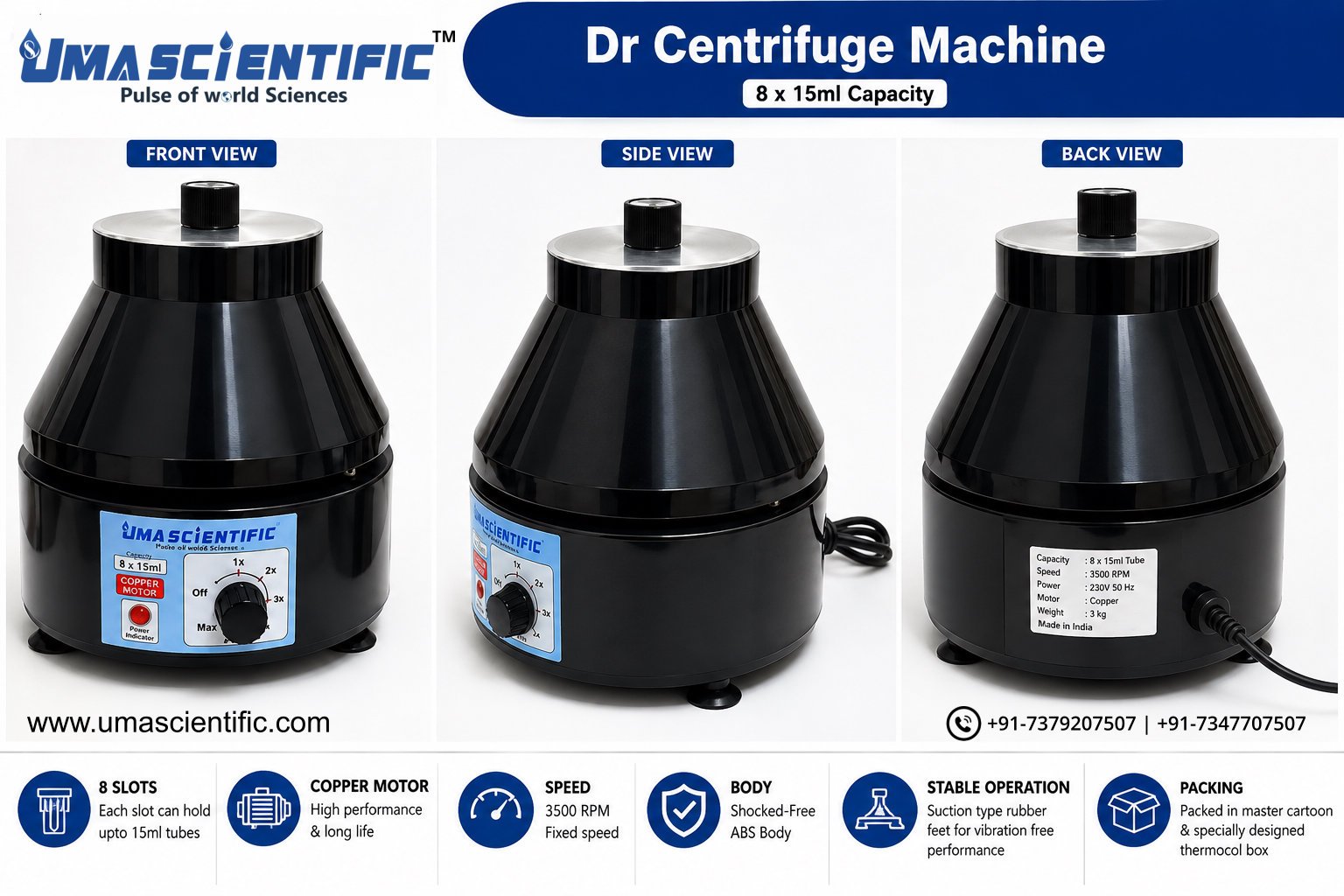
A laboratory centrifuge machine is one of the most widely used instruments in modern laboratories. It is designed to separate components of a liquid mixture by using centrifugal force. Centrifuges are essential in medical laboratories, pathology laboratories, pharmaceutical industries, biotechnology research centers, hospitals, universities, diagnostic laboratories, food-testing laboratories, chemical laboratories, and many other scientific environments.
A laboratory centrifuge is an electrical laboratory instrument used to separate substances based on differences in density.
The machine rotates sample tubes at a controlled speed. During rotation, centrifugal force causes denser particles or components to move outward and settle toward the bottom of the tube, while lighter components remain closer to the top.
The separation process depends on:
A centrifuge can therefore be used to prepare samples for further laboratory analysis.
For example, in a blood sample, centrifugation can help separate cellular components from the liquid portion of blood. In research laboratories, centrifuges may be used to collect cells, separate particles, prepare samples, and support numerous experimental procedures.
India has a growing laboratory equipment manufacturing sector, with manufacturers and suppliers providing centrifuges for laboratories throughout the country.
Uma Scientific is an Indian scientific and laboratory equipment company supplying laboratory instruments and equipment for different applications. Its product portfolio includes laboratory centrifuge machines along with other scientific instruments and liquid-handling products.
A professional laboratory equipment manufacturer should focus on:
For laboratories, hospitals, pharmaceutical companies, educational institutions, and distributors, buying from an experienced Indian manufacturer or supplier can simplify communication, procurement, service, and support.
The centrifuge shown is a compact laboratory model featuring an 8 × 15 mL capacity configuration.
The visible product features include:
The exact speed in RPM, rotor dimensions, timer specifications, electrical specifications, and maximum RCF should always be confirmed from the manufacturer’s technical datasheet for the particular model.
It is important not to assume RPM or RCF from a control marking alone. Laboratory centrifuge performance should be evaluated using the manufacturer’s published specifications.
The working principle of a centrifuge is based on centrifugal force.
When a sample tube is placed inside a rotating rotor, the sample moves in a circular path. As the rotor rotates, particles within the sample experience centrifugal acceleration.
Particles with greater density tend to move outward more rapidly than particles with lower density.
As a result, a mixture can gradually separate into different layers or fractions.
The general process is:
The exact procedure depends on the centrifuge model and laboratory application.
Centrifugal force is commonly used to describe the apparent outward force experienced by material rotating around an axis.
In laboratory centrifugation, rotational speed and rotor radius determine the centrifugal acceleration applied to a sample.
The relative centrifugal force is commonly expressed as RCF or ×g.
A simplified relationship is:
RCF = 1.118 × 10⁻⁵ × r × RPM²
where:
This formula shows why RPM alone does not fully describe centrifugation performance. Two centrifuges operating at the same RPM can generate different RCF values if their rotor radii are different.
Therefore, laboratories should consider both RPM and RCF when selecting a centrifuge for a specific application.
RPM means revolutions per minute.
It tells us how quickly the rotor is rotating.
RCF means relative centrifugal force.
It describes the centrifugal acceleration applied to the sample relative to Earth’s gravitational acceleration.
For laboratory work, RCF can often be a more useful parameter than RPM because it accounts for rotor radius.
When comparing centrifuges, laboratories should therefore check:
The appropriate centrifugation condition should always be selected according to the laboratory procedure and sample requirements.
A laboratory centrifuge consists of several important mechanical and electrical components.
The motor drives the rotor.
The centrifuge shown in the image is labeled with a copper motor.
Motor quality is important because it influences smooth operation, durability, and the ability of the centrifuge to maintain rotational performance.
The rotor is the rotating component that holds the centrifuge tubes.
Different centrifuges use different rotor configurations.
The model shown is designed for 8 × 15 mL tubes.
The rotor must be compatible with the tube size and intended operating conditions.
Tube holders keep sample tubes properly positioned during rotation.
Correct tube placement is essential for safe operation.
The speed-control mechanism allows the user to select the required operating speed according to the centrifuge’s design.
The illustrated model features a simple rotary control.
The actual RPM corresponding to each control position should be confirmed from the product specifications.
The power indicator shows that the instrument is receiving power.
This provides a simple visual indication during operation.
The outer housing protects internal components and provides structural support.
A robust housing also helps make the instrument suitable for routine laboratory environments.
The centrifuge lid provides access to the rotor while helping protect the operator during operation.
Users should never attempt to open a centrifuge while the rotor is still moving.
An 8 × 15 mL centrifuge is designed to accommodate eight centrifuge tubes with a nominal capacity of 15 mL, provided the correct rotor and compatible tubes are used.
This configuration can be useful for laboratories performing routine sample processing.
Typical applications can include:
The exact application depends on the sample type, tube type, speed requirement, and laboratory protocol.
15 mL centrifuge tubes are widely used because they provide a convenient intermediate volume for many laboratory applications.
They can be used for:
A centrifuge designed for 15 mL tubes can therefore be useful for laboratories that routinely process these sample volumes.
The centrifuge shown is marked with COPPER MOTOR.
Copper is widely used in electrical motor windings because of its electrical conductivity.
A motor is an important part of any centrifuge because it provides the rotational energy required to spin the rotor.
When selecting a centrifuge, buyers should evaluate the complete motor and drive system rather than considering the winding material alone.
Other important factors include:
There are many types of centrifuges, and the correct type depends on the application.
General-purpose centrifuges are designed for routine sample separation.
They are commonly used in:
Clinical centrifuges are designed for laboratory diagnostic applications.
They may be used for:
The exact requirements depend on the laboratory protocol.
Microcentrifuges are designed for small-volume tubes, commonly used in molecular biology and research.
Applications include:
High-speed centrifuges are designed to achieve higher rotational speeds and corresponding centrifugal forces.
They are used in applications where higher centrifugal force is required.
Users should always verify the maximum RPM and RCF before selecting a centrifuge.
Refrigerated centrifuges provide temperature control during centrifugation.
They are useful when samples are sensitive to heat generated during rotation or when protocols require controlled temperature.
Applications may include:
A benchtop centrifuge is designed to sit on a laboratory workbench.
The model shown is a compact laboratory-style centrifuge suitable for applications where a relatively small footprint is preferred.
Benchtop centrifuges are popular because they can provide useful centrifugation capability without requiring a large floor-standing instrument.
Blood centrifuges are used for separating components of blood samples.
Depending on the protocol, centrifugation can help separate:
The correct centrifuge speed, time, tube type, and handling procedure depend on the specific laboratory method.
Digital centrifuges use electronic controls and digital displays.
They may provide features such as:
These features can be useful when precise parameter setting is required.
Analog centrifuges use simple rotary controls or knobs.
The centrifuge shown is an example of a simple control configuration.
Such instruments can be useful for routine applications where a straightforward interface is preferred.
Laboratory centrifuges have a wide range of applications.
One of the best-known applications is separation of blood components.
After centrifugation, the sample can form different layers depending on the sample type and procedure.
Centrifugation can be used during sample preparation for serum or plasma analysis.
The exact procedure should follow the laboratory’s validated protocol.
Centrifuges can separate cells from liquid media.
This is common in:
Centrifugation is often part of molecular biology workflows.
It can help collect or separate material during nucleic acid extraction and sample preparation.
Centrifuges are used in various protein-related laboratory procedures.
Depending on the application, centrifugation may be used to remove particles, collect precipitates, or separate fractions.
Pharmaceutical laboratories use centrifuges for different sample preparation and research processes.
Applications can include:
Biotechnology laboratories use centrifuges for:
Centrifugation can be used to collect microbial cells or separate components of microbial samples.
Food laboratories may use centrifugation during:
Centrifugation can help process samples from environmental testing workflows.
A good laboratory centrifuge offers several benefits.
Centrifugation can separate sample components much faster than relying only on natural settling.
Controlled rotational conditions can provide more repeatable sample processing when the instrument is used correctly.
Benchtop centrifuges can fit conveniently into many laboratory environments.
One centrifuge can support a variety of laboratory procedures, depending on its rotor and specifications.
Models with straightforward controls can be easy to operate after appropriate training.
Centrifugation can reduce the time required for certain separation procedures.
Safety is one of the most important considerations when operating a centrifuge.
Follow the manufacturer’s instructions and laboratory SOPs.
General safety practices include:
Balancing is one of the most important operating procedures.
A centrifuge rotor spins at high speed. If the sample tubes are not balanced, uneven forces can develop.
Incorrect balancing may cause:
For an 8-position rotor, users should follow the manufacturer’s instructions for loading samples symmetrically.
If only some positions are occupied, suitable balancing tubes or equivalent balancing arrangements may be required depending on the rotor design and manufacturer instructions.
Suppose four tubes are being centrifuged in an eight-position rotor.
The tubes should generally be arranged symmetrically around the rotor.
The total mass of opposing positions should be appropriately matched according to the manufacturer’s instructions.
The goal is to maintain rotational balance.
Never assume that simply placing tubes in visually opposite positions is sufficient if the tube masses differ significantly.
An unbalanced centrifuge can vibrate significantly.
Minor imbalance may create noise and reduce smooth operation.
More serious imbalance can damage:
It can also create a potential safety risk.
Therefore, balancing should always be treated as a standard operating step rather than an optional procedure.
The centrifuge tube is another important part of the centrifugation system.
Users should select tubes that are compatible with:
A 15 mL centrifuge should not automatically be assumed to accept every type of 15 mL tube. Tube dimensions and rotor compatibility should be checked.
The required speed depends on the laboratory procedure.
Higher speed does not automatically mean better separation.
An excessive speed can:
The appropriate speed should be based on the validated laboratory protocol and the centrifuge’s rated performance.
Centrifugation time is another important parameter.
A procedure may require:
The appropriate duration depends on:
Users should follow the validated method rather than selecting a time simply because it is convenient.
Some centrifugation processes are sensitive to temperature.
A standard laboratory centrifuge may operate at ambient temperature, while refrigerated centrifuges provide active temperature control.
If a sample is temperature-sensitive, the laboratory should determine whether a refrigerated centrifuge is necessary.
Examples of temperature-sensitive applications may include certain:
Regular maintenance helps keep the instrument operating reliably.
After use:
The rotor should be inspected regularly.
Look for:
A damaged rotor should not be used.
The motor should be checked if the centrifuge develops:
Any electrical or mechanical repair should be performed by qualified service personnel.
Cleaning requirements depend on the sample type and laboratory environment.
For routine cleaning:
Do not use chemicals that can damage the rotor or housing.
Depending on the model, laboratory centrifuges may incorporate different safety features.
Possible safety features include:
The exact safety features vary by model.
The pictured centrifuge includes a protective housing and power indicator. Buyers should confirm additional safety features from the manufacturer’s datasheet.
Choosing the best centrifuge requires understanding the laboratory’s actual requirements.
Do you need:
The rotor must match the tube format.
If a laboratory processes eight 15 mL samples at a time, an 8 × 15 mL centrifuge may be suitable.
If the workload is larger, a higher-capacity rotor may be required.
Do not select a centrifuge based only on appearance or RPM.
Check the required RCF for your procedure.
For temperature-sensitive samples, a refrigerated centrifuge may be more suitable.
Consider whether the laboratory needs:
Some applications require precise centrifugation times.
Choose a model with a suitable timer if required.
Motor construction and drive design should be evaluated along with reliability, serviceability, and manufacturer support.
Benchtop models are useful where workspace is limited.
A suitable warranty can provide additional confidence.
Availability of service and spare parts should be considered before purchasing.
The price of a laboratory centrifuge in India depends on many factors.
These include:
A compact 8 × 15 mL centrifuge will generally have different pricing from a high-capacity refrigerated laboratory centrifuge.
For accurate current pricing, customers should request a quotation based on the exact model and required configuration.
Purchasing from an Indian manufacturer or established supplier can provide several practical advantages.
Communication is generally easier for Indian customers.
Domestic supply can reduce some import-related delays.
Local manufacturers and suppliers may provide easier access to replacement components.
Warranty claims can often be managed directly within the domestic market.
Bulk customers may be able to discuss specific requirements.
Indian manufacturing can provide cost-effective solutions for laboratories.
Uma Scientific is based in Lucknow, Uttar Pradesh, and supplies laboratory and scientific equipment to customers in India.
The company serves laboratory equipment requirements across multiple sectors, including:
Its laboratory equipment portfolio includes centrifuge machines and other scientific instruments.
For customers in Uttar Pradesh and across India, working with a local Indian laboratory equipment company can make procurement and communication easier.
A reliable supplier should provide clear information regarding:
Customers should request a technical datasheet before purchasing if the centrifuge is intended for a specialized application.
Hospitals and clinical laboratories require reliable equipment for sample preparation.
Centrifuges can support:
The selected centrifuge should match the laboratory’s approved procedures and safety requirements.
Pathology laboratories frequently process multiple samples.
An 8 × 15 mL centrifuge can be useful for laboratories that routinely work with compatible 15 mL tubes.
Important considerations include:
Pharmaceutical laboratories use centrifugation in research, sample preparation, quality control, and analytical workflows.
Depending on the procedure, centrifugation may be used to:
The centrifuge should be selected according to the specific method.
Biotechnology laboratories frequently use centrifuges in:
The appropriate centrifuge depends on sample volume and required centrifugal force.
Universities, colleges, and educational laboratories can use centrifuges for teaching and practical experiments.
Students can learn:
Compact centrifuges can be especially useful in teaching laboratories because they occupy less bench space.
Research laboratories often require flexible centrifugation capabilities.
Depending on the research, they may need:
A general-purpose centrifuge can support many routine research workflows.
Diagnostic laboratories require dependable sample processing.
Centrifugation may be incorporated into diagnostic workflows involving:
The centrifuge should always be operated according to the diagnostic procedure and laboratory SOP.
Possible causes:
Solution:
Stop the centrifuge and inspect the setup. Do not continue operation if the cause of vibration is unknown.
Possible causes include:
The instrument should be inspected before continued use.
Possible causes may include:
Check the manufacturer’s troubleshooting procedure.
Possible causes may include:
Review the laboratory procedure and centrifuge specifications.
Proper handling can help extend equipment life.
Never exceed the rated speed.
Proper balancing reduces mechanical stress.
Clean contamination promptly.
Cracked tubes can cause leakage and may create safety issues.
Regularly check for corrosion or damage.
Use only compatible tubes, adapters, and holders.
Follow the manufacturer’s recommended maintenance schedule.
Preventive maintenance can identify problems before they become major failures.
A maintenance program may include:
Laboratories with critical workflows should establish documented maintenance procedures.
Rotor life depends on:
Some rotors have manufacturer-defined service lives or inspection requirements.
Always follow the rotor manufacturer’s instructions.
Not every rotor fits every centrifuge.
Before purchasing a rotor or accessory, check:
Using an incompatible rotor or tube can be unsafe.
Quality control is important when centrifuges are used in regulated or critical laboratory environments.
Laboratories may establish procedures for:
The exact requirements depend on the laboratory’s quality system and applicable standards.
A standard laboratory centrifuge is designed for routine sample separation.
An ultracentrifuge is designed for extremely high centrifugal forces and specialized research applications.
Ultracentrifuges are commonly associated with advanced molecular and biochemical research.
A routine 8 × 15 mL laboratory centrifuge should not be considered an ultracentrifuge.
The appropriate equipment depends on the required RCF and application.
A microcentrifuge is designed for small-volume tubes such as microcentrifuge tubes.
A general laboratory centrifuge may accommodate larger tubes, such as the 15 mL tubes used by the pictured model.
The choice depends on the sample volume and application.
Clinical centrifuges are often designed specifically for healthcare and diagnostic workflows.
General laboratory centrifuges may be designed for broader research and sample-preparation applications.
The correct choice depends on:
A premium centrifuge should be evaluated comprehensively.
Important features can include:
A premium instrument is not necessarily the one with the highest speed. It is the one that appropriately meets the laboratory’s requirements while providing reliable and safe operation.
For routine daily use, laboratories often prefer equipment that is:
An 8 × 15 mL configuration can be practical for laboratories that process a moderate number of samples at a time.
Capacity determines how many samples can be processed in one run.
Higher capacity can improve productivity when many samples need processing.
However, larger capacity can also increase equipment size and cost.
Therefore, laboratories should choose capacity based on actual workload.
An 8 × 15 mL centrifuge may be suitable when:
A larger centrifuge may be more appropriate when:
Before purchasing a centrifuge, consider the following:
This checklist can help laboratories compare different models systematically.
If you are searching for a laboratory centrifuge machine for sale in India, compare models based on technical requirements rather than price alone.
The pictured 8 × 15 mL copper motor centrifuge is a compact option for laboratories requiring a compatible 15 mL tube configuration.
Before ordering, customers should confirm:
For bulk orders, distributors and institutions can request commercial quotations based on required quantities.
Wholesale centrifuge supply can be useful for:
Bulk customers should discuss:
A manufacturer or wholesale supplier can recommend suitable models according to the customer’s market and application.
OEM manufacturing allows businesses to sell laboratory centrifuges under their own brand, subject to manufacturer capabilities and commercial terms.
OEM requirements can include:
OEM customers should clearly define specifications before production.
The growth of Indian scientific manufacturing is creating more opportunities for laboratories to source equipment domestically.
A Made-in-India laboratory centrifuge can provide benefits such as:
The most important consideration remains product suitability, quality, safety, and reliable manufacturer support.
Uma Scientific is an Indian laboratory and scientific equipment company based in Lucknow, Uttar Pradesh.
The company works with laboratories, institutions, distributors, dealers, and other scientific equipment customers.
Its product categories include laboratory instruments such as:
The company also offers products under the LABOLIT brand for selected laboratory liquid-handling applications.
For customers searching for laboratory equipment suppliers in India, Uma Scientific provides a range of products for routine and professional laboratory use.
Laboratory equipment is directly connected with the quality of laboratory work.
A centrifuge that operates inconsistently can affect sample preparation.
Therefore, laboratories should prioritize:
The machine is only one part of the process. Correct operating procedures are equally important.
Every laboratory should ensure that operators understand:
Proper training can reduce equipment damage and improve laboratory safety.
Modern laboratories require instruments that combine efficiency, reliability, safety, and ease of use.
Although centrifugation is an established laboratory technique, centrifuges remain essential because sample separation continues to be a fundamental part of laboratory workflows.
From routine pathology testing to advanced biotechnology research, centrifuges support thousands of laboratory procedures.
Centrifuge technology continues to evolve.
Future developments may include:
The specific features available depend on the manufacturer and centrifuge category.
A laboratory centrifuge is an instrument that separates sample components using centrifugal force generated by a rotating rotor.
It is a centrifuge designed to accommodate eight compatible centrifuge tubes with a nominal capacity of 15 mL.
Centrifuges are used for sample separation, serum and plasma preparation, cell collection, sample processing, research, and many other laboratory applications.
RPM describes how fast the rotor spins, while RCF describes the relative centrifugal force generated by the rotor.
Balancing reduces vibration and mechanical stress and helps maintain safe, stable operation.
Not necessarily. The tube must be compatible with the specific rotor and centrifuge specifications.
Copper is commonly used in motor windings because of its electrical conductivity. However, overall centrifuge performance depends on the complete motor, drive, rotor, mechanical design, and manufacturing quality.
The best centrifuge depends on the laboratory’s tube size, capacity, required RCF, speed, sample type, workload, and procedure.
Service life depends on construction, usage, maintenance, rotor condition, operating conditions, and manufacturer quality. Proper maintenance can help extend working life.
The permissible operating cycle depends on the specific model and manufacturer instructions. Users should follow the recommended duty cycle.
Common causes include incorrect balancing, damaged tubes, rotor problems, improper installation, or mechanical faults.
Tubes should be arranged symmetrically with appropriate matching mass according to the manufacturer’s rotor instructions.
The rotor holds the sample tubes and transfers rotational force from the motor to the samples.
A benchtop centrifuge is designed to operate on a laboratory workbench and generally has a compact footprint.
It is necessary only when the laboratory procedure requires temperature control or the sample is sensitive to temperature changes during centrifugation.
Select the speed based on the laboratory protocol and required RCF. Never exceed the centrifuge’s rated maximum speed.
The 8 × 15 mL laboratory centrifuge with copper motor shown in this article is a compact configuration designed for compatible 15 mL centrifuge tubes. Its simple operating design, adjustable control, power indicator, and laboratory-oriented construction make this type of centrifuge useful for routine applications.
When purchasing a centrifuge, laboratories should look beyond price and consider:
Correct operation is equally important. Proper tube balancing, suitable sample containers, correct speed selection, routine cleaning, and regular inspection all contribute to safe and reliable centrifugation.
A well-selected centrifuge can improve laboratory workflow, make sample processing more efficient, and provide reliable support for routine laboratory procedures.
Whether you require an 8 × 15 mL centrifuge, clinical centrifuge, laboratory benchtop centrifuge, research centrifuge, or another centrifugation solution, always select the model according to your specific sample type, tube size, capacity, RCF, speed, and laboratory procedure.
For product specifications, current pricing, bulk orders, dealer enquiries, OEM requirements, and laboratory equipment supply, contact:
Uma Scientific
Lucknow, Uttar Pradesh, India
#LaboratoryCentrifuge #CentrifugeMachine #CentrifugeMachineIndia #LaboratoryEquipment #ScientificEquipment #LabEquipment #LaboratoryInstruments #CentrifugeManufacturer #CentrifugeSupplier #UmaScientific #MadeInIndia #PathologyLab #ResearchLaboratory #PharmaceuticalLaboratory #DiagnosticLaboratory #MedicalLaboratory #Biotechnology #LaboratoryScience #LabMachine #ScientificInstruments
