

Leading Micropipette & Scientific Lab, Medical instrument Manufacturer and Deler A Legacy Of Scientific Precision .



Leading Micropipette & Scientific Lab, Medical instrument Manufacturer and Deler A Legacy Of Scientific Precision .
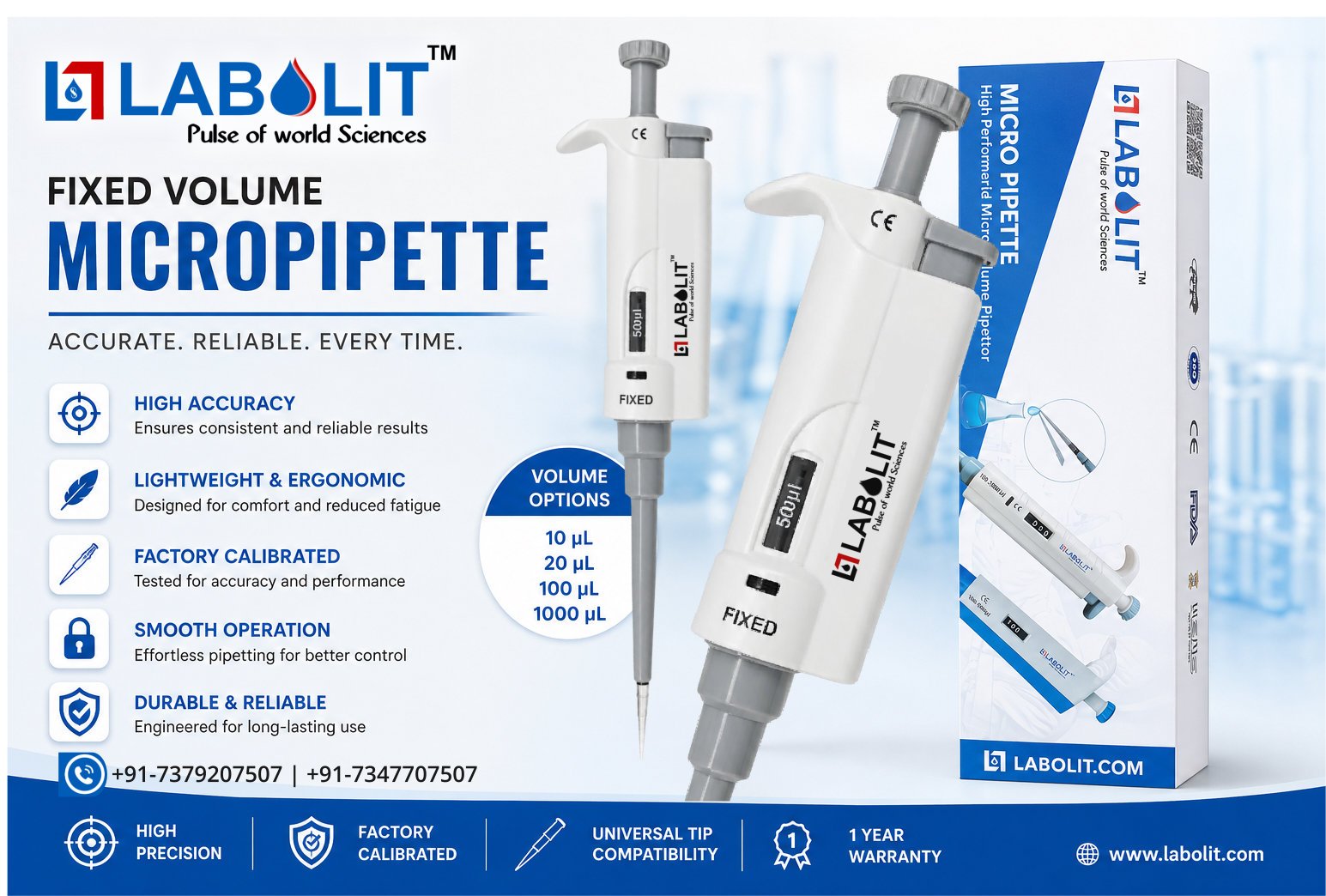
Fixed volume micropipettes are widely used in pharmaceutical laboratories, biotechnology laboratories, research institutions, hospitals, pathology laboratories, diagnostic centers, microbiology laboratories, molecular biology laboratories, food testing laboratories, chemical laboratories, educational institutions, environmental testing laboratories and industrial quality-control laboratories.
Fixed volume micropipettes can be particularly useful when a laboratory repeatedly dispenses the same volume. Because the volume is predetermined, there is no routine volume adjustment during operation, which can simplify repetitive workflows and reduce the possibility of accidental volume changes.
For example, a fixed volume micropipette may be manufactured for:
The exact available volumes depend on the manufacturer’s product range.
The main characteristic of a fixed volume micropipette is that the user does not routinely adjust the volume before every pipetting operation. The instrument is configured for its designated volume.
This makes fixed volume pipettes especially useful in standardized procedures where the same liquid volume is repeatedly transferred.
LABOLIT™ is a laboratory equipment brand associated with Uma Scientific, an Indian scientific equipment manufacturer and supplier.
The company supplies laboratory liquid-handling products for customers including:
A customer searching for a fixed volume micropipette manufacturer in India should evaluate not only price but also product construction, calibration, accuracy, precision, ergonomics, tip compatibility, documentation, warranty and after-sales support.
LABOLIT fixed volume micropipettes are positioned as practical liquid-handling solutions for laboratories requiring repeatable dispensing of predetermined volumes.
Many laboratories perform repetitive procedures where the same volume is transferred hundreds or thousands of times.
In such situations, a fixed volume micropipette can provide several practical benefits.
The pipette is designed for a predetermined volume, helping maintain standardized laboratory procedures.
The user does not need to adjust the volume for every pipetting operation.
Because there is no routine volume-setting process, the possibility of accidentally selecting an incorrect volume can be reduced.
Fixed volume micropipettes can be particularly convenient for repetitive workflows.
A properly calibrated and maintained pipette can provide repeatable liquid transfer.
Fixed volume instruments can be straightforward for laboratory personnel to understand and operate.
Where a laboratory protocol repeatedly specifies one volume, a fixed volume micropipette can be an appropriate choice.
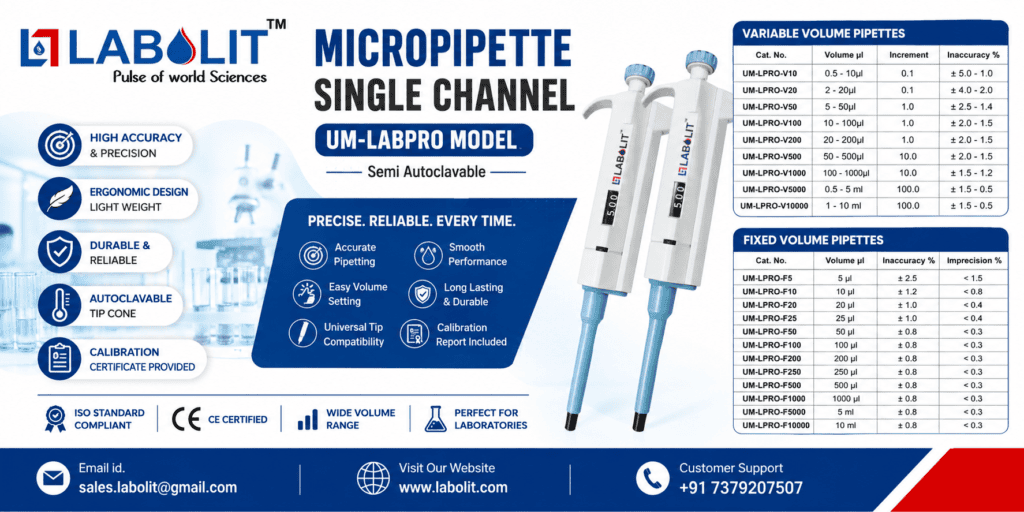
Understanding the difference between fixed and variable volume micropipettes is important before purchasing laboratory liquid-handling equipment.
A fixed volume micropipette is designed for one predetermined volume.
For example:
It is useful when the same volume is repeatedly required.
A variable volume micropipette allows the operator to select a volume within a specified range.
For example:
It is useful when multiple volumes are required.
Choose a fixed volume micropipette when:
Choose a variable volume micropipette when:
Both types have important applications in professional laboratories.
Many laboratory micropipettes operate using a piston-based air-displacement principle.
The instrument contains a piston mechanism that changes the air volume inside the pipette system.
During aspiration:
During dispensing:
The exact mechanism can vary depending on the pipette design.
For critical laboratory applications, operators should follow the manufacturer’s recommended pipetting technique.
A modern fixed volume micropipette consists of several important components.
The plunger controls aspiration and dispensing.
The piston is responsible for changing the internal air volume.
The tip cone provides the connection between the micropipette and compatible pipette tip.
The tip ejector allows the used disposable tip to be removed.
The handle provides the main gripping surface for the operator.
A finger rest can improve support and comfort during repetitive use.
O-rings, seals and other internal components contribute to the performance of the pipetting mechanism.
A fixed volume pipette normally identifies its designated volume through labeling or marking.
LABOLIT fixed volume micropipettes are designed for laboratories requiring standardized liquid transfer.
The product concept focuses on:
The appropriate model should be selected according to the required volume and laboratory procedure.
Different laboratory applications require different predetermined volumes.
Common fixed-volume options may include:
Suitable for small-volume laboratory applications where a standardized 5 µL transfer is required.
A popular choice for repetitive small-volume laboratory procedures.
Useful for standardized laboratory workflows involving 20 µL liquid transfer.
Suitable for routine liquid handling requiring a 50 µL volume.
One of the commonly used fixed-volume options for research and laboratory applications.
Suitable for standardized procedures involving 200 µL transfer.
Useful for larger-volume liquid transfer within laboratory workflows.
Designed for standardized transfer of 1 mL laboratory liquid volumes, subject to the specific pipette design and operating instructions.
Actual available volume models should be confirmed with the manufacturer.
Fixed-volume operation is useful when the same volume must be transferred repeatedly.
A comfortable grip can help reduce operator fatigue during repetitive pipetting.
The designated volume is clearly associated with the instrument.
The operator does not need to repeatedly change the volume.
The instrument is designed for routine laboratory use.
Compatible disposable tips can help reduce cross-contamination risks when replaced according to laboratory procedures.
A dedicated tip-ejection mechanism can make routine use more convenient.

Fixed volume micropipettes are used in a wide variety of scientific and laboratory applications.
Pharmaceutical laboratories perform highly standardized testing and research procedures.
Fixed volume micropipettes can be useful for:
Pharmaceutical laboratories often require equipment that supports repeatable procedures and documented quality systems.
Biotechnology laboratories frequently handle small quantities of biological samples and reagents.
Potential applications include:
When a particular protocol repeatedly requires the same volume, a fixed volume micropipette can be convenient.
Molecular biology laboratories often perform procedures requiring controlled transfer of small liquid quantities.
Applications can include:
The pipette selected should match the required volume and application.
Diagnostic laboratories perform standardized liquid-handling procedures as part of various testing workflows.
Fixed volume micropipettes can be useful where a procedure repeatedly specifies one predetermined liquid volume.
Applications may include:
The specific suitability depends on the diagnostic procedure and laboratory protocol.
Pathology laboratories handle biological samples and reagents in controlled laboratory environments.
A fixed volume pipette may be useful for repetitive liquid-transfer procedures where a defined volume is required.
Research laboratories often conduct experiments requiring repeatable liquid handling.
Fixed volume pipettes can be valuable for experiments where a single standardized volume is used repeatedly.
They can be found in:
Microbiology laboratories can use micropipettes for transferring reagents, samples and prepared solutions.
Fixed volume instruments can simplify procedures where a standardized liquid volume is repeatedly required.
Food and beverage testing laboratories conduct chemical, microbiological and analytical tests.
Micropipettes may be used for controlled transfer of:
The required pipette volume should be selected according to the specific test method.
Chemical laboratories use micropipettes for controlled transfer of suitable laboratory liquids.
The compatibility of the pipette materials with the liquid should always be evaluated before use, particularly when working with aggressive or chemically reactive substances.
Environmental laboratories analyze water, soil and other environmental samples.
Micropipettes can support:
Schools, colleges and universities use laboratory pipettes to teach students practical laboratory techniques.
Fixed volume pipettes can be useful for:
Hospital laboratories may use micropipettes in clinical, diagnostic and research workflows.
The selected instrument should be appropriate for the specific procedure, required volume and laboratory quality system.
Government laboratories, public research organizations and educational institutions may use micropipettes for standardized laboratory procedures.
Procurement requirements can include:
Customers should communicate their exact technical requirements to the supplier before ordering.
Accuracy is one of the most important factors when selecting a laboratory micropipette.
Accuracy can be affected by:
Precision refers to the consistency of repeated measurements.
For example, if a pipette repeatedly dispenses very similar volumes under controlled conditions, it demonstrates good repeatability.
Precision is important in:
A fixed volume design can be advantageous in repetitive applications because the intended volume remains standardized.
Calibration is an important aspect of professional micropipette management.
Calibration helps determine whether the instrument is performing within the required tolerance.
Laboratories may use appropriate calibration procedures based on:
Calibration can involve repeated measurements under controlled conditions.
For regulated laboratories, documentation and traceability requirements may be especially important.
Laboratories purchasing micropipettes for quality-sensitive applications should review the manufacturer’s technical specifications and available calibration documentation.
Fixed volume micropipettes can be calibrated or tested during manufacturing before being supplied to customers.
Factory calibration can help establish the performance of the instrument under defined conditions.
Customers requiring calibration documentation should specify this requirement during procurement.
For highly controlled laboratory environments, users should maintain an appropriate calibration and verification program after purchase.
Correct pipetting technique is essential for reliable results.
Select the fixed volume micropipette corresponding to the required volume.
Use a suitable disposable tip compatible with the pipette.
Firmly attach the tip without damaging the tip cone.
Press the plunger to the recommended position according to the pipette design.
Place the tip into the liquid at the appropriate depth.
Release the plunger smoothly and allow the liquid to enter the tip.
Transfer the pipette tip carefully to the destination vessel.
Press the plunger smoothly according to the manufacturer’s instructions.
Use the tip ejector to remove the used disposable tip.
Store the pipette safely when not in use.
Even a good micropipette can produce inconsistent results if it is not used correctly.
An unsuitable tip can affect liquid handling.
Rapid or uncontrolled plunger movement can affect aspiration and dispensing.
The tip should be immersed appropriately according to the liquid and pipette procedure.
Avoid contact with unintended surfaces.
Impact can damage internal mechanisms.
Store the instrument in an appropriate position and environment.
Laboratories requiring high accuracy should maintain a calibration program.
Regular maintenance can help maintain pipette performance and extend its service life.
Recommended maintenance practices include:
Cleaning procedures should follow the manufacturer’s instructions.
The external surfaces can generally be cleaned using a suitable laboratory-approved cleaning method.
For internal cleaning or disassembly, laboratory personnel should follow the manufacturer’s instructions or use qualified service support.
Improper disassembly can damage the pipette or affect calibration.
Some micropipette models or specific components are designed to withstand autoclaving.
However, not every pipette should be autoclaved.
Before autoclaving, users should confirm:
The manufacturer’s instructions should always take priority.
Pipette tips are an important part of the liquid-handling system.
A high-quality micropipette can still perform poorly if the tip does not fit properly or is unsuitable for the application.
Compatible tips should provide:
For contamination-sensitive applications, sterile or filtered tips may be appropriate depending on the laboratory procedure.
LABOLIT micropipettes should be used with tips suitable for the particular model.
Before purchasing tips, customers should check:
Using suitable tips helps support consistent laboratory operation.
Laboratory personnel may perform hundreds of pipetting cycles during a working day.
Ergonomic design can therefore be important.
Features that may improve comfort include:
Ergonomics are particularly important in high-frequency laboratory workflows.
One of the strongest applications of a fixed volume micropipette is repetitive liquid transfer.
Consider a laboratory procedure that requires 100 µL to be dispensed repeatedly.
A 100 µL fixed volume pipette eliminates the need to reset the volume before each transfer.
This can make the workflow straightforward and help standardize the process.
For laboratories where multiple different volumes are used throughout the day, variable volume pipettes may be more suitable.
Quality-control laboratories depend on standardized laboratory processes.
Fixed volume micropipettes can support repetitive liquid-handling procedures in:
The instrument should be maintained and verified according to the laboratory’s quality requirements.
Research and development laboratories often perform experiments where consistent liquid handling is essential.
Applications can include:
A fixed volume micropipette can be useful when an experiment repeatedly requires a standardized volume.
PCR and molecular biology workflows can involve very small liquid volumes.
A suitable fixed volume micropipette can be useful for repetitive transfers where a specific volume is repeatedly required.
For molecular applications, laboratories should consider:
Fixed volume pipettes can be used for certain microplate workflows when one standardized volume is repeatedly transferred.
For high-throughput microplate applications involving simultaneous transfer into multiple wells, multichannel pipettes may provide greater efficiency.
Standardization is important in scientific work.
Using designated fixed-volume instruments for specific protocols can help laboratories establish repeatable workflows.
For example:
This approach can reduce routine volume-setting requirements.
Choosing the right manufacturer is important for long-term laboratory use.
Customers should consider:
Review the product construction, materials and manufacturing quality.
Ask about calibration procedures and available documentation.
Confirm whether the manufacturer provides the required fixed volume.
Confirm compatible pipette tips.
Review warranty duration and conditions.
Consider service and technical support availability.
For distributors and institutions, confirm production and supply capacity.
Businesses requiring private labeling should discuss OEM options.
Request relevant product specifications and quality documents.
The price of a fixed volume micropipette depends on several factors.
These may include:
A laboratory should not select a pipette based only on the lowest price.
The total value should consider:
Product quality + performance + calibration + warranty + service + tip compatibility + long-term usability.
For current prices, customers can contact Uma Scientific with the required volume and quantity.
Bulk buyers may include:
Bulk orders should specify:
OEM manufacturing is useful for businesses that want laboratory products under their own brand.
OEM requirements may include:
Uma Scientific can discuss OEM requirements based on product model, quantity and customization requirements.
OEM buyers should finalize technical specifications, branding, packaging, minimum order quantity and quality requirements before placing an order.
Laboratory equipment distributors require reliable products that can be supplied consistently.
LABOLIT fixed volume micropipettes can be considered for distributor networks serving:
Distributors can select volume-specific models according to the demand of their customers.
Laboratory equipment demand exists throughout India.
LABOLIT fixed volume micropipettes can be promoted for customers across:
Major scientific and industrial markets include:
Mumbai, Pune, Ahmedabad, Vadodara, Surat, Bengaluru, Chennai, Hyderabad, Delhi, Gurugram, Noida, Kolkata, Jaipur, Lucknow, Kanpur, Agra, Varanasi, Indore, Bhopal, Nagpur, Nashik, Chandigarh, Kochi, Thiruvananthapuram, Coimbatore, Madurai, Visakhapatnam, Vijayawada, Bhubaneswar, Patna, Ranchi, Guwahati, Raipur, Dehradun and many other cities.
Uma Scientific is based in Lucknow, Uttar Pradesh, making Uttar Pradesh an important market for LABOLIT laboratory products.
Customers across Uttar Pradesh can source laboratory micropipettes for:
Major UP markets include:
Lucknow, Kanpur, Noida, Greater Noida, Ghaziabad, Agra, Varanasi, Prayagraj, Meerut, Bareilly, Moradabad, Aligarh, Gorakhpur, Mathura, Saharanpur, Muzaffarnagar, Jhansi, Firozabad, Ayodhya, Rae Bareli, Sitapur, Unnao, Barabanki, Sultanpur, Jaunpur, Azamgarh, Mirzapur, Ghazipur, Bareilly, Rampur and other cities.
Maharashtra has a large pharmaceutical, healthcare, research and industrial laboratory market.
LABOLIT products can be promoted in:
Gujarat is a major pharmaceutical and chemical manufacturing state.
Important markets include:
Pharmaceutical and chemical clusters create demand for laboratory liquid-handling equipment.
Karnataka is one of India’s major biotechnology and research markets.
Major cities include:
Bengaluru is particularly important for biotechnology, research and laboratory equipment.
Tamil Nadu has major pharmaceutical, healthcare, industrial and educational laboratory markets.
Important cities include:
Telangana has a strong pharmaceutical and biotechnology industry.
Major markets include:
Hyderabad is one of India’s important pharmaceutical and biotechnology hubs.
Major Kerala markets include:
LABOLIT fixed volume micropipettes can be used in healthcare, pharmaceutical, academic and research laboratories across Kerala.
Major markets include:
Major markets include:
Major markets include:
Important markets include:
Important markets include:
Important markets include:
Major markets include:
Major markets include:
Major markets include:
Major markets include:
Major markets include:
Important markets include:
Baddi is a significant pharmaceutical manufacturing location and therefore an important market for laboratory equipment.
Major markets include:
Major markets include:
Major markets include:
Laboratory equipment dealers can offer fixed volume micropipettes to local laboratories, educational institutions, healthcare facilities and industrial customers.
A distributor should maintain a product portfolio containing different fixed volumes because customers may require different predetermined volumes.
A professional distributor should also be able to provide:
OEM customers may need fixed volume micropipettes under their own brand.
Important OEM requirements include:
OEM buyers should communicate all requirements before manufacturing begins.
Customers can simplify the quotation process by providing:
Product: Fixed Volume Micropipette
Required Volume: For example 10 µL / 20 µL / 100 µL / 200 µL / 1000 µL
Quantity: Required number of pieces
Application: Research / pharmaceutical / diagnostic / educational / industrial
Location: Delivery city and state
Calibration: Required or not
OEM: Required or standard LABOLIT branding
Packaging: Standard or customized
This information allows the supplier to prepare an appropriate quotation.
Before purchasing, laboratories should evaluate:
Is the required fixed volume available?
Does the manufacturer provide appropriate performance specifications?
Is repeatability documented?
Is calibration available or documented?
Are compatible tips easily available?
Is the pipette comfortable for repetitive use?
Are the materials suitable for the intended laboratory environment?
Can the instrument be serviced and maintained?
What warranty is provided?
Is support available after purchase?
Are technical specifications and relevant certificates available?
Micropipettes should be used according to laboratory safety procedures.
Important practices include:
Accurate liquid handling is essential in modern laboratories.
Even small volume differences can influence certain experimental or analytical results.
For this reason, laboratories should combine:
A high-quality micropipette is one part of the complete liquid-handling system.
LABOLIT™ provides laboratory liquid-handling products designed for customers seeking practical and dependable laboratory equipment.
Key reasons laboratories may consider LABOLIT include:
Customers should select the specific LABOLIT model according to their required volume, application and technical specifications.
A fixed volume micropipette is a laboratory pipette designed to dispense one predetermined volume.
Fixed micropipettes are designed for one volume, while variable micropipettes allow the volume to be adjusted within a specified range.
They are particularly useful for repetitive laboratory procedures requiring the same volume.
A properly manufactured, calibrated and correctly operated micropipette can provide accurate and repeatable liquid handling within its specified performance limits.
Yes. Fixed volume micropipettes can be calibrated or verified according to appropriate procedures.
Yes. The pipette is reusable when properly maintained. Disposable tips are normally replaced between appropriate samples or procedures.
Some models or components may be autoclavable. Always check the manufacturer’s instructions before autoclaving.
The best model depends on the required volume, application, accuracy requirements, tip compatibility, ergonomics, calibration and budget.
Yes, bulk procurement can be discussed with the manufacturer or supplier based on volume, quantity and delivery requirements.
OEM availability depends on the manufacturer, product model, quantity and branding requirements.
Availability depends on the manufacturer’s product range. Common fixed volumes include 10 µL, 20 µL, 50 µL, 100 µL, 200 µL, 500 µL and 1000 µL.
LABOLIT is a laboratory equipment brand associated with Uma Scientific.
Uma Scientific is based in Lucknow, Uttar Pradesh, India.
When selecting a fixed volume micropipette, laboratories should first determine the exact volume required by their protocol.
The next considerations should include:
A fixed volume micropipette is particularly valuable where laboratory processes require repeated transfer of the same volume. By eliminating routine volume adjustment, it can simplify standardized workflows and make repetitive liquid handling more convenient.
LABOLIT fixed volume micropipettes from Uma Scientific are designed to address the needs of research, pharmaceutical, biotechnology, healthcare, diagnostics, education and industrial laboratories.
A Fixed Volume Micropipette is an important laboratory instrument for standardized and repeatable liquid handling. Its predetermined volume makes it particularly suitable for laboratory procedures where the same volume must be transferred repeatedly.
Compared with variable volume micropipettes, fixed volume models can simplify operation because the user does not need to adjust the volume for every pipetting cycle. This makes them useful in repetitive research, pharmaceutical, diagnostic, biotechnology, microbiology, molecular biology, food testing, chemical and educational applications.
LABOLIT™, associated with Uma Scientific, offers laboratory micropipette solutions for customers across India. The product range can serve laboratories, institutions, pharmaceutical companies, research organizations, hospitals, diagnostic centers, dealers, distributors and OEM customers.
Whether you are searching for a Fixed Volume Micropipette Manufacturer in India, Fixed Volume Micropipette Supplier, Fixed Volume Micropipette Exporter, Laboratory Micropipette Manufacturer, Fixed Volume Pipette Manufacturer, Micropipette Manufacturer in Lucknow, Micropipette Supplier in Delhi, Micropipette Supplier in Mumbai, Micropipette Supplier in Bengaluru, Micropipette Supplier in Hyderabad, Micropipette Supplier in Chennai, Micropipette Supplier in Ahmedabad, Micropipette Supplier in Pune, Micropipette Supplier in Kolkata, or a Micropipette Supplier anywhere in India, LABOLIT can be considered for professional laboratory liquid-handling requirements.
For current product specifications, available fixed volumes, pricing, bulk quantities, OEM requirements, calibration documentation and delivery information, customers should contact Uma Scientific – LABOLIT.
LABOLIT™ – Pulse of World Sciences
Manufacturer & Supplier: Uma Scientific
Brand: LABOLIT™
Product: Fixed Volume Micropipette
Website: www.labolit.com
