

Leading Micropipette & Scientific Lab, Medical instrument Manufacturer and Deler A Legacy Of Scientific Precision .



Leading Micropipette & Scientific Lab, Medical instrument Manufacturer and Deler A Legacy Of Scientific Precision .
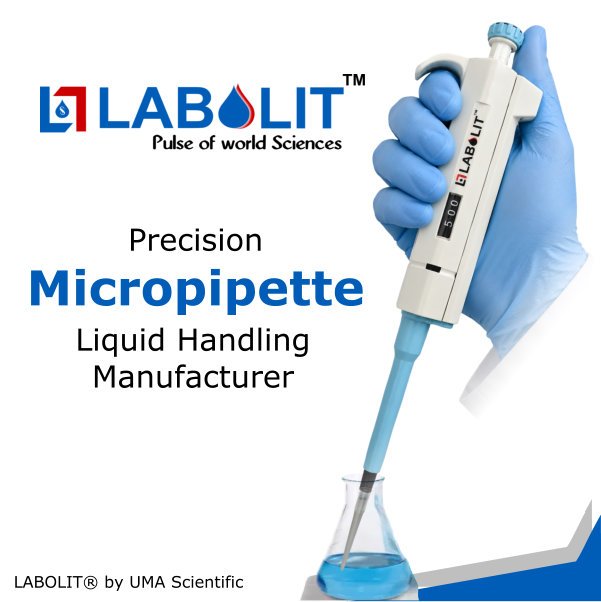
When working with microlitre-level samples, even a small variation in liquid volume can influence experimental results. Therefore, laboratories require micropipettes that provide accuracy, precision, consistency, durability, ergonomic operation, and reliable performance.
This comprehensive guide explains micropipette types, working principles, volume ranges, applications, important features, calibration, maintenance, OEM manufacturing, quality considerations, selection guidelines, and why choosing a reliable laboratory micropipette manufacturer in India is important.
A micropipette is a precision laboratory instrument designed to aspirate and dispense small quantities of liquid. The volume is generally measured in microlitres (µL).
One microlitre is equal to one-millionth of a litre:
1 µL = 0.001 mL
Micropipettes are commonly used when laboratory procedures require controlled and repeatable liquid transfer.
Depending on the model, a micropipette can handle volumes ranging from very small quantities such as 0.1 µL or 0.5 µL to several millilitres.
Modern micropipettes generally use disposable pipette tips to prevent contamination between samples. The operator attaches a suitable tip to the pipette, aspirates the required volume, and then dispenses the liquid into another container.
Precision liquid handling is fundamental to laboratory work. Many laboratory procedures involve reagents, samples, buffers, enzymes, DNA, RNA, proteins, chemicals, and other liquids that must be transferred accurately.
A good micropipette helps laboratories achieve:
In research applications, a difference of even a few microlitres can sometimes affect the concentration of a reaction mixture. Therefore, choosing a suitable micropipette is an important part of laboratory equipment selection.
A reliable laboratory micropipette manufacturer in India should provide products designed around accuracy, durability, ergonomic handling, quality control, and application requirements.
Indian laboratories increasingly require locally available laboratory instruments because domestic sourcing can provide advantages such as:
UMA Scientific supplies laboratory equipment under its LABOLIT brand and focuses on precision liquid-handling products such as micropipettes and related accessories.
The company works with different customer segments, including laboratory distributors, dealers, institutions, research laboratories, pharmaceutical companies, diagnostic centres, educational organizations, hospitals, and industrial laboratories.
LABOLIT micropipettes are designed for routine and precision liquid-handling applications.
Depending on the model and application, micropipettes can be available in different volume ranges, including:
Specialized liquid-handling requirements may also require other volume ranges, including low-volume and higher-volume models.
The correct range should always be selected according to the actual liquid volume required in the laboratory procedure.
Micropipettes are available in several designs. The most suitable model depends on application, volume, throughput, sample type, and laboratory workflow.
A single-channel micropipette contains one tip cone and transfers liquid from one location at a time.
It is one of the most commonly used micropipette types in laboratories.
Single-channel micropipettes are widely used in:
Single-channel pipettes are particularly useful when samples are processed individually or when different volumes are required for each sample.
A multichannel micropipette contains multiple channels and allows the user to transfer liquid into several wells simultaneously.
Common configurations include:
Multichannel pipettes are particularly useful for microplate-based applications.
A multichannel micropipette can:
They are commonly used in molecular biology, ELISA, microbiology, research, pharmaceutical testing, and high-throughput laboratory procedures.
A variable volume micropipette allows the user to select the required volume within a specified operating range.
For example, a micropipette with a range of 20–200 µL can be adjusted to different volumes within its designed range.
Variable volume pipettes are popular because one pipette can handle multiple liquid volumes.
A fixed volume micropipette is designed to deliver one predetermined volume.
For applications where the same volume is repeatedly transferred, fixed-volume pipettes can provide convenient operation and consistent workflow.
They can be useful in routine testing, repetitive procedures, production laboratories, and standardized laboratory protocols.
Mini pipettes are compact liquid-handling instruments designed for situations where portability, simple operation, or specific low-volume handling is required.
Their compact construction can make them convenient for routine laboratory work and educational environments.
Autoclavable micropipettes are designed to withstand appropriate sterilization procedures.
For laboratories working with sensitive biological samples or contamination-controlled workflows, sterilization can be an important consideration.
Before autoclaving, users should always follow the manufacturer’s instructions regarding temperature, duration, disassembly, and compatible components.
Most modern mechanical micropipettes work using an air-displacement principle.
The internal piston moves inside the pipette mechanism and creates a pressure difference. When the pipette is operated, the movement of the piston causes liquid to be aspirated into the disposable tip.
The basic process is:
The exact operating technique depends on the micropipette design and the liquid being handled.
Accuracy and precision are two important concepts in micropipetting.
Accuracy refers to how close the delivered volume is to the intended or nominal volume.
For example, if a pipette is set to 100 µL and delivers a volume close to 100 µL, it demonstrates good accuracy.
Precision refers to how consistently the pipette delivers the same volume during repeated measurements.
A pipette may repeatedly deliver similar volumes but still have a systematic deviation from the target. Therefore, both accuracy and precision matter.
For professional laboratory applications, micropipettes should be appropriately selected, handled, maintained, and periodically checked or calibrated according to laboratory procedures.
Calibration is an important part of quality assurance for precision liquid-handling instruments.
Micropipette calibration typically involves evaluating delivered volume against a reference method.
A commonly used approach is gravimetric testing, where water is dispensed and the mass is measured using a suitable analytical balance. Environmental conditions such as temperature, humidity, evaporation, and water density can influence the results.
Laboratories should maintain calibration records and establish appropriate calibration intervals based on:
For professional laboratory environments, calibration documentation can be an important part of instrument management.
ISO 8655 is an important international standard associated with piston-operated volumetric apparatus, including many types of laboratory pipettes.
When purchasing professional micropipettes, laboratories may consider products designed and tested with applicable standards and quality requirements in mind.
The applicable requirements depend on the instrument type, volume range, testing method, and intended application.
A reliable supplier should be able to provide relevant technical information and documentation where applicable.
When selecting a micropipette, several design features should be considered.
Accurate liquid delivery is essential for laboratory procedures involving precise reagent and sample volumes.
Repeated pipetting should provide consistent results when the instrument is correctly operated and maintained.
Laboratory professionals may use micropipettes for long periods. An ergonomic design can help improve operator comfort and reduce hand fatigue.
A lightweight pipette can be easier to handle during repetitive laboratory work.
Smooth movement of the plunger can help users maintain consistent pipetting technique.
Clear volume settings make it easier for the operator to select the required volume.
The tip cone should provide a secure connection with compatible pipette tips.
An efficient tip ejector helps remove used tips without unnecessary handling.
The materials used in a micropipette should be appropriate for the intended laboratory environment.
Where sterilization is required, an appropriate autoclavable model should be selected.
Selecting the correct volume range is extremely important.
A practical selection approach is to choose a pipette whose operating range comfortably covers the required volume.
Common laboratory ranges include:
| Micropipette Range | Typical Use |
|---|---|
| 0.5–10 µL | Very small-volume applications |
| 2–20 µL | Low-volume liquid handling |
| 5–50 µL | Small-volume laboratory work |
| 10–100 µL | Routine liquid handling |
| 20–200 µL | General laboratory applications |
| 100–1000 µL | Higher-volume micropipetting |
The actual suitability depends on the application, liquid characteristics, accuracy requirements, and laboratory protocol.
Micropipette tips are an essential accessory for liquid handling.
Tips provide the interface between the pipette and sample. Because the tip can come into contact with laboratory liquids, the correct tip selection is important.
Tips are available in different sizes and formats.
Important considerations include:
Using compatible, good-quality tips can help ensure proper aspiration and dispensing.
Filter tips are commonly used in applications where aerosol contamination must be minimized.
They may be particularly useful in molecular biology, PCR-related workflows, microbiology, and other contamination-sensitive procedures.
The choice between standard and filter tips should be based on laboratory protocols and application requirements.
Proper storage is an important part of micropipette maintenance.
A pipette stand can help:
LABOLIT also offers pipette accessories such as pipette stands and related liquid-handling products.
Micropipettes are used across a wide range of industries and laboratory environments.
Pharmaceutical laboratories use micropipettes for:
Biotechnology applications often require precise handling of small volumes.
Micropipettes can be used for:
Diagnostic laboratories frequently handle patient samples and reagents in controlled volumes.
Micropipettes can support:
Pathology laboratories may use micropipettes for sample preparation and analytical processes requiring controlled liquid transfer.
The correct pipette range and tip type should be selected according to the procedure.
Research laboratories commonly use micropipettes for experiments involving small quantities of reagents and samples.
Researchers may require several pipettes covering different volume ranges.
Schools, colleges, universities, and training laboratories can use micropipettes for practical education and laboratory demonstrations.
Training students in correct pipetting technique is important because improper technique can influence experimental results.
Food testing laboratories may use micropipettes for sample preparation, chemical analysis, microbiological testing, and quality control procedures.
Environmental laboratories may use precision liquid-handling equipment for sample preparation, chemical testing, and analytical procedures.
Forensic laboratories often work with limited or valuable samples. Precise liquid handling can therefore be an important part of sample processing and analysis.
Purchasing from an established micropipette manufacturer in India can provide several practical benefits.
Indian customers can communicate directly with local suppliers and manufacturers for technical questions, product information, and support.
Domestic manufacturing and stocking can help reduce delivery time for many orders.
Indian manufacturing can provide cost-effective solutions for laboratories, distributors, educational institutions, and industrial customers.
Indian manufacturers and suppliers can support private-label and OEM requirements for suitable customers.
Manufacturers can support bulk requirements for dealers, distributors, institutional procurement, and corporate laboratories.
Depending on the model and order quantity, OEM customers may request branding, packaging, documentation, and other requirements.
OEM stands for Original Equipment Manufacturer.
OEM micropipette solutions are useful for businesses that want to sell laboratory pipettes under their own brand name.
A professional OEM program may include:
For distributors and laboratory equipment companies, OEM manufacturing can provide an opportunity to develop a dedicated product range without establishing a complete manufacturing facility.
LABOLIT supports OEM/private-label requirements for suitable micropipette models and quantities.
A distributor can develop its own branded laboratory product line through OEM manufacturing.
Potential benefits include:
OEM requirements can vary significantly, so specifications, branding, packaging, MOQ, lead time, and quality documentation should be discussed before placing an order.
Choosing a manufacturer should not be based only on price.
Consider the following factors.
Check construction quality, ergonomics, tip compatibility, volume adjustment, and overall finish.
Review volume range, accuracy, precision, operating mechanism, and material specifications.
Ask about calibration procedures and available calibration documentation.
Check warranty terms, coverage, exclusions, and service support.
For regular laboratory operations, reliable stock availability can be important.
Choose a supplier that can respond to technical and commercial queries.
If you are a distributor or brand owner, verify whether the supplier can support OEM branding and packaging.
Compare prices based on product quality, warranty, calibration, accessories, and service rather than considering price alone.
Micropipette prices in India vary according to model, volume range, channel configuration, quality, features, quantity, brand, and OEM requirements.
The price of a basic laboratory micropipette can differ significantly from that of a premium fully autoclavable model or a multichannel pipette.
Factors influencing micropipette pricing include:
For accurate current pricing, buyers should request a quotation based on their required volume ranges and quantities.
Bulk buyers may include:
Bulk purchasing can help organizations standardize laboratory equipment across multiple departments or locations.
A manufacturer can also help customers select a combination of volume ranges according to their application.
A dependable supplier is important for laboratory equipment dealers because customers expect consistent product availability and after-sales support.
A good dealer-oriented supply program may include:
UMA Scientific works with laboratory equipment businesses seeking dependable liquid-handling products and scientific equipment.
Research laboratories often require multiple pipettes for different applications.
For example, a laboratory may require:
The combination depends on the laboratory workflow.
Research organizations should consider accuracy requirements, sample type, volume range, contamination risk, and frequency of use before purchasing.
The pharmaceutical sector requires controlled and repeatable laboratory processes.
Micropipettes can be used in:
For pharmaceutical laboratories, documentation, calibration, traceability, and proper maintenance may be particularly important.
Diagnostic laboratories process large numbers of samples and may require reliable liquid-handling instruments.
Single-channel and multichannel micropipettes can help support different laboratory workflows.
For diagnostic applications, laboratories should select products based on the test procedure, required volume, contamination-control requirements, and laboratory quality system.
Even a high-quality micropipette can produce poor results if it is operated incorrectly.
Good pipetting technique includes:
Users should follow the manufacturer’s instructions and laboratory SOPs for specific applications.
Using a pipette outside its intended range can reduce performance and may damage the instrument.
A poorly attached tip can cause leakage or inaccurate aspiration.
Rapid plunger release can increase the risk of bubbles and inconsistent liquid uptake.
The tip should be immersed appropriately for the pipette and liquid.
Certain liquid types can enter internal components if the pipette is handled incorrectly.
Reusing tips can introduce contamination and affect experimental reliability.
Leaving pipettes in unsuitable positions or environments can affect their condition over time.
Regular maintenance helps extend the useful life of a pipette.
Recommended practices include:
For maintenance or repair, follow the manufacturer’s instructions.
Contamination control is particularly important in molecular biology, microbiology, diagnostics, and pharmaceutical applications.
Good practices include:
Air-displacement micropipettes are widely used for routine laboratory liquid handling.
Positive-displacement pipettes are designed differently and can be useful for certain challenging liquids.
The choice depends on liquid properties such as:
For routine aqueous solutions, air-displacement micropipettes are commonly used.
For difficult liquids, laboratories should select an appropriate pipetting technology based on manufacturer guidance.
The construction of a micropipette affects its durability and performance.
Common materials used in laboratory pipettes may include engineered plastics, polypropylene components, elastomeric seals, metals, and other suitable materials.
Important construction considerations include:
The material selection should be appropriate for the intended application.
Laboratory technicians may perform hundreds of pipetting actions during a working day.
An ergonomic micropipette can help improve operator comfort.
Important ergonomic factors include:
For high-throughput laboratories, ergonomic design can be especially valuable.
The choice between single-channel and multichannel models depends on workflow.
Best suited for:
Best suited for:
Many laboratories use both types.
Manual micropipettes operate using a mechanical piston mechanism.
Electronic pipettes use a motorized mechanism to control aspiration and dispensing.
Manual pipettes are popular because they are:
Electronic pipettes can provide automated control and may be useful for repetitive or high-throughput workflows.
The appropriate choice depends on laboratory requirements and budget.
A complete liquid-handling solution may include:
Using compatible accessories helps maintain efficient laboratory workflow.
A micropipette is primarily designed for small-volume liquid transfer.
A bottle top dispenser is mounted directly on a reagent bottle and is designed for dispensing larger and repeated volumes.
Both instruments are useful but serve different purposes.
Used for precise small-volume transfer.
Used for controlled dispensing of liquids directly from bottles.
A laboratory may use both instruments depending on the application.
Quality control is an important part of laboratory instrument manufacturing.
A professional manufacturer should maintain appropriate quality procedures throughout the production process.
Quality checks may include:
The exact quality-control process depends on the product and applicable standards.
Proper packaging protects micropipettes during transportation and storage.
Packaging may include:
For OEM customers, customized packaging may also be possible depending on quantity and project requirements.
India’s laboratory equipment manufacturing sector also serves international markets.
Export customers may require:
Export requirements vary according to the destination country and product category.
LABOLIT is a laboratory equipment brand associated with UMA Scientific.
The product portfolio focuses on liquid-handling solutions and laboratory instruments.
Key areas include:
The focus is on providing practical, reliable, and cost-effective laboratory solutions for professional and institutional users.
When searching online for a laboratory micropipette manufacturer in India, customers often compare manufacturers, suppliers, wholesalers, exporters, and OEM companies.
A manufacturer may offer direct product supply, while a supplier or distributor may maintain stock and provide local delivery.
UMA Scientific serves customers looking for laboratory scientific equipment and liquid-handling products.
The company can support requirements for:
Educational laboratories need instruments that are easy to operate and suitable for repeated student use.
Micropipettes can be used for practical training in:
Institutions may purchase multiple volume ranges to support different practical experiments.
Hospitals with diagnostic and research laboratories may require micropipettes for different testing procedures.
The selection should be based on the laboratory department and intended application.
For diagnostic work, laboratories should consider:
Biotechnology companies often perform procedures involving very small volumes.
Reliable liquid handling is important for:
Multichannel pipettes can also be useful where microplate-based processes are performed.
Quality control laboratories require repeatable procedures and consistent measurements.
Micropipettes can be used for sample preparation and reagent transfer.
A laboratory quality system should include appropriate procedures for:
Before requesting a quotation, buyers should prepare basic information.
Single-channel, multichannel, fixed-volume, or variable-volume.
For example:
Specify the number of units required.
Mention whether the pipettes are for research, diagnostics, education, pharmaceutical applications, or another purpose.
Specify calibration, warranty, technical documents, or other documentation required.
For private-label orders, provide brand name, logo, packaging requirements, and expected quantity.
OEM customers can work with an Indian manufacturer to develop branded laboratory micropipettes.
A typical OEM discussion may cover:
OEM terms depend on the specific product and order size.
For businesses building a laboratory equipment brand, OEM micropipettes can be a practical way to expand their product portfolio.
A laboratory micropipette is a precision instrument used to transfer small volumes of liquids, generally measured in microlitres.
Common laboratory ranges include 0.5–10 µL, 2–20 µL, 5–50 µL, 10–100 µL, 20–200 µL, and 100–1000 µL.
Accuracy describes how close the delivered volume is to the target volume, while precision describes the consistency of repeated measurements.
Some micropipettes are designed to be autoclavable, while others are not fully autoclavable. Always follow the manufacturer’s instructions.
Calibration frequency depends on laboratory requirements, usage, risk, manufacturer recommendations, and applicable quality procedures.
An OEM micropipette is supplied for sale under another company’s brand or private label, subject to agreed manufacturing and branding arrangements.
Yes. Micropipettes are widely used in pharmaceutical research, quality control, formulation development, sample preparation, and laboratory testing.
A multichannel micropipette contains multiple channels and can transfer liquid to several wells simultaneously.
Calibration helps verify that the instrument is delivering volumes within the required performance limits.
The demand for reliable liquid-handling instruments is expected to remain important because accurate sample and reagent transfer is fundamental to laboratory workflows.
Manufacturers can increasingly focus on:
The combination of local manufacturing, technical expertise, and competitive pricing can help Indian laboratory equipment companies serve both domestic and international customers.
Choosing the right laboratory micropipette manufacturer in India is an important decision for laboratories, distributors, pharmaceutical companies, research organizations, hospitals, diagnostic centres, universities, and other scientific institutions.
A high-quality micropipette should provide suitable accuracy, precision, ergonomic operation, durability, compatibility with appropriate tips, and reliable performance for its intended application.
LABOLIT by UMA Scientific offers a range of laboratory liquid-handling products, including single-channel micropipettes, variable-volume models, multichannel micropipettes, mini pipettes, bottle top dispensers, pipette tips, and pipette stands.
Whether you require a few micropipettes for a laboratory, bulk quantities for institutional procurement, products for distribution, or OEM/private-label micropipettes, selecting a reliable manufacturer and supplier can help ensure consistent product availability and long-term support.
For laboratory equipment requirements, customers can contact UMA Scientific – LABOLIT for product specifications, volume ranges, bulk requirements, OEM opportunities, and quotations.
UMA Scientific
Manufacturer & Supplier of Laboratory Scientific Equipment
LABOLIT – Laboratory Liquid Handling Solutions
Mobile: +91-7379207507 / +91-7347707507
Website: www.labolit.com
Laboratory Micropipette Manufacturer in India, Micropipette Manufacturer India, Micropipette Supplier India, Best Micropipette Manufacturer in India, Laboratory Micropipette Supplier, Micropipette Manufacturing Company India, OEM Micropipette Manufacturer India, OEM Micropipette Supplier, Variable Volume Micropipette Manufacturer, Single Channel Micropipette Manufacturer, Multichannel Micropipette Manufacturer India, Laboratory Equipment Manufacturer India, Micropipette Supplier for Laboratories, Micropipette Dealer India, Micropipette Exporter India, LABOLIT Micropipette, UMA Scientific Micropipette, Precision Micropipette India, Laboratory Liquid Handling Equipment, Micropipette Manufacturer and Supplier.
