

Leading Micropipette & Scientific Lab, Medical instrument Manufacturer and Deler A Legacy Of Scientific Precision .



Leading Micropipette & Scientific Lab, Medical instrument Manufacturer and Deler A Legacy Of Scientific Precision .
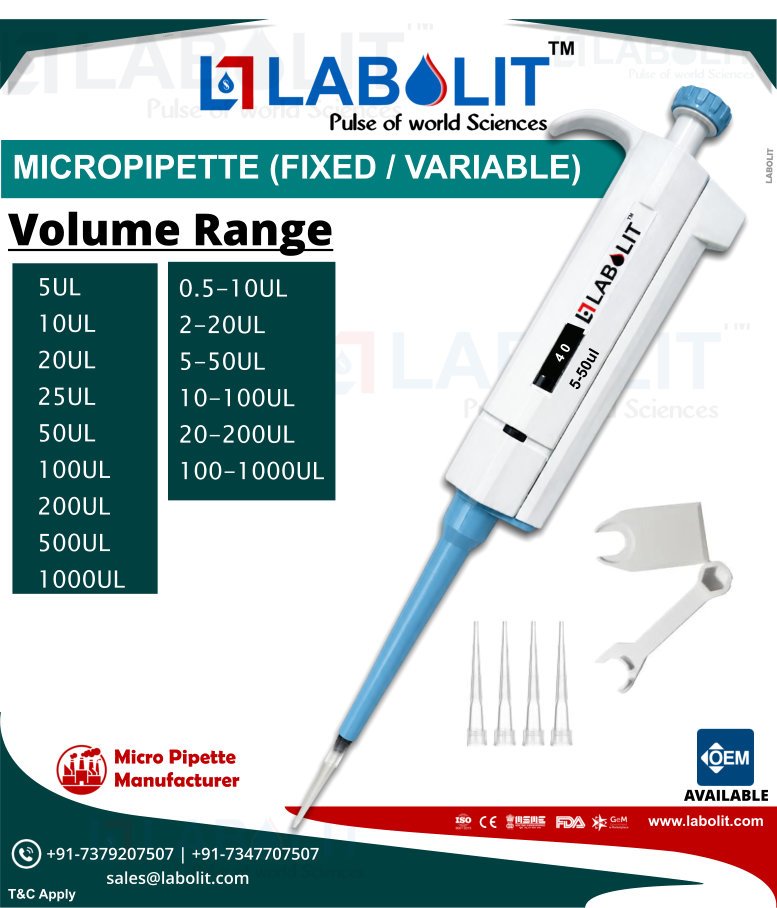
A micropipette is a precision liquid-handling instrument designed to aspirate and dispense small quantities of liquid, usually measured in microliters (µL).
Micropipettes are commonly used for volumes ranging from fractions of a microliter to several milliliters, depending on the model.
Typical applications include:
The accuracy of the pipette is particularly important when working with expensive reagents, sensitive samples, or analytical procedures.
The supplier you choose can have a significant effect on laboratory productivity and experimental accuracy.
A reliable supplier should provide more than a product box. Ideally, the supplier should support customers from product selection through delivery, calibration, maintenance, and after-sales service.
A dependable supplier should maintain consistent manufacturing and quality-control standards.
Micropipettes should have:
Quality consistency is particularly important for laboratories purchasing multiple pipettes.
Accuracy and precision are among the most important characteristics of a micropipette.
Accuracy refers to how close the dispensed volume is to the intended volume.
Precision refers to how consistently the micropipette delivers the same volume across repeated operations.
A laboratory may require excellent performance in both areas depending on its application.
Uma Scientific supplies laboratory equipment and specializes in micropipettes under the LABOLIT brand.
The product range can serve different laboratory requirements, including routine laboratory applications, research work, educational institutions, diagnostic laboratories, pharmaceutical laboratories, biotechnology laboratories, and industrial testing.
LABOLIT micropipette options include different volume ranges and configurations to suit various liquid-handling requirements.
Some commonly used volume ranges include:
Availability of specific models and volume ranges may vary according to the product series.
A reliable micropipette supplier should be able to provide different models rather than offering only one type of instrument.
A single channel micropipette contains one tip cone and is designed to transfer liquid one sample at a time.
It is widely used in:
Single-channel pipettes are suitable for routine liquid handling and are available in multiple volume ranges.
A multichannel micropipette allows the user to transfer liquid into multiple wells simultaneously.
Common configurations include:
Multichannel pipettes are particularly useful for microplate-based laboratory applications.
They can help reduce repetitive pipetting and improve laboratory productivity.
Applications include:
A fixed-volume micropipette is designed to dispense one specific volume.
For example, a fixed-volume pipette may be designed for a specific volume such as 10 µL, 20 µL, 50 µL, 100 µL, or another designated volume.
Advantages include:
Fixed-volume pipettes can be particularly useful when laboratories repeatedly use the same liquid volume.
A variable-volume micropipette allows the user to adjust the volume within a specified range.
For example:
20–200 µL
The operator can select different volumes within the permitted range.
Variable-volume micropipettes are useful when laboratory procedures require different liquid quantities.
Some laboratories require pipettes that can be sterilized through autoclaving.
Fully autoclavable micropipettes are designed for applications where sterilization is an important part of laboratory workflow.
They can be suitable for:
Always follow the manufacturer’s instructions regarding autoclaving temperature, duration, frequency, and component compatibility.
Semi-autoclavable models may have selected components designed for sterilization.
These models can be suitable for laboratories that require a balance between routine liquid handling and sterilization requirements.
Before purchasing, laboratories should confirm exactly which components are autoclavable.
A conventional mechanical micropipette generally operates through an air-displacement mechanism.
The plunger creates changes in air pressure inside the pipette system.
When the plunger is pressed and the pipette tip is immersed into the liquid, releasing the plunger creates a pressure difference that allows liquid to enter the disposable tip.
When the plunger is pressed again, the liquid is expelled.
A typical pipetting cycle involves:
Proper pipetting technique is essential for achieving good results.
Understanding the major components can help users select and maintain their instruments.
The plunger is pressed to aspirate and dispense liquid.
This allows the operator to select the required volume in variable-volume models.
The volume display shows the selected setting.
The tip cone connects the pipette with the disposable pipette tip.
The tip ejector allows users to remove used tips without touching them directly.
The handle is designed for comfortable operation.
These components contribute to the pipette’s liquid-handling performance.
Selecting the correct micropipette depends on the laboratory application.
First identify the liquid volumes that will be handled.
For example:
If the laboratory frequently works with 5–10 µL, a smaller volume pipette may be preferable to a 100–1000 µL model.
For 100–1000 µL applications, a higher-volume micropipette would generally be more appropriate.
Choose a fixed-volume pipette when the same volume is repeatedly required.
Choose a variable-volume pipette when several volumes are required.
For individual sample handling, a single-channel pipette may be suitable.
For microplate applications, an 8-channel or 12-channel micropipette may improve productivity.
Pipette tips should fit securely and consistently.
A reliable supplier should be able to advise customers about compatible tips.
Using unsuitable or poorly fitting tips can affect liquid handling performance.
Calibration is an important part of laboratory quality management.
Micropipette performance can change due to:
Regular performance verification helps laboratories identify potential problems.
For laboratories operating under formal quality systems, calibration may be performed according to applicable laboratory procedures and standards.
The ISO 8655 series is widely referenced for piston-operated volumetric apparatus and related performance requirements.
Calibration documentation may be important for laboratories involved in regulated testing, research, quality control, or audits.
ISO 8655 provides internationally recognized requirements and test methods for piston-operated volumetric apparatus.
When selecting a professional micropipette, laboratories may consider whether the manufacturer’s products and calibration procedures are aligned with relevant requirements.
However, buyers should distinguish between:
Customers should request relevant technical documentation from the supplier when required.
Accuracy and precision are often confused.
Imagine a pipette intended to dispense 100 µL.
If repeated measurements are close to 100 µL but vary slightly from one another, the pipette may have good accuracy but poor precision.
If repeated measurements are very close to each other but consistently around 98 µL, the pipette may have good precision but lower accuracy relative to the target.
A high-quality laboratory micropipette should be designed to provide reliable performance within its specified operating range.
Even an excellent micropipette can produce poor results if it is used incorrectly.
Common technique considerations include:
User training is therefore just as important as selecting the right instrument.
Micropipettes are used across many industries.
Pharmaceutical laboratories use micropipettes for:
Biotechnology laboratories use micropipettes extensively for:
Micropipettes are commonly used in diagnostic workflows where precise liquid handling is required.
Applications can include:
Hospital laboratories may use micropipettes for a wide variety of diagnostic and research procedures.
Educational laboratories use micropipettes to teach students:
Durable and easy-to-use pipettes can be particularly useful in teaching environments.
Research laboratories often require multiple pipettes covering different volume ranges.
A typical laboratory may require:
Selecting the correct combination can improve workflow efficiency and reduce the need to repeatedly adjust pipettes outside their ideal operating ranges.
Micropipette tips are critical components of liquid-handling systems.
The quality and compatibility of the tip can affect:
Tips are generally available in different sizes and packaging formats.
A supplier offering both pipettes and compatible tips can simplify procurement for laboratories.
Sterile tips may be required for applications where contamination control is important.
Depending on the application, laboratories may require:
The appropriate tip should be selected based on the laboratory procedure.
Low-retention tips are designed to minimize liquid remaining on the internal surface of the tip.
They can be useful when working with:
The exact suitability depends on the application and liquid characteristics.
Regular maintenance can help extend the service life of a micropipette.
Recommended practices include:
Wipe the exterior regularly using an appropriate cleaning procedure.
Use cleaning agents compatible with the pipette materials.
Check for cracks, contamination, or damage.
The plunger should operate smoothly.
Mechanical shock can affect internal components and calibration.
Use a suitable pipette stand or holder when the pipette is not in use.
Proper storage is often overlooked.
A pipette should not simply be left on the laboratory bench.
A micropipette stand can help:
Pipette stands are available in different configurations, including multi-position and rack-style designs.
Purchasing from an Indian manufacturer or supplier can offer several practical benefits.
Indian suppliers can often provide faster delivery within India compared with overseas procurement, depending on stock and location.
Customers can communicate directly with the supplier regarding:
Local suppliers can provide easier access to after-sales support and replacement products.
Distributors, institutions, hospitals, universities, and government organizations may benefit from domestic bulk supply.
Bulk buyers often have different requirements from individual laboratories.
They may require:
An experienced supplier should be able to discuss these requirements before finalizing the order.
OEM stands for Original Equipment Manufacturer.
OEM services allow businesses and distributors to sell products under their own brand or customized packaging, subject to agreed terms and specifications.
OEM micropipette requirements may include:
For distributors planning private-label products, OEM manufacturing can be an important procurement option.
Uma Scientific can also serve customers requiring laboratory product supply for distribution and resale.
Distributors may require:
A strong supplier-distributor relationship can help laboratories and customers access products across different regions of India.
Schools, colleges, universities, and training institutes require laboratory instruments that are reliable and economical.
Student laboratories may require:
A supplier offering multiple laboratory products can simplify institutional procurement.
Pharmaceutical companies have strict requirements for laboratory equipment.
Depending on the application, procurement teams may evaluate:
Choosing a professional supplier can help maintain consistent laboratory workflows.
Diagnostic laboratories may need micropipettes in multiple volume ranges for routine testing.
When selecting pipettes for diagnostic applications, laboratories should consider:
Research institutions often use pipettes for advanced laboratory applications.
Researchers may need different pipettes for:
A supplier with a broad product range can help research organizations standardize their liquid-handling equipment.
Micropipette prices can vary significantly.
Important factors include:
Different models have different construction and performance specifications.
Low-volume precision pipettes can have different pricing from higher-volume models.
Multichannel pipettes generally cost more than standard single-channel models because of their additional mechanisms.
Construction materials and internal components influence cost.
Fully autoclavable designs may have additional engineering requirements.
Calibration and documentation requirements may affect the final procurement cost.
Bulk orders may have different commercial terms compared with individual purchases.
OEM and customized packaging requirements may affect pricing.
Before placing an order, compare suppliers using multiple criteria rather than selecting only the lowest price.
Check technical specifications and construction.
Look for a supplier that can cover your current and future requirements.
Understand the warranty duration and terms.
Ask about calibration options and documentation.
Check whether the supplier provides technical assistance.
Confirm availability and estimated dispatch timelines.
Ask whether replacement components and accessories are available.
A responsive supplier is valuable when issues arise.
Before buying, customers can ask:
These questions can help buyers identify a professional supplier.
LABOLIT is a micropipette brand associated with Uma Scientific.
The product range is intended to provide solutions for different liquid-handling requirements.
Key considerations include:
Customers should select the model according to their specific laboratory requirements.
Laboratory professionals may perform hundreds of pipetting operations during a working day.
Therefore, ergonomics matter.
A well-designed micropipette should provide:
Ergonomic design can improve user comfort and workflow efficiency.
The cheapest pipette is not necessarily the best choice.
A lower purchase price may become expensive if the product requires frequent replacement or provides inconsistent performance.
Using a pipette at an inappropriate range can affect performance.
Always verify compatible tips before purchasing.
For precision applications, calibration and verification should not be overlooked.
Always clarify warranty terms.
A research laboratory, educational laboratory, and diagnostic laboratory may have different requirements.
Users can improve their results by following good laboratory practices.
Choose the pipette closest to the required working volume.
Use compatible and properly fitting tips.
A consistent aspiration and dispensing technique improves repeatability.
Change tips whenever required by the procedure.
Keep the pipette clean and inspect it regularly.
Follow your laboratory’s calibration schedule and applicable standards.
Micropipettes are essential tools in molecular biology.
They are used for:
Because many molecular biology reactions use small volumes, precise liquid handling is important.
PCR workflows often involve small reaction volumes.
Researchers may use different micropipettes for:
Multichannel pipettes can also be useful for microplate-based workflows.
Microbiology laboratories use pipettes for:
Depending on the application, sterile or specialized pipette tips may be required.
Food testing laboratories perform numerous analytical procedures that involve liquid samples and reagents.
Micropipettes may be used in:
Environmental testing laboratories may use micropipettes for:
A professional supplier can provide a more complete procurement experience.
Benefits can include:
This can be especially valuable for institutions purchasing multiple laboratory products.
Uma Scientific is a laboratory scientific equipment supplier based in India and offers laboratory products for different sectors.
Its product portfolio includes laboratory equipment and liquid-handling products such as:
The company serves laboratories, institutions, distributors, research organizations, healthcare-related laboratories, educational institutions, and other scientific customers.
A supplier should not only be evaluated for one purchase.
If your organization uses micropipettes regularly, consider long-term factors such as:
Building a long-term relationship with a reliable supplier can simplify future procurement.
A professional Indian supplier can support customers in different regions, including:
Availability and delivery time depend on product stock, order quantity, and destination.
Demand for laboratory equipment is strong across South India, particularly in pharmaceutical, biotechnology, diagnostic, educational, and research sectors.
Customers in:
can source micropipettes from Indian manufacturers and suppliers for laboratory applications.
Maharashtra has a large pharmaceutical, biotechnology, healthcare, research, and industrial laboratory sector.
Cities such as Mumbai, Pune, Nashik, Nagpur, and Aurangabad have laboratories that may require reliable liquid-handling equipment.
Uma Scientific operates from Lucknow, Uttar Pradesh, providing access to customers seeking laboratory scientific products.
Customers throughout Uttar Pradesh can source micropipettes for:
Government laboratories and educational institutions may purchase laboratory equipment through formal procurement processes and approved platforms.
Suppliers serving this segment may need to provide:
Buyers should confirm the exact documentation requirements for their procurement process.
Bulk purchasing is suitable for:
For bulk requirements, buyers should provide:
This allows the supplier to provide an accurate quotation.
Businesses looking for their own laboratory equipment brand can explore OEM manufacturing.
An OEM supplier may provide:
OEM terms such as MOQ, branding specifications, packaging, production timelines, and commercial conditions should be confirmed directly with the manufacturer.
India has a growing scientific equipment and laboratory supply industry.
Domestic manufacturing and supply can support:
As Indian laboratories continue to expand, demand for dependable scientific instruments and liquid-handling products is also increasing.
Laboratories are increasingly focused on:
Micropipettes remain an essential tool even as laboratories adopt more automated liquid-handling systems.
Manual and semi-automated pipetting will continue to play an important role in research, diagnostics, education, and routine laboratory work.
Uma Scientific, with its LABOLIT micropipette range, is one option for laboratories and organizations looking for Indian-supplied micropipettes. Buyers should compare specifications, warranty, calibration, application suitability, and commercial terms before purchasing.
Micropipettes are available in multiple ranges, from very low-volume models to high-volume models. Common ranges include 0.5–10 µL, 2–20 µL, 5–50 µL, 10–100 µL, 20–200 µL, 50–500 µL, and 100–1000 µL, with additional ranges available depending on the model.
Bulk supply can be discussed according to the required model, quantity, and specifications.
OEM/private-label requirements can be discussed for suitable models and quantities.
Yes, different micropipette configurations can be selected according to the application and budget.
A fixed-volume pipette is designed for one specific volume, while a variable-volume pipette allows the user to select a volume within a specified range.
Some models are designed to be fully or partially autoclavable. Buyers should check the manufacturer’s specifications for the exact model.
The appropriate calibration interval depends on laboratory usage, quality requirements, manufacturer recommendations, and applicable laboratory procedures.
Calibration helps verify whether the pipette is dispensing liquid within the required performance limits.
Yes. Tip fit, quality, compatibility, liquid characteristics, and pipetting technique can all influence liquid-handling performance.
Selecting a reliable supplier is an important decision for every laboratory.
Before placing an order, evaluate:
Product Quality – Check construction, specifications, and intended application.
Accuracy & Precision – Choose a model appropriate for your required working volume.
Volume Range – Select a suitable pipette range rather than using one pipette for every application.
Tip Compatibility – Confirm suitable tips before purchase.
Calibration – Consider calibration and verification requirements.
Ergonomics – Choose a comfortable instrument for repetitive laboratory work.
Warranty – Confirm warranty coverage and terms.
After-Sales Support – Reliable technical support can be valuable over the product’s service life.
Bulk Supply – For institutions and distributors, confirm availability and commercial terms.
OEM Support – Businesses requiring private-label products should discuss OEM options.
Supplier Reputation – Consider the supplier’s product range, experience, communication, and ability to support long-term requirements.
A reliable micropipette supplier in India should provide more than competitive pricing. Laboratories need dependable instruments, appropriate volume ranges, compatible consumables, technical information, warranty support, calibration options, and consistent service.
Uma Scientific – LABOLIT offers a range of laboratory micropipettes designed for different liquid-handling requirements, including single-channel, multichannel, fixed-volume, variable-volume, and autoclavable options. The range is suitable for laboratories, research institutes, pharmaceutical companies, biotechnology organizations, diagnostic centers, hospitals, educational institutions, distributors, and OEM customers.
Whether you need a single micropipette for routine laboratory work, a complete set of different volume ranges, multichannel micropipettes for microplate applications, or bulk/OEM supply, selecting the right model and supplier is essential.
For laboratories looking for micropipettes in India, focus on quality, performance, compatibility, calibration, ergonomics, warranty, service, and long-term availability—not simply the lowest price.
Uma Scientific – LABOLIT aims to provide dependable laboratory liquid-handling solutions for customers across India and support the growing requirements of India’s scientific and research community.
