

Leading Micropipette & Scientific Lab, Medical instrument Manufacturer and Deler A Legacy Of Scientific Precision .



Leading Micropipette & Scientific Lab, Medical instrument Manufacturer and Deler A Legacy Of Scientific Precision .
Today, micropipettes are used in pharmaceutical laboratories, biotechnology companies, diagnostic laboratories, hospitals, universities, research institutions, food testing laboratories, pathology laboratories and industrial quality-control facilities.
India has a large and growing market for laboratory equipment. As a result, customers can find manufacturers, suppliers, distributors, dealers and importers offering different types of micropipettes.
However, selecting the right supplier is not simply about finding the lowest price.
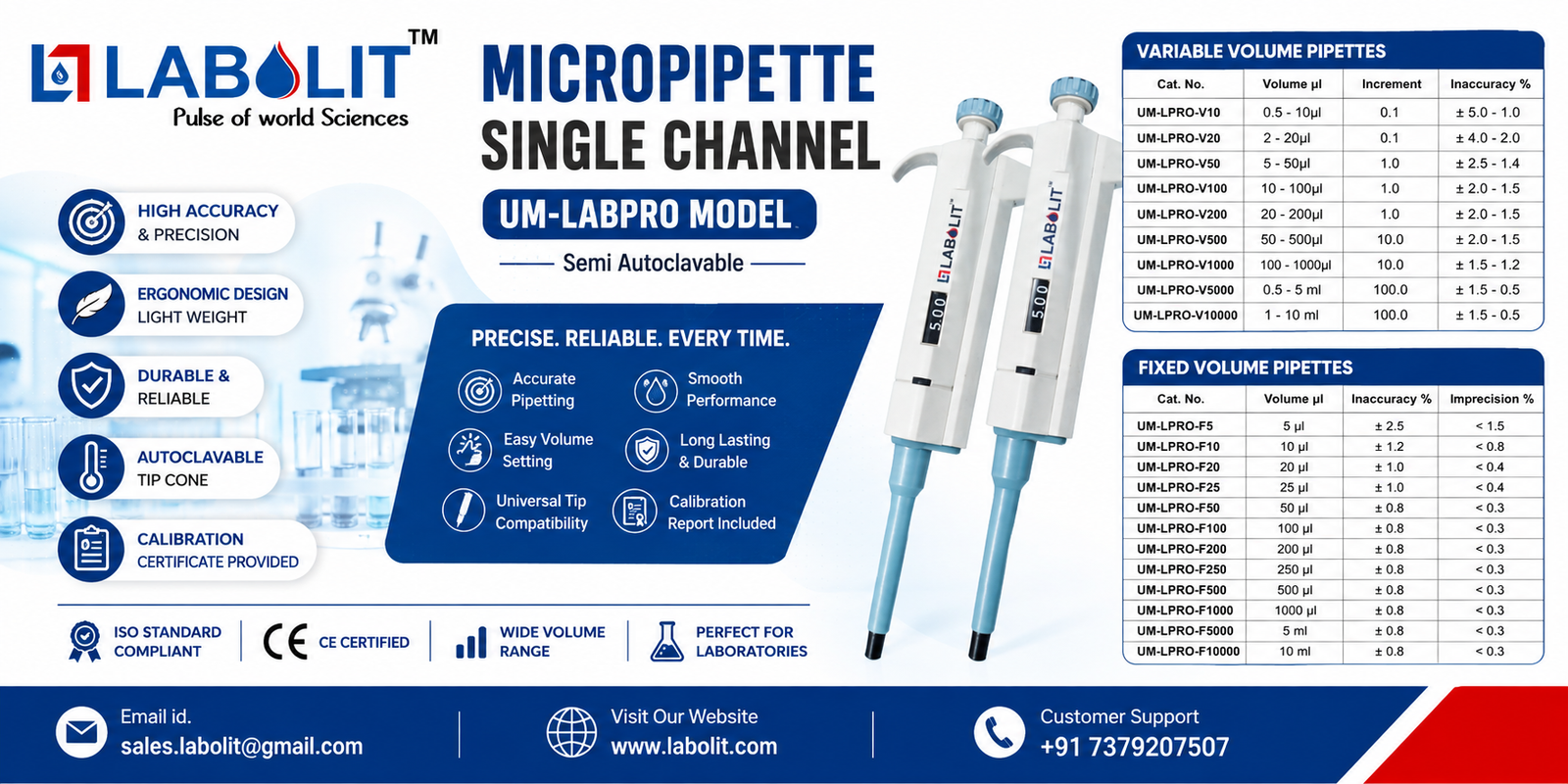
LABOLIT by Uma Scientific offers a range of laboratory micropipettes for different liquid-handling requirements, including fixed-volume and variable-volume models, with multiple volume ranges and OEM opportunities.
This detailed guide explains everything buyers should consider when searching for a micropipette supplier in India.
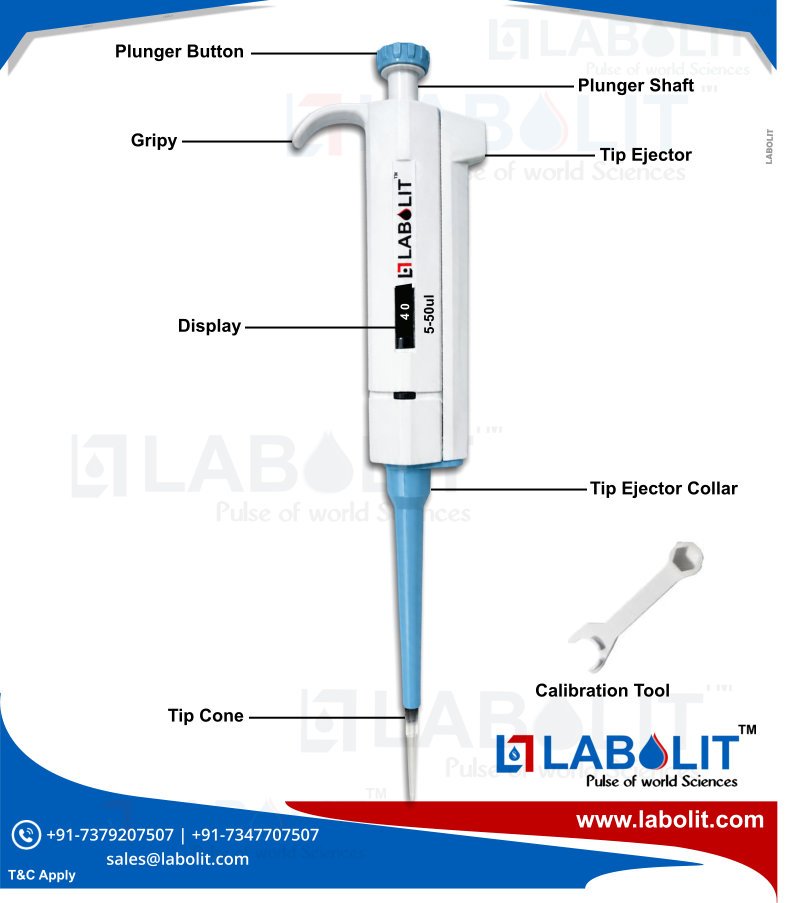
A micropipette is a precision liquid-handling instrument designed to aspirate and dispense small volumes of liquid.
The word “micro” refers to the small volumes commonly handled by the instrument, generally expressed in microlitres.
For example, laboratory procedures may require the transfer of:
Depending on the model, a micropipette may have a fixed volume or an adjustable volume range.
Micropipettes generally use disposable tips that are attached to the pipette’s tip cone.
The user sets or selects the desired volume, attaches an appropriate tip and uses the plunger mechanism to aspirate and dispense liquid.
Modern laboratory procedures frequently involve small-volume liquid transfers.
Micropipettes can be used for:
The appropriate pipette depends on the procedure, liquid characteristics and required volume.
When a laboratory purchases a micropipette, it is not simply buying a plastic or mechanical instrument.
The laboratory is investing in a liquid-handling system that may be used repeatedly over months or years.
A reliable supplier can help the customer select an appropriate product based on:
A professional supplier should also provide clear product information rather than making unsupported performance claims.
Customers often search for both “micropipette supplier India” and “micropipette manufacturer India.”
These terms are related but not always identical.
A manufacturer produces the product or operates manufacturing processes.
A supplier may:
Some companies operate as both manufacturer and supplier.
For buyers, the most important consideration is whether the company can provide the required product with suitable specifications, documentation, support and supply continuity.
LABOLIT is a laboratory equipment brand associated with Uma Scientific, based in Lucknow, Uttar Pradesh, India.
LABOLIT offers micropipette solutions for different laboratory requirements.
The product range includes options such as:
The availability of particular models and specifications should be confirmed with the supplier before purchase.
Selecting the right volume range is one of the most important steps when purchasing a micropipette.
LABOLIT product ranges promoted for micropipettes include the following.
Different models may have different specifications, so buyers should request the latest catalogue or technical datasheet for the exact product.
A fixed-volume micropipette is designed to dispense one specified volume.
For example:
100 µL Fixed Volume Micropipette
is designed for procedures that require a fixed 100 µL transfer.
Fixed-volume pipettes can be useful when a laboratory performs repetitive procedures with the same volume.
A laboratory may maintain several fixed-volume micropipettes if it routinely uses different volumes.
A variable-volume micropipette allows the user to select a volume within a defined range.
For example:
20–200 µL
allows the user to set an appropriate volume within that range according to the product specification.
Variable-volume micropipettes are popular because they can be used for multiple laboratory procedures.
A single-channel micropipette has one liquid-handling channel.
It is one of the most commonly used micropipette formats.
Single-channel pipettes are suitable for:
They are particularly useful when samples are handled individually.
A multichannel micropipette has multiple channels that allow several liquid transfers to occur simultaneously.
Common configurations include:
Multichannel pipettes can be particularly useful for microplate applications.
The correct channel configuration should be selected according to the laboratory workflow.
Some laboratory applications require sterilization.
An autoclavable micropipette is designed with components that can withstand the manufacturer’s specified autoclaving process.
Autoclavability should never be assumed merely because a pipette is made from plastic or metal.
The supplier should clearly specify:
Users should follow the manufacturer’s instructions.
Autoclavable equipment can be useful in laboratories where sterilization is part of routine workflow.
Potential applications include:
Sterilization requirements depend on the laboratory procedure and internal SOP.
Accuracy and precision are two important concepts when evaluating a micropipette.
Accuracy refers to how close the measured or delivered volume is to the target value.
Precision refers to the consistency of repeated measurements or deliveries.
For example, if a pipette is intended to deliver 100 µL and repeated measurements are very close to one another, it demonstrates good repeatability.
Buyers should review the manufacturer’s stated performance specifications for the particular model rather than comparing products based only on marketing language.
Micropipettes are precision instruments.
Over time, their performance may be affected by:
Laboratories should establish appropriate calibration or verification procedures based on their quality system and applications.
Calibration documentation can be particularly important for laboratories operating under formal quality-management systems.
ISO 8655 is a recognized standard series related to piston-operated volumetric apparatus, including requirements and test methods applicable to pipettes.
When evaluating a supplier, buyers should ask for specific information about:
A supplier should clearly distinguish between a product being tested according to an applicable standard and making broad or unsupported certification claims.
Many manual micropipettes operate using an air-displacement principle.
The general process is:
The exact technique depends on the pipette design and liquid properties.
A typical manual micropipette can contain:
The exact construction varies between products.
A common mistake when purchasing a micropipette is choosing the volume range only by maximum capacity.
Instead, buyers should consider the volume they use most frequently.
For example, if the laboratory commonly handles 100 µL, a suitable pipette range should be selected so that 100 µL is comfortably within its specified operating range.
For low-volume work, a dedicated low-volume pipette may provide more appropriate performance than using a high-capacity pipette at its lowest setting.
Some commonly used laboratory ranges include:
Useful for very small liquid volumes.
Suitable for low-volume laboratory applications.
Useful for many routine small-volume procedures.
Suitable for intermediate volumes.
One of the common ranges for routine laboratory work.
Useful for larger microlitre volumes.
The correct range should always be selected according to the procedure and manufacturer’s specifications.
A micropipette is used together with a disposable tip.
The tip should be compatible with the micropipette.
A suitable tip should provide a secure connection and appropriate liquid handling for the application.
Types of tips can include:
Not every tip is appropriate for every application.
An unsuitable tip can lead to:
Therefore, laboratories should evaluate the micropipette and tip together.
A reliable micropipette supplier in India should be able to guide customers regarding compatible tips.
Pharmaceutical laboratories use micropipettes in many processes.
Applications may include:
Pharmaceutical buyers may require additional documentation and quality-control information.
When purchasing, they may consider:
Biotechnology laboratories regularly perform small-volume liquid transfers.
Micropipettes can be used for:
Both single-channel and multichannel pipettes can be useful.
Diagnostic laboratories use micropipettes for transferring samples, reagents and controls.
Depending on the application, laboratories may require:
Selection should be based on the laboratory’s validated procedures.
Hospital laboratories may use micropipettes for routine laboratory testing and sample preparation.
Important considerations can include:
A supplier should be able to provide product information appropriate to institutional procurement requirements.
Educational institutions use micropipettes for teaching laboratory techniques.
Students can learn:
For educational institutions, durability and ease of use can be particularly important.
Research laboratories often require several different volume ranges because experimental procedures can change.
A laboratory may maintain:
A combination of suitable ranges can cover a broad range of laboratory tasks.
Food and beverage laboratories may use micropipettes for sample preparation, dilution and analytical procedures.
The required micropipette depends on the testing method.
Important purchasing factors may include:
Industrial laboratories may use micropipettes for:
For industrial buyers, reliable supply can be as important as the initial product purchase.
Laboratory technicians may perform hundreds of pipetting actions during a working day.
Therefore, ergonomics matter.
Features that can contribute to comfortable operation include:
A comfortable instrument can help reduce unnecessary hand strain during repetitive work.
Regular maintenance can help preserve instrument performance.
Basic practices can include:
Always follow the specific manufacturer’s maintenance instructions.
A micropipette should ideally be stored in a suitable stand or holder.
A pipette stand can:
Proper storage can also reduce the risk of accidental damage.
Even a good micropipette may provide inconsistent results if the user employs poor technique.
Common errors include:
User training is therefore an important part of liquid-handling quality.
A basic workflow can be described as follows.
Choose the appropriate volume range.
Adjust the pipette to the desired volume within its specified range.
Attach a compatible tip securely.
Use the appropriate plunger technique and place the tip correctly into the liquid.
Move the pipette to the receiving vessel.
Dispense the liquid using the appropriate technique.
Remove and dispose of the used tip according to laboratory procedures.
Before ordering, buyers should evaluate the supplier carefully.
Ask the following questions:
Check the available ranges.
This provides flexibility.
This is important for different workflows.
Confirm the specific model.
Request a datasheet or catalogue.
Confirm the exact warranty terms.
Ask about calibration documentation and procedures.
This is important for long-term use.
Useful for distributors and private-label companies.
Buying from an Indian supplier can offer several practical advantages for domestic customers.
Potential benefits include:
The actual service level depends on the individual supplier.
Bulk customers may include:
For bulk purchases, customers should discuss:
with the supplier.
Dealers require more than just products.
They may need:
A supplier capable of supporting dealers can help distributors build a stronger laboratory equipment portfolio.
OEM is an important opportunity for laboratory equipment businesses.
An OEM customer may want to sell a micropipette under its own brand.
Depending on the supplier’s capabilities, OEM services may include:
Before placing an OEM order, customers should confirm:
Indian suppliers can also support companies involved in laboratory equipment exports.
Export buyers may require:
Export documentation depends on the destination country and transaction.
The price of a micropipette can vary significantly.
Factors affecting price include:
Therefore, buyers should request a quotation for the exact model rather than relying on a generic online price.
Bulk orders may receive different pricing compared with individual purchases.
A useful comparison table can help buyers select a supplier.
| Factor | What to Check |
|---|---|
| Product Range | Fixed, variable, single, multichannel |
| Volume | Required range available |
| Accuracy | Published specification |
| Precision | Published specification |
| Autoclavability | Confirm model-specific capability |
| Tips | Compatible options |
| Calibration | Support/documentation |
| Warranty | Terms and duration |
| OEM | MOQ and customization |
| Service | Technical assistance |
| Supply | Bulk availability |
| Documentation | Catalogue/datasheet |
| Price | Compare equivalent models |
Always compare equivalent specifications rather than comparing only prices.
A professional laboratory supplier should be able to provide relevant product information.
This may include:
Documentation helps procurement teams make informed decisions.
Government laboratories, colleges, universities and hospitals may purchase equipment through formal procurement procedures.
Suppliers may need to provide:
Requirements vary by tender and institution.
Research institutions often have diverse liquid-handling requirements.
They may require:
A supplier with a broad portfolio can simplify procurement.
Buying the micropipette is only the first step.
Laboratories also need a consistent supply of compatible tips.
A reliable supplier should ideally be able to provide information about:
A pipette with easily available compatible tips is generally more convenient for long-term laboratory use.
Quality control is important at both the manufacturer and laboratory level.
Manufacturers may conduct:
Laboratories can establish their own:
Together, these activities support consistent liquid handling.
The correct micropipette should be selected based on the actual laboratory procedure.
For example:
Consider a low-volume range such as 0.5–10 µL.
A range such as 20–200 µL may be suitable depending on the procedure.
A 100–1000 µL model may be appropriate.
A fixed-volume pipette can be convenient.
A multichannel pipette may improve efficiency.
Consider an appropriate autoclavable model.
Laboratory equipment buyers across India may search for suppliers using city-specific keywords.
Examples include:
A supplier serving customers across India can support laboratories in multiple regions.
North Indian customers may search for suppliers in:
Local logistics and customer support can be useful for institutional buyers.
South India has a large laboratory and pharmaceutical ecosystem.
Major markets include:
Micropipettes are used across pharmaceutical, biotechnology, healthcare, academic and research laboratories.
Maharashtra and Gujarat are important industrial and pharmaceutical markets.
Laboratories in these regions may require micropipettes for:
A supplier with bulk-order capability can be valuable for industrial customers.
Pharmaceutical companies may purchase micropipettes in larger quantities.
They may require:
A supplier should understand the customer’s technical and procurement requirements.
Diagnostic centers often need reliable instruments for routine liquid handling.
Depending on the application, they may purchase:
The correct selection depends on the diagnostic procedure.
Schools, colleges and universities can use micropipettes for practical training.
Educational buyers may focus on:
Bulk educational procurement may involve several models and quantities.
A low-cost micropipette may appear attractive, but the purchase decision should consider the complete value.
Important questions include:
The lowest price does not necessarily represent the lowest total cost of ownership.
The total cost can include:
A slightly higher initial investment may be justified if the product provides appropriate performance and support.
A reliable supplier can help customers before and after purchase.
This complete approach is more useful than simply dispatching the product.
Many buyers search online before contacting a supplier.
When purchasing online, customers should verify:
For institutional purchases, it is often useful to request a formal quotation before ordering.
Before placing an order, ask:
These questions can prevent misunderstandings.
LABOLIT provides options for different laboratory liquid-handling requirements.
The advertised volume options include:
5 µL, 10 µL, 20 µL, 25 µL, 50 µL, 100 µL, 200 µL, 500 µL and 1000 µL
0.5–10 µL, 2–20 µL, 5–50 µL, 10–100 µL, 20–200 µL and 100–1000 µL
Customers can select the appropriate product based on their application and required volume.
LABOLIT can also be considered by distributors and companies seeking OEM/private-label micropipette requirements.
OEM buyers can discuss:
OEM requirements should be finalized before production.
Distributors can build a laboratory equipment portfolio around products such as:
A supplier with multiple laboratory products can simplify distributor procurement.
For laboratories, a good supplier should make product selection straightforward.
The supplier should be able to understand:
Application → Volume → Pipette Type → Tip → Sterilization → Quantity → Documentation → Warranty
This approach reduces the risk of purchasing an unsuitable product.
Quality should be evaluated through measurable specifications and documentation.
Buyers should avoid choosing products solely because they are described as:
Instead, ask for specific product information.
A transparent supplier should be able to explain the product’s intended use and specifications.
The Indian laboratory equipment market continues to develop as research, healthcare, pharmaceutical manufacturing, biotechnology and diagnostic services expand.
Demand for liquid-handling products is likely to remain important across:
Suppliers that combine product availability with technical support and reliable service can serve this market effectively.
LABOLIT offers a range of micropipette configurations intended for different laboratory requirements.
Customers can evaluate LABOLIT products based on:
Customers should always confirm current specifications for the model they intend to purchase.
Before placing an order, use this checklist:
☐ Correct model
☐ Correct volume range
☐ Fixed/variable confirmed
☐ Single/multichannel confirmed
☐ Accuracy specification
☐ Precision specification
☐ Tip compatibility
☐ Autoclavability confirmed if required
☐ Quantity
☐ Price
☐ GST
☐ Shipping
☐ Delivery time
☐ Payment terms
☐ Catalogue
☐ Datasheet
☐ Warranty
☐ Calibration documentation where applicable
☐ Service support
☐ Spare parts
☐ Replacement policy
☐ Technical assistance
A micropipette supplier is a company that provides micropipettes and related liquid-handling products to laboratories, institutions, distributors and other customers.
You can purchase micropipettes from manufacturers, authorized suppliers, distributors and laboratory equipment companies. LABOLIT by Uma Scientific offers micropipette products for Indian laboratory customers.
The appropriate brand depends on your application, specifications, budget and service requirements. LABOLIT is one Indian laboratory equipment brand offering several micropipette options.
A fixed-volume micropipette is designed for one specified volume. A variable-volume micropipette allows volume adjustment within a defined range.
A pipette range that appropriately covers 100 µL can be selected, such as a 10–100 µL or 20–200 µL model, depending on the required application and product specifications.
Some models are designed to be autoclavable. Buyers must check the specific manufacturer’s instructions.
Common ranges include 0.5–10 µL, 2–20 µL, 5–50 µL, 10–100 µL, 20–200 µL and 100–1000 µL.
Micropipettes may require periodic calibration or performance verification depending on the laboratory’s quality system, application and usage.
Yes. Bulk procurement is common for pharmaceutical companies, hospitals, universities, distributors, diagnostic centers and research institutions.
OEM/private-label opportunities are available subject to product, quantity and commercial requirements.
A micropipette is an essential instrument for modern laboratory liquid handling. Choosing the right supplier can make a significant difference in product selection, long-term usability, support and procurement efficiency.
When searching for a micropipette supplier in India, buyers should consider more than price.
Look at:
✔ Product range
✔ Volume options
✔ Fixed and variable models
✔ Single and multichannel options
✔ Autoclavability
✔ Accuracy and precision specifications
✔ Tip compatibility
✔ Calibration support
✔ Warranty
✔ Technical documentation
✔ OEM capability
✔ Bulk supply
✔ After-sales support
LABOLIT by Uma Scientific offers a range of fixed-volume and variable-volume micropipettes for laboratory applications, with multiple volume ranges and options for different customer requirements.
Whether you are a research laboratory, pharmaceutical company, biotechnology organization, diagnostic laboratory, hospital, university, distributor, dealer, OEM buyer or exporter, selecting the appropriate micropipette should begin with understanding your exact liquid-handling requirements.
For product selection and quotations, customers can share the required volume range, quantity, application and preferred configuration with the supplier.
Micropipette Supplier & Laboratory Equipment Provider in India
📞 +91-7379207507
📞 +91-7347707507
📧 sales@labolit.com
🌐 www.labolit.com
Fixed Volume: 5 µL to 1000 µL
Variable Volume: 0.5–10 µL to 100–1000 µL
Single Channel: Available
Multichannel: Available for selected models
Autoclavable: Available for selected models
OEM: Available subject to requirements
LABOLIT – Your Partner for Reliable Laboratory Liquid Handling.
Micropipette Supplier India
Micropipette Supplier in India, Micropipette Manufacturer India, Micropipette Distributor India, Laboratory Micropipette Supplier, Micropipette Supplier Near Me, Micropipette Price India, Micropipette Manufacturer and Supplier, Variable Volume Micropipette Supplier, Fixed Volume Micropipette Supplier, Autoclavable Micropipette Supplier, Single Channel Micropipette India, Multichannel Micropipette India, OEM Micropipette Supplier India, Laboratory Equipment Supplier India, LABOLIT Micropipette, Uma Scientific Micropipette, Micropipette Supplier for Laboratories, Micropipette Supplier for Pharma, Micropipette Supplier for Research Labs, Micropipette Supplier for Diagnostic Laboratories.
