

Leading Micropipette & Scientific Lab, Medical instrument Manufacturer and Deler A Legacy Of Scientific Precision .



Leading Micropipette & Scientific Lab, Medical instrument Manufacturer and Deler A Legacy Of Scientific Precision .
Meta Title: Best Micropipette Manufacturer in India | LABOLIT Micropipettes
Meta Description: Looking for the best micropipette manufacturer in India? Explore fixed, variable, single-channel, multichannel and autoclavable micropipettes for laboratories, pharma, biotech, diagnostics and research.
Focus Keyword: Best Micropipette Manufacturer in India
Secondary Keywords: Micropipette Manufacturer in India, Micropipette Supplier India, Laboratory Micropipette, Variable Volume Micropipette, Fixed Volume Micropipette, Autoclavable Micropipette, LABOLIT Micropipette, Micropipette Manufacturer
Micropipettes are one of the most important liquid-handling instruments used in modern laboratories. From pharmaceutical research and biotechnology to diagnostic laboratories, hospitals, universities, food testing facilities and industrial laboratories, micropipettes are used whenever small volumes of liquid need to be transferred with controlled and repeatable technique.
India has a growing laboratory equipment manufacturing sector, and customers now have access to a wide range of manual, variable-volume, fixed-volume, single-channel, multichannel and autoclavable micropipettes.
Among the important factors when selecting a micropipette manufacturer are the manufacturer’s product range, manufacturing capabilities, quality-control process, technical support and ability to supply products consistently.
This article provides a detailed guide for laboratories and buyers looking for a reliable micropipette manufacturer in India.
A micropipette is a laboratory liquid-handling instrument used to aspirate and dispense small quantities of liquid, generally measured in microlitres (µL).
The instrument normally works with a disposable pipette tip. Depending on the design, the user can select a specific volume or adjust the volume within a defined range.
Micropipettes are widely used because conventional laboratory glassware is not always practical for transferring very small volumes.
For example, laboratories may need to transfer:
The correct micropipette should be selected according to the required volume and application.
A micropipette is a precision laboratory instrument. Its performance can influence the reliability and repeatability of liquid-handling procedures.
A manufacturer should therefore consider several aspects of product development and production.
These can include:
For laboratories performing critical work, purchasing decisions should be based on documented specifications rather than price alone.
There is no single factor that makes a manufacturer the “best.” A professional buyer should evaluate multiple criteria.
A reliable micropipette manufacturer should ideally provide:
A good manufacturer should offer multiple volume ranges and configurations.
Products should be manufactured with appropriate quality controls.
Customers should be able to obtain clear information about the product.
Relevant product and calibration documentation should be available where applicable.
Technical and commercial support should be accessible.
Clear warranty terms should be provided.
For distributors and private-label businesses, OEM support can be valuable.
Manufacturers should be able to support repeat orders and bulk requirements.
LABOLIT is a laboratory equipment brand associated with Uma Scientific, based in Lucknow, Uttar Pradesh, India.
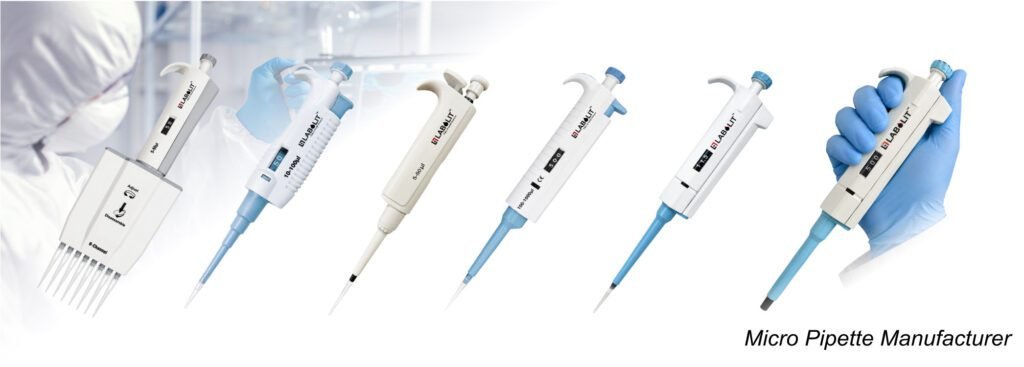
The LABOLIT range includes micropipettes designed for laboratory liquid-handling applications.
Depending on the model, customers can choose from:
The exact features, specifications and availability should be confirmed for the individual model.
LABOLIT product ranges promoted for micropipettes include:
The actual model specifications should always be checked against the current product catalogue.
Fixed-volume micropipettes are designed for a particular volume.
For example, a laboratory may use a:
100 µL Fixed Volume Micropipette
for procedures where 100 µL is repeatedly required.
Fixed-volume pipettes can be particularly useful in laboratories where standardized procedures repeatedly require the same volume.
Variable-volume micropipettes allow the user to select a volume within a specified range.
For example:
20–200 µL
can be used for different volumes within its stated operating range.
Variable-volume models are useful for laboratories performing multiple procedures.
Instead of purchasing a separate fixed pipette for every volume, the laboratory can use an appropriate adjustable pipette for several requirements.
Single-channel micropipettes have one liquid-handling channel.
They are widely used in:
Their flexibility makes them a standard liquid-handling tool in many laboratories.
Multichannel micropipettes allow several liquid transfers to occur simultaneously.
Common configurations include:
They can be particularly useful for microplate applications.
The appropriate channel configuration depends on the laboratory’s workflow.
Autoclavability is an important feature for some laboratories.
A fully autoclavable micropipette is specifically designed so that the applicable components can withstand the manufacturer’s specified autoclaving conditions.
Autoclaving uses pressurized steam for sterilization.
However, users should never assume that every micropipette can be autoclaved.
The manufacturer’s instructions should specify:
Laboratories handling biological materials may require sterilization procedures.
A compatible autoclavable micropipette can simplify workflows where sterilization is required.
Applications may include:
The actual sterilization requirements depend on the laboratory’s SOP and the material being handled.
Two important terms when evaluating micropipettes are:
Accuracy
and
Precision
Accuracy refers to how close the delivered volume is to the target.
Precision refers to the consistency of repeated deliveries.
For example, a pipette that delivers:
99.9 µL
100.0 µL
100.1 µL
when targeting 100 µL demonstrates good consistency in this simplified example.
A professional manufacturer should provide applicable accuracy and precision specifications for its models.
Micropipettes are precision instruments and can experience changes in performance due to:
Regular verification or calibration can help laboratories identify performance changes.
The required calibration interval should be determined according to the laboratory’s quality system, application and risk assessment.
ISO 8655 is an important international standard series concerning piston-operated volumetric apparatus, including requirements and test methods applicable to pipettes and related equipment.
When evaluating a micropipette, laboratories should check:
Manufacturers and suppliers should provide accurate and applicable claims rather than making unsupported statements about compliance.
Many manual micropipettes use the air-displacement principle.
The basic process involves controlling the air volume inside the pipette.
The user:
Proper technique is essential for obtaining consistent results.
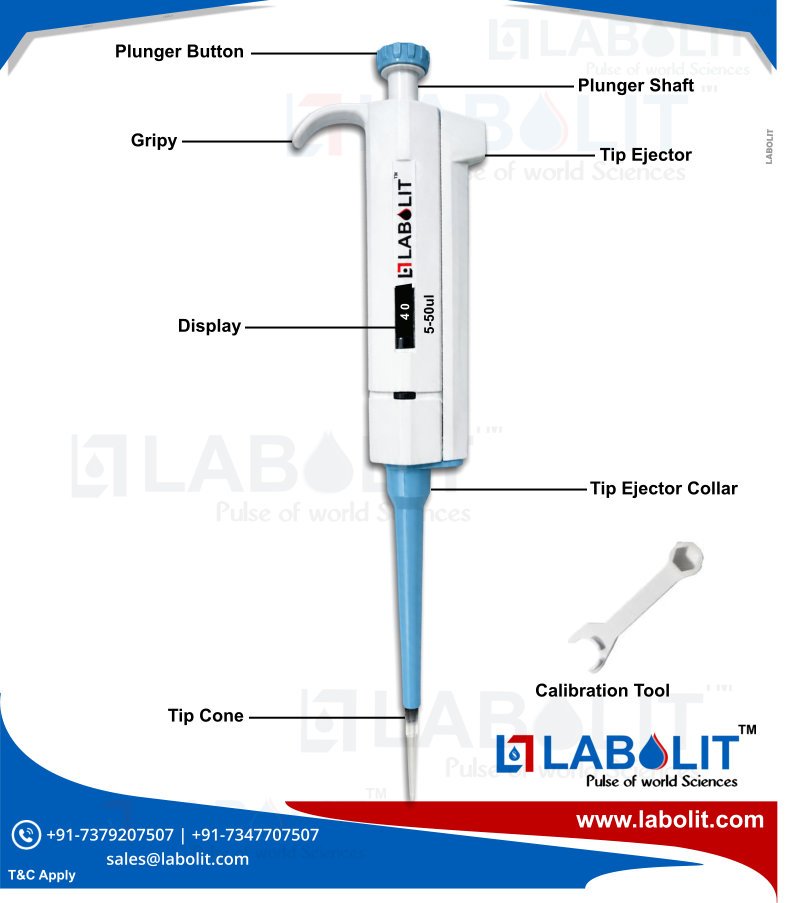
A typical manual micropipette may include:
The construction differs by model and manufacturer.
One of the most important purchasing decisions is selecting the correct volume range.
Suppose a laboratory regularly handles 100 µL.
A suitable pipette range may be:
20–200 µL
or another appropriate range specified for the application.
If the laboratory works with very small volumes, it may require a low-volume pipette such as:
0.5–10 µL
The volume range should always be selected according to the actual laboratory procedure.
One pipette cannot efficiently cover every laboratory volume.
For example, a laboratory may require:
Each range is designed for different working volumes.
Maintaining a suitable collection of pipettes allows users to select an appropriate instrument for each application.
A pipette tip is the disposable component that comes into contact with the liquid.
The tip should:
Different applications may require:
Tip compatibility should be confirmed before purchasing.
The quality of the pipette tip can influence liquid handling.
An unsuitable tip may result in:
Therefore, laboratories should consider the micropipette and tip as a complete system.
Pharmaceutical laboratories use micropipettes in many areas, including:
Pharmaceutical laboratories often require appropriate documentation and controlled laboratory procedures.
When selecting a pipette, buyers may consider:
Biotechnology laboratories frequently work with small-volume liquid transfers.
Micropipettes can be used for:
Both single-channel and multichannel pipettes can have important roles.
Diagnostic laboratories may use micropipettes for controlled transfer of:
The appropriate pipette depends on the procedure.
For sensitive workflows, laboratories may also use sterile or filtered tips according to their protocols.
Research laboratories require flexible liquid-handling instruments because experimental procedures can vary significantly.
A research laboratory may require several volume ranges and both fixed and variable-volume instruments.
Common applications include:
Educational laboratories use micropipettes to teach students modern laboratory techniques.
Students can learn:
Manufacturers supplying educational institutions should consider durability, ease of use, price and after-sales support.
Food laboratories may use micropipettes for sample preparation and analytical procedures.
Applications depend on the testing method and laboratory SOP.
Important purchasing considerations may include:
Industrial laboratories may use micropipettes in:
Industrial users often require consistent supply and technical support in addition to the product itself.
Ergonomics are important because laboratory technicians may perform hundreds of pipetting actions.
Useful ergonomic characteristics can include:
Manufacturers should consider operator comfort during product development.
A basic workflow is:
Choose the pipette according to the required volume.
Adjust the volume within the specified range.
Securely attach a compatible tip.
Press to the appropriate stop.
Place the tip appropriately in the liquid and release the plunger smoothly.
Move to the receiving vessel and dispense according to the appropriate technique.
Dispose of the used tip appropriately.
Correct technique may vary depending on liquid properties and laboratory SOPs.
Even a high-quality micropipette can produce inconsistent results if used incorrectly.
Common mistakes include:
Operator training is therefore an important part of liquid-handling quality.
Routine maintenance can help preserve performance.
Recommended practices may include:
The manufacturer’s maintenance instructions should always be followed.
Micropipettes should ideally be stored in a suitable stand or rack.
A pipette stand can:
A properly organized storage system can also help prevent accidental damage.
Quality control can include:
The frequency of checks should be based on the laboratory’s requirements.
Critical applications may require more frequent verification than routine applications.
A professional micropipette manufacturer may establish quality-control checkpoints throughout production.
These may involve:
Materials and components can be checked before production.
Components are assembled according to defined procedures.
The assembled pipette can be tested for operation.
Applicable models may undergo volume-performance testing.
The completed product can be inspected before packaging.
The specific manufacturing and testing processes vary between manufacturers.
Materials influence:
Manufacturers need to select materials appropriate for the intended product design.
For autoclavable models, material selection becomes especially important.
Warranty is an important purchasing consideration.
Before ordering, customers should confirm:
For example, some LABOLIT models may be offered with a one-year warranty, subject to the specific product terms.
The relationship between manufacturer and customer should not end after delivery.
After-sales support can include:
This is particularly important for laboratories using pipettes on a daily basis.
OEM is an important part of the laboratory equipment market.
Companies may want to sell micropipettes under their own brand.
An OEM manufacturer can potentially provide:
OEM buyers should confirm:
Dealers and distributors can benefit from a reliable manufacturer that provides:
A consistent supply chain helps dealers serve laboratories more effectively.
Government institutions, universities and hospitals may procure laboratory equipment through formal procurement processes and platforms.
Manufacturers and suppliers may need to provide appropriate:
Procurement requirements vary by tender and institution.
Indian laboratory equipment manufacturers can also serve international markets.
Potential markets include laboratories and distributors in:
Export buyers may require:
Export requirements vary by destination and product.
Micropipette prices vary according to:
Therefore, buyers should request a quotation for the exact model and quantity.
For bulk orders, manufacturers may provide different commercial pricing from retail quantities.
When comparing manufacturers, use a structured checklist.
| Parameter | What to Check |
|---|---|
| Product Range | Fixed, variable, single and multichannel |
| Volume Range | Does it cover your requirements? |
| Accuracy | Published specifications |
| Precision | Published specifications |
| Autoclavability | Applicable model/components |
| Calibration | Documentation/support |
| Warranty | Terms and duration |
| Tips | Compatibility and availability |
| OEM | MOQ and customization |
| Service | Technical support |
| Supply | Bulk/repeat availability |
| Documentation | Catalogue and technical information |
This approach is better than comparing price alone.
When searching online for the best micropipette manufacturer in India, buyers should consider the following questions:
A wide range makes it easier to select the right product.
Both can be useful for different applications.
This is important for laboratories requiring sterilization compatibility.
Important for distributors and private-label brands.
Documentation helps laboratories make informed procurement decisions.
Support is important for long-term use.
Important for distributors, institutions and large laboratories.
LABOLIT’s micropipette portfolio can support different laboratory requirements.
The range includes products in multiple volume categories.
5 µL
10 µL
20 µL
25 µL
50 µL
100 µL
200 µL
500 µL
1000 µL
0.5–10 µL
2–20 µL
5–50 µL
10–100 µL
20–200 µL
100–1000 µL
Depending on the model, customers can also evaluate autoclavability, ergonomics, warranty and OEM options.
Purchasing from an Indian manufacturer can offer potential advantages depending on the supplier.
These may include:
The actual benefits depend on the manufacturer’s capabilities and business model.
Bulk buyers may include:
Bulk buyers should discuss:
with the manufacturer before placing an order.
Laboratory distributors need products that are easy to sell and support.
A good manufacturer can provide:
LABOLIT can be positioned for distributors looking to add laboratory liquid-handling products to their portfolio.
Micropipettes are technical products.
Customers often search online for information such as:
Educational content can help manufacturers reach buyers during the research stage.
Manufacturers can target keywords related to:
Creating useful technical content around these topics can support organic search visibility.
LABOLIT’s product positioning includes a range of fixed and variable-volume micropipettes for laboratory applications.
Customers can evaluate the brand based on:
Rather than relying only on the term “best,” buyers should compare the exact specifications of the model required for their application.
A practical selection process is:
Identify the liquid volume.
Determine whether fixed or variable volume is better.
Determine whether single-channel or multichannel is required.
Check whether autoclaving is necessary.
Select compatible tips.
Review accuracy and precision specifications.
Check calibration requirements.
Review warranty and service.
Request a quotation.
Confirm product specifications before ordering.
The best manufacturer depends on the buyer’s application, required specifications, budget, service expectations and product requirements. LABOLIT by Uma Scientific is one Indian laboratory equipment brand offering fixed and variable-volume micropipettes.
Common ranges include 0.5–10 µL, 2–20 µL, 5–50 µL, 10–100 µL, 20–200 µL and 100–1000 µL, depending on the model.
Yes, LABOLIT promotes fixed-volume options such as 5 µL, 10 µL, 20 µL, 25 µL, 50 µL, 100 µL, 200 µL, 500 µL and 1000 µL.
Autoclavable options are available within the range, subject to the specific model and manufacturer’s instructions.
OEM opportunities are available subject to product, quantity and commercial requirements.
Micropipettes can be purchased directly from manufacturers, authorized suppliers and laboratory equipment distributors. Buyers should compare specifications and support before ordering.
Prices vary according to model, volume range, design, quantity and specifications. Request a quotation for the exact model.
Warranty varies by model and product terms. Certain LABOLIT models are promoted with a one-year warranty.
Fixed-volume models are designed for one specified volume, while variable-volume models allow adjustment within a defined range.
It is a micropipette with multiple channels that allows simultaneous transfer of liquid to multiple positions.
Selecting the right micropipette manufacturer should be based on product quality, technical specifications, reliability and service rather than marketing claims alone.
Before making a purchase, evaluate:
✔ Volume range
✔ Fixed or variable design
✔ Single or multichannel configuration
✔ Accuracy and precision specifications
✔ Autoclavability
✔ Pipette-tip compatibility
✔ Calibration support
✔ Warranty
✔ Technical documentation
✔ After-sales service
✔ OEM availability
✔ Bulk supply capability
For laboratories that require reliable liquid-handling instruments, a manufacturer with a broad product portfolio can make procurement easier.
LABOLIT by Uma Scientific offers fixed-volume and variable-volume micropipette options designed for different laboratory liquid-handling requirements. The range is suitable for consideration by research laboratories, pharmaceutical companies, biotechnology organizations, diagnostic laboratories, universities, hospitals, distributors and OEM buyers.
For the most suitable model, customers should share their required volume range, quantity, application and configuration so that the appropriate product can be selected.
LABOLIT – Pulse of World Sciences
Micropipette Manufacturer & Supplier
📞 +91-7379207507
📞 +91-7347707507
📧 sales@labolit.com
🌐 www.labolit.com
Fixed Volume: 5 µL to 1000 µL
Variable Volume: 0.5–10 µL to 100–1000 µL
Single Channel: Available
Multichannel: Available for selected models
Autoclavable Models: Available for selected models
OEM: Available subject to requirements
LABOLIT – Reliable Liquid Handling for Modern Laboratories.
Best micropipette manufacturer in India, micropipette manufacturer India, micropipette supplier India, laboratory micropipette manufacturer, micropipette company in India, variable volume micropipette manufacturer, fixed volume micropipette manufacturer, autoclavable micropipette manufacturer, single channel micropipette India, multichannel micropipette India, OEM micropipette manufacturer India, micropipette supplier, micropipette price India, laboratory equipment manufacturer India, LABOLIT micropipette, Uma Scientific micropipette.
