Premium Quality Micropipette Manufacturer in India | LABOLIT

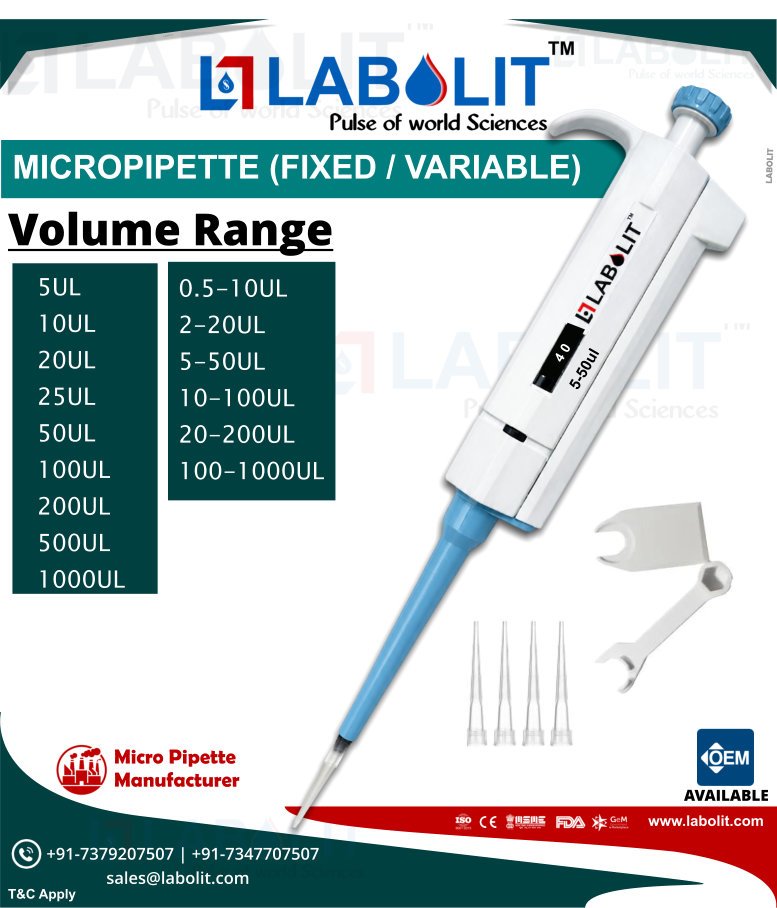
# Micropipette: Complete Guide to Precision Liquid Handling, Types, Applications, Selection, Operation and Maintenance In modern laboratories, **precision liquid handling** is one of the most important steps in obtaining reliable and reproducible results. Whether a laboratory is performing molecular biology experiments, pharmaceutical research, diagnostic testing, microbiology, biotechnology, food analysis or academic research, even a small error in liquid volume can influence the final outcome. A **micropipette** is a precision laboratory instrument specifically designed to aspirate and dispense small quantities of liquid, generally in the microliter range. It allows laboratory professionals to transfer measured volumes more conveniently and consistently than conventional droppers or measuring cylinders. The growing demand for accurate laboratory equipment has made micropipettes an essential product for research institutions, pharmaceutical companies, hospitals, diagnostic laboratories, universities, biotechnology companies and quality-control laboratories. **LABOLIT**, a laboratory equipment brand, offers micropipettes in **fixed-volume and variable-volume configurations**, with multiple volume ranges designed for different laboratory requirements. This comprehensive article explains the fundamentals of micropipettes, their types, working principles, components, applications, volume ranges, advantages, proper operating techniques, calibration, maintenance, common mistakes and important factors to consider before purchasing a micropipette. --- # What Is a Micropipette? A micropipette is a laboratory liquid-handling device used to accurately transfer small volumes of liquids. The word "micro" refers to the small volume capacity of the instrument. Volumes are commonly measured in **microliters (µL)**. For reference: **1,000 µL = 1 mL** Therefore: * 5 µL = 0.005 mL * 10 µL = 0.01 mL * 20 µL = 0.02 mL * 50 µL = 0.05 mL * 100 µL = 0.1 mL * 200 µL = 0.2 mL * 500 µL = 0.5 mL * 1000 µL = 1 mL Micropipettes are designed to provide controlled liquid transfer within a specified volume range. Depending on the model, a micropipette can be: * Fixed volume * Variable volume * Single channel * Multichannel * Manual * Electronic * Air displacement * Positive displacement * Autoclavable or partially autoclavable The correct type depends on the laboratory application. --- # Why Are Micropipettes Important in Laboratories? Many laboratory experiments use very small quantities of samples and reagents. For example, a molecular biology procedure may require only a few microliters of a particular reagent. Measuring such a volume using a conventional measuring cylinder would not provide the required level of control. Micropipettes allow laboratory professionals to transfer small volumes efficiently. They are used for: * DNA analysis * RNA analysis * PCR * qPCR * ELISA * Cell culture * Microbiology * Biochemistry * Pharmaceutical research * Clinical diagnostics * Sample preparation * Food testing * Environmental testing * Forensic science * Biotechnology * Academic research --- # LABOLIT Micropipette The LABOLIT micropipette shown in the supplied product image is designed for laboratory liquid-handling applications. The product is available in: ### Fixed Volume * 5 µL * 10 µL * 20 µL * 25 µL * 50 µL * 100 µL * 200 µL * 500 µL * 1000 µL ### Variable Volume * 0.5–10 µL * 2–20 µL * 5–50 µL * 10–100 µL * 20–200 µL * 100–1000 µL This range allows laboratories to select a pipette according to the volume requirements of their application. --- # Understanding Micropipette Volume Ranges Choosing the correct volume range is one of the most important decisions when purchasing a micropipette. A micropipette should be used only within its specified operating range. For example, a **5–50 µL micropipette** is designed for volumes within its specified 5–50 µL range. Similarly, a **100–1000 µL micropipette** is intended for larger liquid volumes within its operating range. Using the correct volume range can help improve liquid-handling consistency. --- # Fixed-Volume Micropipette A fixed-volume micropipette is designed to deliver one specific volume. Examples include: * 5 µL * 10 µL * 20 µL * 25 µL * 50 µL * 100 µL * 200 µL * 500 µL * 1000 µL Fixed-volume pipettes are particularly useful for laboratories that repeatedly perform procedures requiring the same liquid volume. ## Benefits of Fixed-Volume Micropipettes Fixed-volume pipettes can offer: * Simple operation * Fast repetitive pipetting * Consistent volume selection * Reduced volume-adjustment errors * Convenient operation for routine protocols If a laboratory repeatedly uses exactly 100 µL, for example, a fixed 100 µL micropipette can be a convenient option. --- # Variable-Volume Micropipette A variable-volume micropipette allows the operator to select different volumes within a specified range. For example: **5–50 µL** allows the user to adjust the volume according to the requirements of the laboratory procedure. Variable-volume micropipettes are highly useful in research laboratories because one instrument can support multiple procedures within its operating range. --- # Fixed vs Variable Micropipette | Feature | Fixed Volume | Variable Volume | | -------------------- | ----------------- | ------------------------------------ | | Volume selection | One volume | Multiple volumes | | Flexibility | Lower | Higher | | Repetitive work | Excellent | Excellent | | Multiple experiments | Limited | More flexible | | Adjustment required | Usually no | Yes | | Common use | Routine protocols | Research and general laboratory work | Both types have their own advantages. --- # Air-Displacement Micropipette The LABOLIT micropipette shown in the supplied product image is representative of the common manual **air-displacement micropipette** design. Air-displacement pipettes use an internal piston and an air column between the piston and liquid. When the plunger is pressed and released, the air volume changes, creating the pressure difference required to aspirate or dispense liquid. The general principle can be represented as: **Plunger movement → Piston movement → Air displacement → Pressure change → Liquid movement** Air-displacement pipettes are widely used because they are versatile and suitable for many routine laboratory applications. --- # Positive-Displacement Micropipettes Positive-displacement pipettes work differently from conventional air-displacement systems. The piston directly interacts with the liquid through the disposable tip or piston assembly. They may be useful for difficult liquids such as: * Highly viscous liquids * Volatile liquids * Liquids with unusual vapor pressure * Certain challenging laboratory reagents For routine aqueous laboratory liquids, air-displacement micropipettes are widely used. --- # Main Parts of a Micropipette Understanding the construction of a micropipette helps users operate and maintain it correctly. The LABOLIT micropipette shown in the supplied image includes several major components. These include: 1. Plunger Button 2. Plunger Shaft 3. Grippy 4. Tip Ejector 5. Display 6. Tip Ejector Collar 7. Tip Cone 8. Calibration Tool Each component has a specific role. --- # 1. Plunger Button The **plunger button** is positioned at the top of the micropipette. It is operated by the user's thumb. Pressing the plunger activates the internal piston mechanism. Most conventional manual micropipettes have two distinct plunger positions: ### First Stop The first stop is used for controlled aspiration and dispensing of the selected volume. ### Second Stop The second stop can be used during the final dispensing or blow-out stage to help expel residual liquid from the tip. The user should operate the plunger smoothly rather than pressing it suddenly. --- # 2. Plunger Shaft The plunger shaft connects the plunger mechanism with the internal operating system. When the plunger button is moved, the plunger shaft transfers the mechanical movement into the piston mechanism. This contributes to controlled liquid aspiration and dispensing. --- # 3. Grippy The **grippy** provides finger support and contributes to ergonomic handling. A comfortable grip is important because laboratory users may perform hundreds of pipetting operations during a working day. An ergonomic pipette can help reduce: * Hand fatigue * Finger strain * Wrist discomfort * Repetitive stress --- # 4. Tip Ejector The **tip ejector** is used to remove the disposable pipette tip. Instead of manually pulling the tip from the tip cone, the operator can activate the tip ejector mechanism. This is useful for: * Contamination control * Convenient operation * Safer tip disposal * Faster laboratory workflow --- # 5. Display The display indicates the selected volume on adjustable micropipettes. For example, the supplied LABOLIT product image shows a variable-volume pipette marked: **5–50 µL** The operator should always check the displayed volume before starting the procedure. --- # 6. Tip Ejector Collar The tip ejector collar is positioned around the lower section of the micropipette body. It forms part of the tip-ejection mechanism and helps transfer movement from the ejector system to the disposable pipette tip. --- # 7. Tip Cone The tip cone is the lower connection section of the micropipette. The disposable pipette tip is attached to the tip cone. A good connection between the tip and tip cone is important because poor fitting may result in: * Air leakage * Liquid leakage * Inconsistent aspiration * Incorrect dispensing * Tip detachment --- # 8. Calibration Tool The calibration tool shown with the LABOLIT micropipette is intended for appropriate calibration or adjustment procedures where supported by the product design. Calibration adjustments should be performed by trained or authorized personnel according to the manufacturer's instructions and applicable laboratory requirements. --- # How Does a Micropipette Work? The working principle of a conventional air-displacement micropipette involves the controlled movement of a piston. The piston changes the volume of air inside the pipette. When the plunger is operated, pressure inside the system changes. This pressure difference allows liquid to enter the disposable tip during aspiration. When the plunger is pressed during dispensing, the pressure changes in the opposite direction and the liquid is expelled. The complete process involves: **Volume setting → Plunger operation → Piston movement → Pressure change → Liquid aspiration → Liquid dispensing** --- # Step-by-Step Guide to Using a Micropipette Correct technique is essential for achieving consistent results. ## Step 1: Select the Correct Pipette First determine the volume required for your procedure. Then select a micropipette whose specified range covers the required volume. --- ## Step 2: Set the Volume Adjust the volume mechanism until the required volume appears on the display. Never force the volume adjustment beyond the specified range. --- ## Step 3: Select the Correct Tip Choose a compatible pipette tip. The tip should fit securely onto the tip cone. --- ## Step 4: Attach the Tip Press the pipette tip onto the tip cone using appropriate pressure. Do not apply excessive force. --- ## Step 5: Press to the First Stop Press the plunger smoothly until the first stop. --- ## Step 6: Immerse the Tip Place the tip into the liquid at an appropriate immersion depth. Do not unnecessarily immerse the tip deeply. --- ## Step 7: Aspirate Slowly release the plunger to aspirate the liquid. Smooth operation is important. --- ## Step 8: Pause Allow a short pause after aspiration where appropriate. --- ## Step 9: Move to the Receiving Container Transfer the micropipette to the destination vessel without touching the tip against unwanted surfaces. --- ## Step 10: Dispense Press the plunger smoothly. Depending on the technique and application, the second stop may be used for the final blow-out. --- ## Step 11: Eject the Tip Activate the tip ejector to release the used tip. Dispose of the tip appropriately. --- # Micropipetting Technique Good technique is one of the most important factors affecting pipette performance. The following practices can help improve consistency: * Hold the pipette appropriately. * Use the correct pipette range. * Use compatible tips. * Operate the plunger slowly. * Maintain consistent immersion depth. * Avoid unnecessary tip contact. * Dispense smoothly. * Change tips between samples where required. * Keep the pipette clean. * Follow calibration procedures. --- # Why Tip Immersion Depth Matters When using an air-displacement pipette, the depth at which the tip is immersed can influence aspiration. If the tip is inserted too deeply: * More liquid may adhere to the outside. * Hydrostatic effects may influence aspiration. * Contamination risk may increase. If the tip is inserted too shallowly: * Air may be aspirated. * The intended volume may not be transferred correctly. Therefore, maintaining an appropriate and consistent immersion depth is important. --- # Why Pipette Angle Matters During aspiration, the micropipette should generally be held in a consistent and appropriate orientation. An excessive angle can change the relationship between the tip, liquid and air column. Consistent technique improves repeatability. --- # Pre-Wetting Pipette Tips Pre-wetting can be useful for certain applications. It involves aspirating and dispensing the same liquid before taking the final sample. This can help condition the tip and may improve consistency for certain liquids. However, pre-wetting should be applied according to the specific liquid and laboratory procedure. --- # Pipetting Water-Based Liquids Water-like solutions are generally straightforward for air-displacement micropipettes. Examples include: * Buffers * Dilute aqueous solutions * Many laboratory reagents * Water * Certain biological samples Correct pipetting technique remains important even for simple liquids. --- # Pipetting Viscous Liquids Viscous liquids behave differently from water. Examples include: * Glycerol-rich solutions * Concentrated protein solutions * Certain oils * Thick biological solutions These liquids may require slower aspiration and dispensing. In some cases, reverse pipetting or positive-displacement technology may be more appropriate. --- # Pipetting Volatile Liquids Volatile liquids can evaporate rapidly. Because air-displacement pipettes contain an air column, vapor pressure may influence performance. For volatile liquids, the laboratory should use an appropriate technique or pipette technology recommended for the application. --- # Micropipette Accuracy Accuracy is an important characteristic of a laboratory micropipette. Accuracy refers to how close the delivered volume is to the intended or reference volume. For example, if a pipette is set to deliver a specified volume, its actual delivery should be evaluated against the relevant performance specification. Accuracy should be verified using appropriate calibration or testing procedures. --- # Micropipette Precision Precision refers to the closeness of repeated measurements to one another. For example, if a pipette repeatedly delivers nearly the same volume, it demonstrates good repeatability. A pipette should ideally provide both: **Accuracy + Precision** These two characteristics are essential for reliable laboratory liquid handling. --- # Accuracy vs Precision Consider the following example. A pipette repeatedly delivers: 99.8 µL, 99.9 µL and 100.0 µL This demonstrates good repeatability around the intended 100 µL value. However, if a pipette repeatedly delivers: 97 µL, 97.1 µL and 97.2 µL the measurements may be consistent with one another but are not close to the intended 100 µL. This illustrates the difference between precision and accuracy. --- # Micropipette Calibration Calibration is the process of checking and, where applicable, adjusting a pipette to ensure that its performance is within the required limits. Calibration is especially important in: * Pharmaceutical laboratories * Clinical laboratories * Research laboratories * Biotechnology * Quality-control laboratories * Accredited laboratories * Diagnostic facilities The calibration procedure should be performed according to applicable standards, manufacturer recommendations and laboratory quality procedures. --- # ISO 8655 and Pipette Performance The **ISO 8655** series provides important requirements and test methods for piston-operated volumetric apparatus. Laboratories should use the relevant standard and their own quality procedures when establishing pipette verification and calibration programs. Calibration documentation can be particularly important for regulated environments. --- # Gravimetric Calibration of Micropipettes One commonly used approach for evaluating pipette performance is gravimetric testing. In a controlled environment, a defined volume of water is dispensed and its mass is measured. The measured mass can then be converted to volume using appropriate corrections. Factors such as: * Water temperature * Air temperature * Atmospheric pressure * Evaporation * Water density may need to be considered. Formal calibration should be carried out by trained personnel using suitable equipment and procedures. --- # How Often Should a Micropipette Be Calibrated? There is no single universal interval suitable for every laboratory. Calibration frequency can depend on: * Frequency of use * Type of application * Required accuracy * Regulatory requirements * Manufacturer recommendations * Previous calibration results * Laboratory quality system A pipette used heavily for critical testing may require more frequent verification than a pipette used occasionally for educational work. --- # Micropipette Maintenance Routine maintenance helps preserve pipette performance. Important maintenance activities may include: * External cleaning * Inspection * Tip cone inspection * Plunger inspection * Tip ejector inspection * Seal inspection * Calibration * Replacement of worn parts * Proper storage The exact maintenance procedure depends on the pipette model. --- # Cleaning a Micropipette A general cleaning process may include: 1. Remove the disposable tip. 2. Inspect the pipette. 3. Clean the external surface using a compatible cleaning method. 4. If required, disassemble permitted components. 5. Clean contaminated parts according to manufacturer instructions. 6. Dry appropriately. 7. Reassemble. 8. Verify performance where necessary. Do not use cleaning chemicals that may damage the pipette materials. --- # Pipette Storage Proper storage is often underestimated. A micropipette should preferably be stored on a suitable pipette stand. A stand can help prevent: * Accidental falls * Bench contamination * Tip cone damage * Unnecessary contact with laboratory surfaces For laboratories using multiple pipettes, a dedicated pipette stand can improve organization. --- # Common Micropipette Problems ## Liquid Leakage Possible causes may include: * Poorly fitted tip * Damaged tip * Damaged seal * Incorrect assembly * Contamination --- ## Inconsistent Volume Possible causes include: * Incorrect pipetting technique * Poor tip fit * Calibration issues * Damaged internal components * Temperature effects * Liquid properties --- ## Difficult Plunger Movement Possible causes may include: * Contamination * Mechanical wear * Incorrect assembly * Damaged internal components --- ## Tip Ejector Not Working Possible causes may include: * Mechanical obstruction * Incorrect assembly * Damaged ejector mechanism --- # When Should a Micropipette Be Serviced? A micropipette should be inspected or serviced if: * It has been dropped. * The plunger behaves abnormally. * Liquid leakage occurs. * Tip attachment becomes unreliable. * Volume performance is questionable. * Calibration results fall outside acceptable limits. * The ejector mechanism becomes difficult to operate. * Internal contamination is suspected. --- # Micropipette Tips and Their Importance A micropipette tip is not simply an accessory. It is a critical part of the liquid-handling system. The quality and compatibility of the tip can affect: * Aspiration * Dispensing * Leakage * Sample retention * Contamination * Reproducibility Always use suitable tips for the micropipette. --- # Standard Pipette Tips Standard tips are commonly used for routine laboratory applications. They are suitable for many: * Aqueous solutions * Buffers * Reagents * Samples The exact tip size should match the micropipette. --- # Filter Pipette Tips Filter tips contain a barrier designed to reduce aerosol movement into the pipette. They can be useful for applications where contamination control is important, such as: * PCR * Molecular biology * DNA work * RNA work * Clinical laboratory procedures --- # Sterile Pipette Tips Sterile tips are commonly used where microbiological or biological contamination must be controlled. Examples include: * Cell culture * Molecular biology * Biotechnology * Clinical research --- # Low-Retention Pipette Tips Low-retention tips are designed to minimize liquid remaining on the inner wall of the tip. They can be beneficial when handling: * Proteins * Expensive reagents * Small volumes * Viscous samples --- # Single-Channel Micropipette A single-channel micropipette transfers liquid through one tip. It is one of the most widely used pipette configurations. Applications include: * Individual sample handling * Reagent transfer * PCR * DNA extraction * Biochemistry * Microbiology * Research --- # Multichannel Micropipette Multichannel micropipettes contain multiple tip channels. Common configurations include: * 8-channel * 12-channel They are particularly useful when working with microplates. Applications include: * ELISA * High-throughput screening * Microplate assays * Molecular biology * Research laboratories --- # Micropipettes in PCR PCR is one of the most common applications for small-volume micropipettes. PCR reactions may require carefully measured amounts of: * Template DNA * Primers * Polymerase * Buffer * Nucleotides * Water A pipette with a suitable small-volume range can help ensure consistent reagent transfer. --- # Micropipettes in Molecular Biology Molecular biology frequently requires precise transfer of very small liquid volumes. Micropipettes are used during: * DNA extraction * RNA extraction * PCR * qPCR * Gel-related sample preparation * Reagent preparation * Nucleic acid workflows Because contamination can compromise experiments, appropriate tips and good laboratory practices are important. --- # Micropipettes in Pharmaceutical Research Pharmaceutical laboratories use micropipettes in: * Drug discovery * Formulation research * Quality control * Sample preparation * Analytical development * Research and development Precision liquid handling contributes to reproducible laboratory workflows. --- # Micropipettes in Diagnostic Laboratories Diagnostic laboratories may use micropipettes for: * Sample preparation * Reagent addition * Immunoassays * Molecular diagnostics * Biochemistry * Research Because diagnostic workflows may have strict quality requirements, appropriate pipette calibration and documentation can be important. --- # Micropipettes in Biotechnology Biotechnology laboratories rely heavily on precise liquid handling. Applications may include: * Cell biology * Genetic research * Protein research * Microbiology * Molecular biology * Sample preparation --- # Micropipettes in Microbiology Microbiology laboratories use micropipettes for transferring: * Culture samples * Reagents * Buffers * Antibiotic solutions * Microbial suspensions * Test samples Sterile tips and appropriate laboratory procedures help minimize contamination. --- # Micropipettes in Food Testing Food and beverage laboratories use micropipettes for: * Sample preparation * Chemical analysis * Microbiological testing * Reagent dispensing * Quality control Precise liquid transfer can contribute to reliable analytical workflows. --- # Micropipettes in Environmental Laboratories Environmental testing laboratories may use micropipettes for: * Water testing * Soil extract preparation * Chemical analysis * Microbiological testing * Reagent preparation The correct pipette range depends on the testing method. --- # Micropipettes in Forensic Laboratories Forensic laboratories may use micropipettes for small-volume sample preparation and molecular analysis. Applications can include: * DNA analysis * Biological sample preparation * Reagent transfer * Molecular testing Because forensic samples can be limited, careful liquid handling is especially important. --- # Micropipettes in Academic Research Universities and colleges use micropipettes in: * Biology * Biochemistry * Biotechnology * Microbiology * Chemistry * Molecular biology Micropipette training is an important part of laboratory education. --- # Importance of Ergonomic Micropipette Design Laboratory professionals may perform repetitive pipetting tasks for extended periods. An ergonomic micropipette can help make these tasks more comfortable. Useful ergonomic characteristics include: * Comfortable grip * Smooth plunger movement * Convenient tip ejection * Balanced design * Easy volume adjustment * Low operating effort Ergonomics can be especially important for high-throughput laboratory environments. --- # How to Choose the Right Micropipette Before purchasing a micropipette, evaluate the following: ## Volume Requirement Identify the minimum and maximum volumes required. ## Fixed or Variable Choose fixed volume for repetitive single-volume work. Choose variable volume for flexibility. ## Single or Multichannel Select single-channel for individual samples. Select multichannel for microplates and high-throughput work. ## Accuracy Requirement Consider the accuracy required by your application. ## Tip Compatibility Confirm that suitable tips are available. ## Sterility Determine whether sterile or filtered tips are required. ## Autoclavability Consider autoclavability if your laboratory requires it. ## Calibration Check calibration and service support. ## Ergonomics Consider comfort for repetitive pipetting. --- # Why One Micropipette Is Not Enough for Every Laboratory Application Many laboratories initially try to use one pipette for multiple volume ranges. However, different pipettes are designed for different volume capacities. For example, a laboratory may require: * 0.5–10 µL * 2–20 µL * 5–50 µL * 10–100 µL * 20–200 µL * 100–1000 µL Having appropriate pipettes for different volume ranges allows laboratory personnel to select the right instrument for each task. --- # Advantages of Using LABOLIT Micropipettes LABOLIT micropipettes provide a range of options for laboratories requiring controlled liquid handling. Key product categories include: * Fixed-volume micropipettes * Variable-volume micropipettes * Single-channel micropipettes * Multichannel micropipettes * Different laboratory volume ranges * OEM options * Laboratory liquid-handling solutions The exact features and specifications depend on the selected model. --- # LABOLIT Micropipette for OEM Applications OEM solutions can be useful for distributors and businesses looking to market laboratory products under their own brand. OEM requirements can include: * Product branding * Logo printing * Packaging * Labels * Product configuration * Documentation OEM availability, minimum order quantity and customization options should be confirmed according to the specific model and commercial requirements. --- # Micropipette Manufacturer in India India has a growing laboratory equipment industry serving: * Pharmaceutical companies * Hospitals * Diagnostic laboratories * Biotechnology companies * Research institutes * Universities * Government laboratories * Industrial laboratories A reliable micropipette manufacturer can support laboratories and distributors with products covering multiple volume ranges and application requirements. LABOLIT is positioned as a laboratory equipment brand offering micropipettes and other scientific products. --- # Micropipette Supplier in India When selecting a micropipette supplier, customers should evaluate: * Product specifications * Quality documentation * Calibration support * Warranty * Service * Tip availability * Replacement parts * Delivery * OEM capability * Technical support The cheapest product is not necessarily the most economical choice if service and long-term support are unavailable. --- # Micropipette for Distributors Micropipettes are regularly required by laboratory equipment distributors. A distributor may serve customers from: * Hospitals * Pathology labs * Pharmaceutical companies * Universities * Colleges * Research institutes * Diagnostic centers * Biotechnology companies * Government laboratories Maintaining multiple volume ranges can help distributors address different customer requirements. --- # Micropipette for Government Laboratories Government research and testing laboratories may require pipettes for: * Research * Quality testing * Environmental testing * Food testing * Pharmaceutical analysis * Public health laboratories For institutional procurement, customers may also require documentation, specifications, warranty information and appropriate compliance records. --- # Micropipette for Hospital Laboratories Hospital laboratories may require micropipettes for routine and specialized testing. Before purchasing, the laboratory should evaluate: * Volume range * Accuracy * Precision * Sterility requirements * Calibration * Service * Warranty --- # Micropipette Price in India The price of a micropipette depends on several factors. These may include: * Brand * Model * Volume range * Fixed or variable operation * Channel configuration * Autoclavability * Materials * Calibration documentation * Warranty * Order quantity For bulk procurement, distributors and institutions may receive different commercial pricing. --- # What Makes a Good Micropipette? A good micropipette should be appropriate for its intended application and provide: * Suitable volume range * Reliable mechanical operation * Good ergonomics * Secure tip fitting * Easy volume adjustment * Convenient tip ejection * Appropriate calibration support * Suitable maintenance options Quality should always be evaluated against the requirements of the laboratory procedure. --- # Micropipette and Laboratory Reproducibility Reproducibility is a major objective in scientific research. If different operators transfer different liquid volumes during the same procedure, experimental results can vary. Standardized pipetting practices and properly maintained pipettes can help reduce operator-to-operator variability. Laboratories can improve consistency by: * Training operators * Standardizing pipetting techniques * Using compatible tips * Maintaining pipettes * Establishing calibration schedules --- # Operator Training for Micropipettes Even a high-quality pipette requires proper user training. Training should cover: * Volume setting * Tip attachment * Plunger operation * Aspiration * Dispensing * Tip ejection * Cleaning * Storage * Contamination control New users should practice with suitable liquids before performing critical laboratory procedures. --- # Common Micropipette Mistakes to Avoid ## 1. Using the Wrong Volume Range Never operate outside the manufacturer's specified range. ## 2. Setting the Wrong Volume Always check the display. ## 3. Using Incompatible Tips Poor fit can lead to leakage and inconsistent delivery. ## 4. Pressing the Plunger Too Fast Smooth movement generally provides better control. ## 5. Aspirating at an Inconsistent Angle Maintain a consistent position. ## 6. Immersing the Tip Too Deeply Use appropriate immersion depth. ## 7. Reusing Tips Incorrectly Change tips according to the laboratory procedure. ## 8. Ignoring Calibration Critical pipettes should be verified according to the laboratory quality system. ## 9. Storing Pipettes Improperly Use a suitable stand when possible. ## 10. Dropping the Pipette Mechanical shocks can affect performance. --- # Micropipette Contamination Control Contamination is particularly important in molecular biology, microbiology and diagnostic applications. Good practices include: * Using appropriate disposable tips * Changing tips between samples * Using filter tips when required * Avoiding contact with contaminated surfaces * Keeping the pipette clean * Following laboratory biosafety procedures --- # Micropipette and Sample Integrity Sample integrity can be affected by incorrect handling. Precise and consistent pipetting helps laboratories maintain controlled experimental conditions. For valuable or limited samples, proper pipetting technique is especially important. --- # Micropipette Selection Checklist Before purchasing a micropipette, ask: ### Volume What volume will be transferred most frequently? ### Range Which pipette range covers the required volume? ### Type Fixed or variable? ### Channel Single or multichannel? ### Tips Which tips are compatible? ### Sterility Are sterile or filtered tips required? ### Maintenance How will the pipette be cleaned and serviced? ### Calibration What calibration process is required? ### Warranty What warranty is offered? ### Support Is technical and after-sales support available? ### OEM Is customization required? --- # Frequently Asked Questions ## What is a micropipette used for? A micropipette is used to aspirate and dispense small volumes of liquid accurately and consistently. ## What is the unit used in micropipetting? Micropipette volumes are commonly measured in microliters (µL). ## How many microliters are in one milliliter? There are: **1,000 µL = 1 mL** ## What is a fixed-volume micropipette? It is a micropipette designed to deliver one predetermined volume. ## What is a variable-volume micropipette? It allows the user to select different volumes within its specified range. ## What is an air-displacement micropipette? It uses an air column and piston mechanism to aspirate and dispense liquid. ## What is a tip cone? It is the lower section of the pipette where the disposable tip is attached. ## What does the tip ejector do? It removes the used disposable pipette tip. ## Why is calibration important? Calibration helps verify whether the pipette is delivering volumes within the required performance limits. ## Can micropipettes be used for PCR? Yes. Micropipettes are commonly used for PCR reagent and sample preparation. ## Can micropipettes be used for DNA extraction? Yes. They are commonly used for transferring buffers, reagents and samples during DNA extraction workflows. ## Can micropipettes be autoclaved? Some models are designed to be autoclavable. Always follow the manufacturer's instructions. ## How should a micropipette be stored? It should preferably be stored upright on a suitable pipette stand when not in use. ## Why are disposable tips important? Disposable tips help reduce cross-contamination and simplify liquid handling. ## What volume range should I choose? Choose a range that comfortably covers the volume required by your application and follows the manufacturer's specified operating limits. --- # Conclusion A **micropipette is an essential laboratory instrument for precise small-volume liquid handling**. Its applications extend across pharmaceutical research, biotechnology, molecular biology, microbiology, diagnostics, hospitals, universities, food testing, environmental analysis and many other scientific fields. The performance of a micropipette depends on several factors, including instrument design, volume range, tip quality, calibration, liquid properties, temperature and operator technique. LABOLIT offers **fixed-volume and variable-volume micropipettes** in a broad selection of ranges, including: **5 µL, 10 µL, 20 µL, 25 µL, 50 µL, 100 µL, 200 µL, 500 µL and 1000 µL fixed-volume options**, along with variable ranges such as: **0.5–10 µL, 2–20 µL, 5–50 µL, 10–100 µL, 20–200 µL and 100–1000 µL.** The LABOLIT micropipette design includes important components such as the **plunger button, plunger shaft, grippy, display, tip ejector, tip ejector collar, tip cone and calibration tool**. For laboratories, distributors, research institutes, pharmaceutical companies, hospitals and educational institutions, choosing the correct micropipette is an important step toward efficient and consistent liquid handling. **Choose the right volume. Use the right tip. Follow the correct pipetting technique. Maintain and calibrate the instrument appropriately.** ### LABOLIT – Pulse of World Sciences **Micropipette Manufacturer | Fixed & Variable Volume Micropipettes | Laboratory Liquid Handling Solutions | OEM Available** 🌐 **Website:** [www.labolit.com](http://www.labolit.com) 📧 **Email:** [sales@labolit.com](mailto:sales@labolit.com) 📞 **Phone:** +91-7379207507 | +91-7347707507 --- ## SEO Keywords for This Blog **micropipette, micropipette manufacturer in India, best micropipette manufacturer, micropipette supplier India, micropipette price India, LABOLIT micropipette, LABOLIT micropipette manufacturer, laboratory micropipette, laboratory pipette, micro pipette, precision micropipette, fixed volume micropipette, variable volume micropipette, adjustable micropipette, air displacement micropipette, single channel micropipette, multichannel micropipette, autoclavable micropipette, fully autoclavable micropipette, 5-50 µL micropipette, 10-100 µL micropipette, 20-200 µL micropipette, 100-1000 µL micropipette, micropipette for PCR, micropipette for molecular biology, micropipette for biotechnology, micropipette for pharmaceutical laboratory, micropipette for diagnostic laboratory, micropipette for research laboratory, pipette calibration, ISO 8655 pipette, micropipette tips, pipette tip manufacturer, laboratory equipment manufacturer India, laboratory equipment supplier, laboratory liquid handling, liquid handling equipment, micropipette OEM manufacturer, OEM micropipette, micropipette exporter India, best laboratory pipette brand, LABOLIT laboratory equipment.**

Premium Quality Micropipette Manufacturer in India

Introduction

Micropipettes are among the most important liquid-handling instruments used in modern laboratories. From research and pharmaceutical laboratories to diagnostic centers, biotechnology companies, hospitals, universities, food testing laboratories, and quality-control facilities, accurate liquid handling is essential for obtaining reliable and repeatable results.

A high-quality micropipette allows laboratory professionals to transfer very small quantities of liquid with precision and consistency. Even a minor variation in liquid volume can affect an experiment, assay, reaction, diagnostic test, or research result. For this reason, laboratories need dependable micropipettes manufactured with appropriate materials, accurate mechanisms, quality-control procedures, and suitable calibration.

India has become an important manufacturing and supply center for laboratory equipment, including micropipettes. Indian manufacturers are increasingly providing high-quality laboratory products for domestic laboratories as well as distributors, institutions, pharmaceutical companies, diagnostic centers, and international markets.

Uma Scientific, with its LABOLIT brand, focuses on manufacturing and supplying laboratory liquid-handling products including micropipettes. The LABOLIT range is designed for applications where accuracy, ease of use, durability, and cost-effectiveness are important.

This comprehensive guide explains what makes a premium micropipette, how micropipettes work, different types and volume ranges, important features, calibration, applications, maintenance, selection criteria, and why choosing a reliable micropipette manufacturer in India can be beneficial for laboratories and distributors.


What Is a Micropipette?

A micropipette is a precision laboratory instrument used to aspirate and dispense small volumes of liquid. Depending on the model, micropipettes can handle volumes ranging from fractions of a microliter to several milliliters.

The term microliter (µL) is commonly used when discussing micropipette capacity.

1 µL = 0.001 mL

For example:

  • 10 µL = 0.01 mL
  • 100 µL = 0.1 mL
  • 1,000 µL = 1 mL
  • 5,000 µL = 5 mL
  • 10,000 µL = 10 mL

Micropipettes are widely used because they provide controlled liquid transfer compared with ordinary measuring cylinders, droppers, or non-precision transfer devices.

A laboratory may use micropipettes for:

  • Sample preparation
  • Reagent transfer
  • DNA and RNA research
  • PCR preparation
  • ELISA testing
  • Pharmaceutical analysis
  • Diagnostic testing
  • Microbiology
  • Cell culture
  • Biotechnology research
  • Food testing
  • Chemical analysis
  • Quality control
  • Academic research

Premium Quality Micropipette Manufacturer in India

Choosing the right manufacturer is one of the most important decisions when purchasing laboratory micropipettes. A manufacturer should not only provide an attractive product but should also focus on manufacturing consistency, material quality, volume accuracy, ergonomics, quality control, and after-sales support.

A premium micropipette manufacturer in India should ideally offer:

  • Consistent manufacturing quality
  • Reliable liquid-handling performance
  • Suitable volume ranges
  • Ergonomic design
  • Quality raw materials
  • Smooth plunger operation
  • Secure tip fitting
  • Calibration support
  • Quality inspection
  • Suitable documentation
  • Warranty support
  • Bulk supply capability
  • OEM and private-label options where required

LABOLIT by Uma Scientific is positioned as an Indian laboratory equipment brand offering micropipettes and other scientific laboratory products for different laboratory requirements.

The objective of a professional manufacturer is to provide products that combine precision, usability, durability, and value.


Why Micropipette Quality Matters

In laboratory work, accuracy is not simply a product feature—it can directly influence results.

Suppose a laboratory protocol requires 50 µL of a reagent. If the micropipette consistently delivers a significantly different volume, the final concentration may change. In a sensitive experiment, this can affect the outcome.

Quality micropipettes are therefore important for:

Accuracy

Accuracy refers to how close the delivered volume is to the intended volume.

Precision

Precision refers to the consistency of repeated liquid transfers.

Repeatability

A good micropipette should deliver consistent results when operated correctly under the same conditions.

Ergonomics

Laboratory personnel may use pipettes hundreds of times during a working day. A comfortable instrument can help reduce hand fatigue.

Durability

A micropipette used regularly should be manufactured using appropriate materials and components to withstand routine laboratory operation.


LABOLIT Micropipettes by Uma Scientific

LABOLIT micropipettes are designed for laboratories looking for reliable liquid-handling solutions at competitive prices.

The product range can include different models and volume configurations according to laboratory requirements.

Common LABOLIT series discussed for laboratory applications include:

  • LABOLIT UM-ECO
  • LABOLIT UM-PRIME
  • LABOLIT UM-PRO
  • LABOLIT UM-MAX
  • LABOLIT UM-ULTRA
  • LABOLIT UM-MULTI
  • LABOLIT UM-MINI
  • LABOLIT UM-LABPRO

The availability of a particular model and volume range may depend on the current product configuration.

Different laboratory users may have different priorities. A routine teaching laboratory may focus on affordability and reliability, while a research laboratory may prioritize advanced ergonomics, calibration, and precision.


Types of Micropipettes

Micropipettes are available in several configurations.

1. Variable Volume Micropipette

A variable-volume micropipette allows the user to select a volume within a defined operating range.

For example, a 20–200 µL micropipette can generally be adjusted for liquid transfer within its specified range.

Common variable-volume ranges include:

  • 0.1–2 µL
  • 0.5–10 µL
  • 2–20 µL
  • 5–50 µL
  • 10–100 µL
  • 20–200 µL
  • 50–500 µL
  • 100–1,000 µL
  • 1,000–5,000 µL
  • 0.5–5 mL
  • 1–10 mL

The exact specifications depend on the model.

Variable-volume pipettes are particularly useful in laboratories where different volumes are routinely required.


Fixed Volume Micropipette

A fixed-volume micropipette is designed to dispense a predetermined volume.

For example:

  • 10 µL
  • 20 µL
  • 50 µL
  • 100 µL
  • 200 µL
  • 1,000 µL

Fixed-volume pipettes can be useful in standardized laboratory workflows where a specific volume is repeatedly required.

They can also simplify operation because the user does not need to adjust the volume before every transfer.


Single-Channel Micropipette

A single-channel micropipette contains one liquid-handling channel.

It is one of the most common laboratory pipette configurations.

Single-channel micropipettes are suitable for:

  • Sample transfer
  • Reagent preparation
  • Routine laboratory testing
  • Molecular biology
  • Pharmaceutical laboratories
  • Diagnostic laboratories
  • Academic laboratories
  • Research laboratories

A laboratory can select several single-channel pipettes with different volume ranges to cover its complete liquid-handling requirements.


Multichannel Micropipette

A multichannel micropipette contains multiple channels, allowing several wells or containers to be handled simultaneously.

Common configurations include:

  • 8-channel micropipette
  • 12-channel micropipette

Multichannel pipettes are particularly useful for microplate-based applications.

Applications include:

  • ELISA
  • PCR setup
  • Microplate preparation
  • Serial dilution
  • Research assays
  • High-throughput laboratory workflows

The primary advantage is improved efficiency. Instead of transferring liquid individually into every well, multiple wells can be handled in one operation.


Fully Autoclavable Micropipettes

Some laboratory environments require instruments that can undergo sterilization procedures.

A fully autoclavable micropipette is designed so that the specified components or the complete pipette can be autoclaved according to the manufacturer’s instructions.

LABOLIT’s premium-range configurations can include fully autoclavable micropipettes for laboratories where sterilization is an important consideration.

Before autoclaving any laboratory instrument, users should always follow the manufacturer’s operating and sterilization instructions.


Semi-Autoclavable Micropipettes

Semi-autoclavable models are designed with selected components that can be sterilized according to manufacturer specifications.

These can provide a balance between routine laboratory requirements and sterilization needs.

The exact autoclavability of components should always be confirmed from the product documentation.


Important Parts of a Micropipette

Understanding the major components of a micropipette helps users operate and maintain the instrument correctly.

Plunger Button

The plunger button is pressed during aspiration and dispensing.

Many micropipettes use a two-stop plunger mechanism.

The first stop is generally used for aspiration and dispensing of the selected volume, while the second stop can be used for blow-out during dispensing.


Volume Adjustment Mechanism

Variable-volume pipettes include a mechanism for setting the desired volume.

The user should adjust the volume within the manufacturer’s specified operating range.

Operating a pipette outside its designed range can negatively affect performance and may damage the mechanism.


Tip Cone

The tip cone connects the disposable pipette tip to the pipette.

A well-designed tip cone helps provide secure tip attachment and consistent liquid handling.


Tip Ejector

Many micropipettes include a tip-ejection mechanism that allows the used tip to be removed without directly touching it.

This is useful for laboratory hygiene and convenient operation.


Piston and Seal System

The internal piston and sealing system are critical components of the liquid-handling mechanism.

Quality materials and appropriate manufacturing tolerances help maintain consistent operation.


How Does a Micropipette Work?

A conventional air-displacement micropipette operates using a piston mechanism.

When the plunger is pressed, the piston moves inside the pipette. This creates a change in air pressure. When a disposable tip is attached and the plunger is released, liquid is drawn into the tip.

The basic process is:

  1. Set the required volume.
  2. Attach the correct pipette tip.
  3. Press the plunger to the first stop.
  4. Immerse the tip into the liquid to the appropriate depth.
  5. Slowly release the plunger.
  6. Allow the liquid to enter the tip.
  7. Move the pipette to the receiving vessel.
  8. Press the plunger to dispense.
  9. Use the second stop when appropriate for blow-out.
  10. Eject the used tip.

Correct technique is extremely important. Even a high-quality micropipette can produce poor results if operated incorrectly.


Air Displacement vs Positive Displacement Pipettes

Micropipettes can broadly be categorized into air-displacement and positive-displacement systems.

Air-Displacement Micropipette

Air-displacement micropipettes use an air cushion between the piston and liquid.

They are widely used for routine laboratory liquid handling.

They are suitable for many aqueous solutions and standard laboratory applications.

Positive-Displacement Pipette

Positive-displacement systems use a piston that comes into direct contact with the liquid or operates through a specialized disposable piston system.

They can be advantageous for certain difficult liquids, including some viscous, volatile, or challenging samples.

The correct pipette technology should be selected according to the liquid and application.


Common Micropipette Volume Ranges

Selecting the correct volume range is essential for obtaining reliable results.

A laboratory should avoid using a pipette at an unsuitable volume simply because it is available.

For example, if a laboratory routinely transfers 5 µL, a pipette designed specifically for a low-volume range may be more suitable than a 1,000 µL pipette.

Common ranges include:

Micropipette RangeTypical Use
0.1–2 µLVery low-volume applications
0.5–10 µLMolecular biology and small-volume transfer
2–20 µLSmall reagent and sample volumes
5–50 µLRoutine laboratory work
10–100 µLGeneral liquid handling
20–200 µLCommon laboratory applications
50–500 µLMedium-volume transfer
100–1,000 µLLarger routine liquid transfer
1,000–5,000 µLHigh-volume liquid handling
0.5–5 mLMilliliter-scale transfer
1–10 mLHigh-volume applications

The appropriate range depends on the actual laboratory procedure.


What Makes a Premium Micropipette?

A premium micropipette is not defined only by its appearance. Several technical and practical factors contribute to product quality.

1. Reliable Volume Adjustment

The volume-adjustment mechanism should operate smoothly and allow the user to select the required volume accurately.

2. Smooth Plunger Movement

A smooth plunger reduces unnecessary force during repetitive operation.

3. Ergonomic Design

The pipette should be comfortable to hold and operate.

4. Secure Tip Fit

The disposable tip should fit securely without unnecessary force.

5. Consistent Liquid Handling

The instrument should provide reliable aspiration and dispensing when used according to specifications.

6. Durable Materials

The body and internal components should be manufactured using appropriate materials for laboratory use.

7. Calibration Capability

Professional laboratory micropipettes should be capable of calibration and performance verification according to applicable procedures.

8. Quality Control

Manufacturing inspection and quality-control procedures are important for consistent production.


Micropipette Calibration

Calibration is one of the most important aspects of micropipette quality management.

Calibration determines whether a pipette delivers liquid within specified performance limits.

A gravimetric method using a calibrated balance is commonly used in professional pipette calibration procedures.

Factors that may influence results include:

  • Temperature
  • Humidity
  • Liquid density
  • Operator technique
  • Pipette condition
  • Tip quality
  • Evaporation
  • Balance accuracy
  • Environmental conditions

Laboratories should establish calibration and verification schedules based on usage, risk, regulatory requirements, and internal quality systems.


ISO 8655 and Micropipette Performance

ISO 8655 is an important international standard associated with piston-operated volumetric apparatus, including pipettes.

When evaluating a micropipette, laboratories may consider whether the product is designed and tested with reference to applicable standards.

However, users should distinguish between:

  • Manufacturer specifications
  • Calibration reports
  • Product compliance statements
  • Third-party certification

These are not necessarily the same thing.

A professional manufacturer should provide accurate product documentation and should not make unsupported certification claims.


Importance of Pipette Tips

A micropipette is only part of the liquid-handling system.

The quality and compatibility of the pipette tip can significantly affect performance.

A suitable pipette tip should provide:

  • Proper fit
  • Good sealing
  • Consistent dimensions
  • Appropriate material quality
  • Low contamination risk
  • Reliable liquid retention characteristics

LABOLIT and Uma Scientific also focus on laboratory liquid-handling accessories and tips for different applications.


5 mL and 10 mL Pipette Tips

Larger-volume liquid handling may require 5 mL and 10 mL pipette tips or compatible high-volume pipetting solutions.

These products are useful for laboratories handling larger liquid volumes.

Because high-volume tips can involve different manufacturing requirements and material consumption, availability and production may depend on specific customer requirements and order quantities.

For specialized 10 mL tips, manufacturing on an order basis can be suitable when customers require specific quantities or configurations.


Why Choose an Indian Micropipette Manufacturer?

India has a growing scientific equipment manufacturing ecosystem.

Buying from an Indian manufacturer can provide several advantages.

Local Communication

Indian customers can communicate directly with the manufacturer or supplier regarding product specifications, pricing, delivery, and technical requirements.

Faster Support

Local customers may benefit from easier communication regarding warranty and service.

Bulk Supply

Indian manufacturers can support distributors, institutions, laboratories, and industrial customers requiring multiple units.

OEM Opportunities

Many businesses require products under their own brand name. OEM manufacturing can support such requirements, subject to manufacturer terms and minimum order quantities.

Competitive Pricing

Domestic manufacturing can provide competitive pricing by reducing some import-related costs.

Product Customization

Depending on the manufacturer, certain specifications, branding, packaging, or accessories may be customized for bulk orders.


OEM Micropipette Manufacturing in India

OEM stands for Original Equipment Manufacturer.

OEM micropipette manufacturing allows businesses to source products manufactured according to an agreed specification and sell them under their own brand.

OEM customers may include:

  • Laboratory equipment distributors
  • Scientific instrument companies
  • Medical suppliers
  • Pharmaceutical suppliers
  • Exporters
  • Regional distributors
  • Institutional suppliers

OEM requirements may include:

  • Brand printing
  • Customized packaging
  • Product labels
  • Instruction manuals
  • Model numbers
  • Bulk quantities
  • Packaging configurations

For businesses considering OEM micropipettes, it is important to discuss product specifications, quality requirements, branding, MOQ, packaging, inspection, warranty, and delivery timelines before placing an order.


Micropipette Manufacturer for Distributors and Dealers

Scientific equipment distributors play an important role in supplying laboratories throughout India.

A reliable manufacturer can help distributors by providing:

  • Dealer pricing
  • Product catalogues
  • Product images
  • Technical specifications
  • Sales support
  • Warranty information
  • Bulk supply
  • OEM/private-label support
  • Product training material

A distributor should evaluate not only purchase price but also product quality, consistency, warranty, availability, and customer support.

The cheapest product is not always the most economical choice if poor performance results in replacement costs or customer complaints.


Micropipettes for Pharmaceutical Laboratories

Pharmaceutical laboratories require accurate liquid handling during:

  • Formulation development
  • Quality control
  • Research
  • Analytical procedures
  • Sample preparation
  • Microbiological testing
  • Research and development

Micropipettes can be used for transferring reagents, samples, buffers, standards, and other laboratory liquids.

In regulated environments, laboratories should follow their internal SOPs and applicable quality-management requirements.


Micropipettes for Diagnostic Laboratories

Diagnostic laboratories frequently perform procedures where accurate sample and reagent volumes are essential.

Micropipettes may be used for:

  • Sample preparation
  • Reagent dispensing
  • Biochemistry procedures
  • Immunoassays
  • Molecular diagnostics
  • Microbiology
  • Serology
  • Research applications

The selected pipette should be appropriate for the required volume, liquid type, workload, and laboratory procedure.


Micropipettes for Biotechnology Research

Biotechnology laboratories often work with very small volumes.

Micropipettes are essential for:

  • DNA research
  • RNA research
  • PCR
  • qPCR preparation
  • Protein analysis
  • Cell biology
  • Molecular biology
  • Genetic research
  • Enzyme assays

Low-volume pipettes can be particularly important when working with precious samples or expensive reagents.


Micropipettes for Universities and Educational Laboratories

Educational laboratories use micropipettes to teach students proper liquid-handling techniques.

Students can learn:

  • Volume measurement
  • Pipetting technique
  • Serial dilution
  • Sample preparation
  • Laboratory safety
  • Basic molecular biology
  • Biochemistry procedures

For educational institutions, durability, ease of use, affordability, and availability of replacement tips are important considerations.


Micropipettes for Food and Beverage Laboratories

Food testing laboratories may use micropipettes during:

  • Microbiological testing
  • Chemical analysis
  • Quality control
  • Sample preparation
  • Research
  • Contamination testing

Because food laboratories can handle different types of samples, proper tip selection and cleaning procedures are important.


Micropipettes for Research Laboratories

Research laboratories often need several micropipette ranges because experiments may involve different liquid volumes.

A typical laboratory may maintain:

  • Low-volume pipettes
  • Medium-volume pipettes
  • High-volume pipettes
  • Multichannel pipettes
  • Specialized pipettes

Using a range of pipettes helps researchers select an instrument suited to the required volume.


How to Select the Best Micropipette

Selecting a micropipette should be based on application rather than appearance alone.

Consider the following factors.

1. Required Volume

Determine the actual volumes used most frequently.

2. Volume Range

Select a pipette where the required volume falls comfortably within its specified operating range.

3. Accuracy Requirements

For sensitive applications, pay particular attention to performance specifications.

4. Precision Requirements

Repeated measurements require good repeatability.

5. Ergonomics

For high-throughput applications, comfortable operation is important.

6. Autoclavability

If sterilization is required, select an appropriate autoclavable model.

7. Tip Compatibility

Ensure that suitable tips are readily available.

8. Maintenance

Check whether replacement parts, seals, and service support are available.

9. Calibration

Consider calibration requirements and documentation.

10. Warranty

A suitable warranty can provide additional confidence for laboratory purchasing.


Common Mistakes When Using Micropipettes

Even premium-quality micropipettes can provide poor results when used incorrectly.

Common mistakes include:

  • Using the wrong pipette range
  • Operating outside the specified volume range
  • Using incompatible tips
  • Pressing the plunger too quickly
  • Immersing the tip too deeply
  • Holding the pipette at an incorrect angle
  • Failing to pre-wet tips when required
  • Reusing disposable tips unnecessarily
  • Ignoring calibration
  • Dropping the pipette
  • Storing the pipette incorrectly
  • Applying excessive force during tip attachment

Proper user training is therefore essential.


Correct Pipetting Technique

For reliable liquid transfer, users should follow the manufacturer’s instructions and laboratory SOP.

General best practices include:

  1. Select the appropriate pipette.
  2. Set the desired volume within the allowed range.
  3. Attach a compatible tip securely.
  4. Pre-wet the tip when appropriate.
  5. Press the plunger smoothly to the correct stop.
  6. Hold the pipette in the recommended position.
  7. Immerse the tip appropriately.
  8. Aspirate slowly and consistently.
  9. Move to the receiving vessel without touching contaminated surfaces.
  10. Dispense smoothly.
  11. Use blow-out where appropriate.
  12. Eject the tip safely.

Different liquids and procedures may require different techniques.


Micropipette Maintenance

Regular maintenance helps extend the working life of a pipette.

Daily Care

At the end of routine use:

  • Inspect the pipette.
  • Remove used tips.
  • Clean external surfaces as appropriate.
  • Check for contamination.
  • Store correctly.

Regular Inspection

Check:

  • Plunger operation
  • Tip cone condition
  • Tip ejector
  • Volume adjustment mechanism
  • External damage
  • Signs of leakage

Calibration and Verification

Follow the laboratory’s calibration schedule.

If a pipette is dropped, contaminated, or shows abnormal performance, it should be inspected before being returned to routine use.


Proper Micropipette Storage

Storage conditions can influence instrument life.

Pipettes should generally be stored in a clean and dry environment according to manufacturer instructions.

A dedicated pipette stand can help prevent:

  • Accidental falls
  • Tip-cone contamination
  • Damage
  • Unnecessary contact with laboratory surfaces

Pipette stands and holders are therefore useful accessories for professional laboratories.


Micropipette Accuracy vs Precision

These two terms are often confused.

Accuracy

Accuracy means closeness to the target value.

For example, if the target volume is 100 µL and the pipette consistently delivers close to 100 µL, it has good accuracy.

Precision

Precision means consistency between repeated measurements.

A pipette could repeatedly deliver almost the same volume but still be offset from the target. In that situation, precision may be good while accuracy is poor.

Professional pipette evaluation should consider both.


Factors Affecting Micropipette Performance

Several factors can influence liquid delivery.

Temperature

Temperature differences between the pipette, liquid, and environment can affect air-displacement pipetting.

Liquid Properties

Viscosity, volatility, surface tension, and density can influence pipetting.

Operator Technique

Different users may achieve different results if technique is inconsistent.

Tip Quality

Poorly fitting or inconsistent tips can affect performance.

Pipette Condition

Worn seals or damaged components can influence aspiration and dispensing.

Calibration

Pipettes should be calibrated and verified according to appropriate procedures.


Advantages of LABOLIT Micropipettes

LABOLIT micropipettes are developed for laboratories requiring a combination of:

  • Precision
  • Practical design
  • Ergonomics
  • Reliable operation
  • Multiple volume options
  • Laboratory compatibility
  • Cost-effective solutions

Depending on the model, features may include:

  • Variable volume adjustment
  • Single-channel configuration
  • Multichannel options
  • Ergonomic body design
  • Two-step plunger operation
  • Tip ejector
  • Universal tip compatibility for suitable tips
  • Autoclavable configurations
  • Calibration support
  • Warranty

Customers should always refer to the specific model’s technical specifications before purchasing.


LABOLIT UM-ULTRA Fully Autoclavable Micropipette

The LABOLIT UM-ULTRA series represents a premium-oriented micropipette configuration for laboratories requiring a combination of ergonomic operation and sterilization capability.

Depending on the selected model, the series can cover different volume ranges.

Potential advantages include:

  • Fully autoclavable design
  • Ergonomic handling
  • Smooth plunger mechanism
  • Suitable tip-cone design
  • Laboratory-oriented construction
  • Calibration support
  • Professional appearance

The specific specifications, operating ranges, and autoclavability instructions should be confirmed from the applicable product documentation.


LABOLIT Multichannel Micropipettes

Multichannel pipettes can improve productivity in laboratories working with microplates.

An 8-channel or 12-channel configuration can allow simultaneous transfer into multiple wells.

Benefits include:

  • Reduced pipetting time
  • Improved workflow
  • Convenient microplate operation
  • Reduced repetitive manual transfers
  • Better suitability for high-throughput applications

Multichannel pipettes are particularly useful in ELISA, PCR preparation, research assays, and other microplate workflows.


Micropipette Price in India

The price of a micropipette in India depends on several factors.

These include:

  • Model
  • Volume range
  • Single-channel or multichannel design
  • Autoclavability
  • Materials
  • Performance specifications
  • Accessories
  • Packaging
  • Quantity
  • OEM requirements
  • Brand
  • Calibration requirements

Customers should compare products based on total value rather than price alone.

A premium laboratory micropipette should be evaluated according to performance, durability, support, and long-term usability.

For bulk requirements, manufacturers may offer different commercial terms depending on quantity and configuration.


Micropipette Manufacturer and Supplier in India

When searching for a micropipette manufacturer and supplier in India, laboratories and distributors should consider several factors.

Look for a company that can provide:

  • Manufacturer information
  • Technical specifications
  • Model-wise volume ranges
  • Product documentation
  • Warranty
  • Calibration information
  • Replacement support
  • Bulk supply
  • OEM capability
  • Reliable communication

Uma Scientific supplies laboratory and scientific equipment for customers across India, while LABOLIT is used as a brand for selected laboratory liquid-handling products.


Why Buy Micropipettes Directly from a Manufacturer?

Buying directly from a manufacturer can offer benefits such as:

Better Communication

Customers can discuss requirements directly with the manufacturing or sales team.

Product Knowledge

The manufacturer can provide information about models, specifications, and applications.

Bulk Orders

Direct manufacturers may be better positioned to support larger requirements.

OEM Support

Businesses looking for private-label products can discuss OEM possibilities directly.

Technical Support

Questions regarding usage, specifications, and product selection can be addressed more efficiently.


Micropipette Manufacturer for Bulk Orders

Bulk buyers may include:

  • Distributors
  • Dealers
  • Government institutions
  • Universities
  • Pharmaceutical companies
  • Diagnostic laboratories
  • Hospitals
  • Research organizations
  • Exporters
  • Scientific equipment suppliers

Bulk procurement should consider:

  • Required quantity
  • Volume ranges
  • Product models
  • Delivery schedule
  • Packaging
  • Warranty
  • Calibration documentation
  • Replacement parts
  • Payment terms
  • Shipping requirements

Manufacturers can help customers choose an appropriate combination of models.


Micropipette Exporter from India

Indian laboratory equipment manufacturers and suppliers are increasingly serving international customers.

Micropipettes can be supplied to international distributors and laboratory equipment companies depending on product requirements, destination-country regulations, documentation, shipping conditions, and commercial terms.

For export customers, it is important to discuss:

  • Product specifications
  • Packaging
  • Quantity
  • Branding
  • Export documentation
  • Country-specific requirements
  • Shipping terms
  • Payment terms
  • Lead time

Uma Scientific can work with customers looking for laboratory equipment supply and business opportunities, subject to applicable export and product requirements.


Micropipette Quality Control During Manufacturing

A professional manufacturing process should include quality-control checkpoints.

These can include:

  • Incoming material inspection
  • Component inspection
  • Assembly inspection
  • Functional testing
  • Volume-performance verification
  • Visual inspection
  • Plunger operation testing
  • Tip-fit checking
  • Final packaging inspection

Quality control helps reduce variation between units.

Manufacturers should maintain appropriate records according to their internal quality systems and applicable requirements.


Raw Materials and Manufacturing Quality

The quality of raw materials can influence the final product.

Micropipettes contain multiple components, including:

  • Polymer components
  • Sealing elements
  • Springs
  • Piston components
  • Mechanical parts
  • Tip-cone components

Manufacturers need to select appropriate materials for the intended application.

Changes in raw material costs can also affect manufacturing prices. As a result, micropipette pricing may be revised periodically based on material, production, packaging, logistics, and other operating costs.


Micropipette Brand Selection: What Should Laboratories Check?

Before purchasing a new micropipette brand, buyers should ask:

  1. Who is the manufacturer?
  2. What volume ranges are available?
  3. Is the pipette variable or fixed volume?
  4. Is it single-channel or multichannel?
  5. What tips are compatible?
  6. Is it autoclavable?
  7. What are the stated performance specifications?
  8. Is calibration documentation available?
  9. What warranty is provided?
  10. Is after-sales support available?
  11. Are replacement parts available?
  12. Is the product suitable for the intended application?
  13. Can bulk quantities be supplied?
  14. Is OEM branding available if required?

These questions can help buyers make an informed purchasing decision.


Micropipettes and Laboratory Safety

Micropipette operation should always follow laboratory safety procedures.

Important practices include:

  • Wear appropriate personal protective equipment.
  • Never pipette by mouth.
  • Use compatible tips.
  • Avoid touching contaminated tips.
  • Dispose of used tips according to laboratory waste procedures.
  • Decontaminate equipment when required.
  • Follow chemical and biological safety procedures.
  • Handle hazardous liquids according to the relevant SOP.

A micropipette is a precision instrument, but it should also be treated as part of the laboratory’s overall safety system.


Future of Micropipette Manufacturing in India

The Indian laboratory equipment sector continues to develop as demand increases from:

  • Pharmaceutical research
  • Biotechnology
  • Healthcare
  • Diagnostics
  • Academic research
  • Food testing
  • Environmental laboratories
  • Industrial quality control

The future of micropipette manufacturing is likely to focus on:

  • Improved ergonomics
  • Better materials
  • More consistent manufacturing
  • Advanced calibration systems
  • Sustainable manufacturing
  • Improved tip compatibility
  • Multichannel liquid handling
  • Automation
  • Digital laboratory workflows
  • OEM and private-label manufacturing

Indian manufacturers have opportunities to serve both domestic and international markets by maintaining consistent quality and developing products according to laboratory needs.


Frequently Asked Questions About Micropipettes

What is the best micropipette for laboratory use?

The best micropipette depends on the required volume, application, accuracy, precision, workload, liquid properties, and sterilization requirements. There is no single pipette that is ideal for every laboratory.

Which micropipette brand is good in India?

Laboratories should compare manufacturers based on quality, specifications, calibration, warranty, service, tip compatibility, and application suitability. LABOLIT by Uma Scientific is one Indian laboratory brand offering micropipettes in different configurations.

What is a variable-volume micropipette?

A variable-volume micropipette allows the user to adjust the liquid volume within the specified operating range.

What is a fixed-volume micropipette?

A fixed-volume micropipette is designed for a predetermined volume and is useful when the same volume is repeatedly required.

What is a multichannel micropipette?

A multichannel micropipette has multiple liquid-handling channels and can transfer liquid into several wells or containers simultaneously.

Are LABOLIT micropipettes autoclavable?

Selected LABOLIT models are designed with autoclavability features. Users should check the specific model documentation for exact sterilization instructions.

What is the difference between 20–200 µL and 100–1,000 µL pipettes?

They are designed for different volume ranges. A 20–200 µL pipette is suitable for smaller volumes, while a 100–1,000 µL pipette is intended for larger volumes within its specified range.

How often should a micropipette be calibrated?

Calibration frequency depends on usage, laboratory quality requirements, risk level, regulatory requirements, and internal SOPs. High-use or critical pipettes may require more frequent verification.

Can micropipettes be used with different brands of tips?

Tip compatibility depends on the pipette design and tip specifications. Users should confirm compatibility before use.

Why is pipette technique important?

Incorrect aspiration speed, immersion depth, angle, dispensing technique, and tip handling can affect liquid-delivery performance.


Conclusion

A micropipette is a small laboratory instrument with a major role in scientific accuracy. Whether used in pharmaceutical research, biotechnology, diagnostics, microbiology, hospitals, universities, food laboratories, or industrial quality control, dependable liquid handling is essential.

Choosing a premium quality micropipette manufacturer in India requires more than comparing prices. Laboratories should evaluate product design, volume range, accuracy, precision, ergonomics, materials, calibration, tip compatibility, autoclavability, warranty, and after-sales support.

Uma Scientific and its LABOLIT brand provide laboratory liquid-handling solutions including single-channel, variable-volume, multichannel, and selected autoclavable micropipette configurations.

For laboratories and distributors, the right micropipette can improve workflow, support repeatable liquid handling, reduce operational difficulties, and provide long-term value.

Whether you need a single micropipette for routine laboratory work, a complete set covering multiple volume ranges, multichannel pipettes for microplate applications, or bulk/OEM requirements, selecting a dependable manufacturer is an important step toward reliable laboratory operations.

Choose the Right Micropipette for Your Laboratory

If you are looking for a premium quality micropipette manufacturer in India, consider LABOLIT by Uma Scientific for laboratory liquid-handling requirements.

LABOLIT Micropipette Product Range

  • Variable Volume Micropipettes
  • Fixed Volume Micropipettes
  • Single Channel Micropipettes
  • Multichannel Micropipettes
  • Fully Autoclavable Micropipettes
  • Low Volume Micropipettes
  • High Volume Micropipettes
  • Micropipette Tips
  • Pipette Stands and Holders
  • OEM Micropipette Solutions

For product specifications, available volume ranges, bulk requirements, OEM enquiries, dealer opportunities, and current pricing, contact Uma Scientific – LABOLIT.


  • Micropipette manufacturer in India
  • Micropipette supplier in India
  • Best micropipette manufacturer India
  • Premium micropipette India
  • Laboratory micropipette manufacturer
  • Laboratory micropipette supplier
  • Micropipette manufacturer and supplier
  • Variable volume micropipette manufacturer
  • Fixed volume micropipette manufacturer
  • Single channel micropipette India
  • Multichannel micropipette India
  • Autoclavable micropipette India
  • Fully autoclavable micropipette
  • Micropipette supplier for laboratories
  • Micropipette manufacturer for distributors
  • OEM micropipette manufacturer India
  • Micropipette wholesale supplier India
  • Laboratory equipment manufacturer India
  • LABOLIT micropipette
  • Uma Scientific micropipette

Micropipette, Micropipette Manufacturer India, Laboratory Equipment, LABOLIT, Uma Scientific, Variable Volume Micropipette, Autoclavable Micropipette, Multichannel Micropipette, Laboratory Instruments, Scientific Equipment

Leave a Comment

Your email address will not be published. Required fields are marked *

error: Content is protected !!