Micropipette: Complete Guide to Types, Parts, Working Principle, Uses, Volume Ranges, Accuracy, Calibration, Autoclaving and Laboratory Applications

  • Home
  • Micropipette
  • Micropipette: Complete Guide to Types, Parts, Working Principle, Uses, Volume Ranges, Accuracy, Calibration, Autoclaving and Laboratory Applications
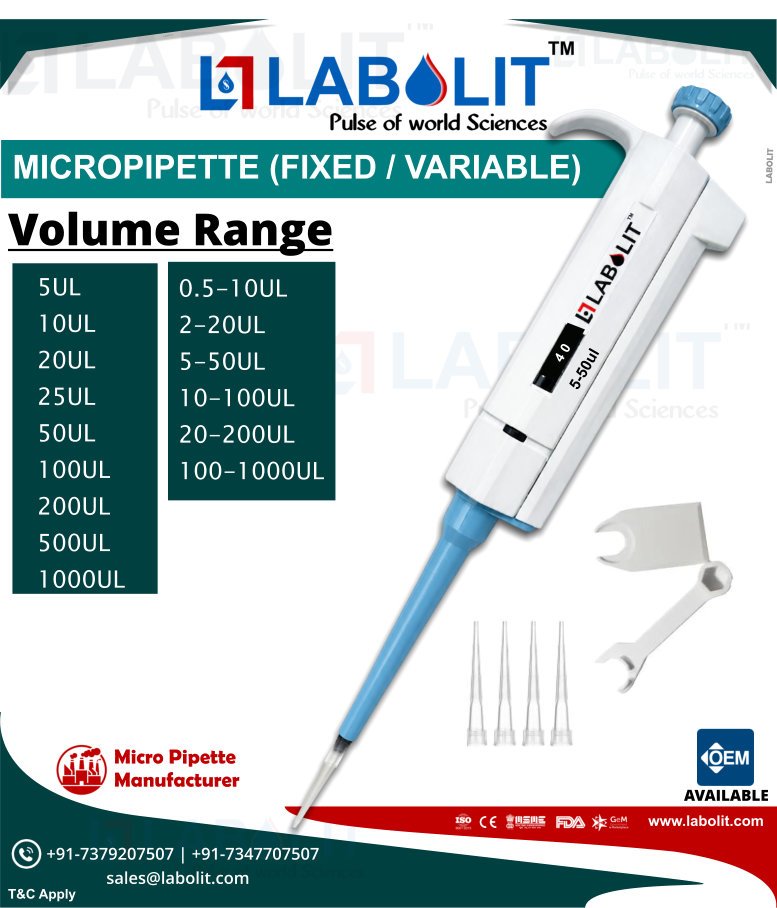
# Micropipette: Complete Guide to Precision Liquid Handling, Types, Applications, Selection, Operation and Maintenance In modern laboratories, **precision liquid handling** is one of the most important steps in obtaining reliable and reproducible results. Whether a laboratory is performing molecular biology experiments, pharmaceutical research, diagnostic testing, microbiology, biotechnology, food analysis or academic research, even a small error in liquid volume can influence the final outcome. A **micropipette** is a precision laboratory instrument specifically designed to aspirate and dispense small quantities of liquid, generally in the microliter range. It allows laboratory professionals to transfer measured volumes more conveniently and consistently than conventional droppers or measuring cylinders. The growing demand for accurate laboratory equipment has made micropipettes an essential product for research institutions, pharmaceutical companies, hospitals, diagnostic laboratories, universities, biotechnology companies and quality-control laboratories. **LABOLIT**, a laboratory equipment brand, offers micropipettes in **fixed-volume and variable-volume configurations**, with multiple volume ranges designed for different laboratory requirements. This comprehensive article explains the fundamentals of micropipettes, their types, working principles, components, applications, volume ranges, advantages, proper operating techniques, calibration, maintenance, common mistakes and important factors to consider before purchasing a micropipette. --- # What Is a Micropipette? A micropipette is a laboratory liquid-handling device used to accurately transfer small volumes of liquids. The word "micro" refers to the small volume capacity of the instrument. Volumes are commonly measured in **microliters (µL)**. For reference: **1,000 µL = 1 mL** Therefore: * 5 µL = 0.005 mL * 10 µL = 0.01 mL * 20 µL = 0.02 mL * 50 µL = 0.05 mL * 100 µL = 0.1 mL * 200 µL = 0.2 mL * 500 µL = 0.5 mL * 1000 µL = 1 mL Micropipettes are designed to provide controlled liquid transfer within a specified volume range. Depending on the model, a micropipette can be: * Fixed volume * Variable volume * Single channel * Multichannel * Manual * Electronic * Air displacement * Positive displacement * Autoclavable or partially autoclavable The correct type depends on the laboratory application. --- # Why Are Micropipettes Important in Laboratories? Many laboratory experiments use very small quantities of samples and reagents. For example, a molecular biology procedure may require only a few microliters of a particular reagent. Measuring such a volume using a conventional measuring cylinder would not provide the required level of control. Micropipettes allow laboratory professionals to transfer small volumes efficiently. They are used for: * DNA analysis * RNA analysis * PCR * qPCR * ELISA * Cell culture * Microbiology * Biochemistry * Pharmaceutical research * Clinical diagnostics * Sample preparation * Food testing * Environmental testing * Forensic science * Biotechnology * Academic research --- # LABOLIT Micropipette The LABOLIT micropipette shown in the supplied product image is designed for laboratory liquid-handling applications. The product is available in: ### Fixed Volume * 5 µL * 10 µL * 20 µL * 25 µL * 50 µL * 100 µL * 200 µL * 500 µL * 1000 µL ### Variable Volume * 0.5–10 µL * 2–20 µL * 5–50 µL * 10–100 µL * 20–200 µL * 100–1000 µL This range allows laboratories to select a pipette according to the volume requirements of their application. --- # Understanding Micropipette Volume Ranges Choosing the correct volume range is one of the most important decisions when purchasing a micropipette. A micropipette should be used only within its specified operating range. For example, a **5–50 µL micropipette** is designed for volumes within its specified 5–50 µL range. Similarly, a **100–1000 µL micropipette** is intended for larger liquid volumes within its operating range. Using the correct volume range can help improve liquid-handling consistency. --- # Fixed-Volume Micropipette A fixed-volume micropipette is designed to deliver one specific volume. Examples include: * 5 µL * 10 µL * 20 µL * 25 µL * 50 µL * 100 µL * 200 µL * 500 µL * 1000 µL Fixed-volume pipettes are particularly useful for laboratories that repeatedly perform procedures requiring the same liquid volume. ## Benefits of Fixed-Volume Micropipettes Fixed-volume pipettes can offer: * Simple operation * Fast repetitive pipetting * Consistent volume selection * Reduced volume-adjustment errors * Convenient operation for routine protocols If a laboratory repeatedly uses exactly 100 µL, for example, a fixed 100 µL micropipette can be a convenient option. --- # Variable-Volume Micropipette A variable-volume micropipette allows the operator to select different volumes within a specified range. For example: **5–50 µL** allows the user to adjust the volume according to the requirements of the laboratory procedure. Variable-volume micropipettes are highly useful in research laboratories because one instrument can support multiple procedures within its operating range. --- # Fixed vs Variable Micropipette | Feature | Fixed Volume | Variable Volume | | -------------------- | ----------------- | ------------------------------------ | | Volume selection | One volume | Multiple volumes | | Flexibility | Lower | Higher | | Repetitive work | Excellent | Excellent | | Multiple experiments | Limited | More flexible | | Adjustment required | Usually no | Yes | | Common use | Routine protocols | Research and general laboratory work | Both types have their own advantages. --- # Air-Displacement Micropipette The LABOLIT micropipette shown in the supplied product image is representative of the common manual **air-displacement micropipette** design. Air-displacement pipettes use an internal piston and an air column between the piston and liquid. When the plunger is pressed and released, the air volume changes, creating the pressure difference required to aspirate or dispense liquid. The general principle can be represented as: **Plunger movement → Piston movement → Air displacement → Pressure change → Liquid movement** Air-displacement pipettes are widely used because they are versatile and suitable for many routine laboratory applications. --- # Positive-Displacement Micropipettes Positive-displacement pipettes work differently from conventional air-displacement systems. The piston directly interacts with the liquid through the disposable tip or piston assembly. They may be useful for difficult liquids such as: * Highly viscous liquids * Volatile liquids * Liquids with unusual vapor pressure * Certain challenging laboratory reagents For routine aqueous laboratory liquids, air-displacement micropipettes are widely used. --- # Main Parts of a Micropipette Understanding the construction of a micropipette helps users operate and maintain it correctly. The LABOLIT micropipette shown in the supplied image includes several major components. These include: 1. Plunger Button 2. Plunger Shaft 3. Grippy 4. Tip Ejector 5. Display 6. Tip Ejector Collar 7. Tip Cone 8. Calibration Tool Each component has a specific role. --- # 1. Plunger Button The **plunger button** is positioned at the top of the micropipette. It is operated by the user's thumb. Pressing the plunger activates the internal piston mechanism. Most conventional manual micropipettes have two distinct plunger positions: ### First Stop The first stop is used for controlled aspiration and dispensing of the selected volume. ### Second Stop The second stop can be used during the final dispensing or blow-out stage to help expel residual liquid from the tip. The user should operate the plunger smoothly rather than pressing it suddenly. --- # 2. Plunger Shaft The plunger shaft connects the plunger mechanism with the internal operating system. When the plunger button is moved, the plunger shaft transfers the mechanical movement into the piston mechanism. This contributes to controlled liquid aspiration and dispensing. --- # 3. Grippy The **grippy** provides finger support and contributes to ergonomic handling. A comfortable grip is important because laboratory users may perform hundreds of pipetting operations during a working day. An ergonomic pipette can help reduce: * Hand fatigue * Finger strain * Wrist discomfort * Repetitive stress --- # 4. Tip Ejector The **tip ejector** is used to remove the disposable pipette tip. Instead of manually pulling the tip from the tip cone, the operator can activate the tip ejector mechanism. This is useful for: * Contamination control * Convenient operation * Safer tip disposal * Faster laboratory workflow --- # 5. Display The display indicates the selected volume on adjustable micropipettes. For example, the supplied LABOLIT product image shows a variable-volume pipette marked: **5–50 µL** The operator should always check the displayed volume before starting the procedure. --- # 6. Tip Ejector Collar The tip ejector collar is positioned around the lower section of the micropipette body. It forms part of the tip-ejection mechanism and helps transfer movement from the ejector system to the disposable pipette tip. --- # 7. Tip Cone The tip cone is the lower connection section of the micropipette. The disposable pipette tip is attached to the tip cone. A good connection between the tip and tip cone is important because poor fitting may result in: * Air leakage * Liquid leakage * Inconsistent aspiration * Incorrect dispensing * Tip detachment --- # 8. Calibration Tool The calibration tool shown with the LABOLIT micropipette is intended for appropriate calibration or adjustment procedures where supported by the product design. Calibration adjustments should be performed by trained or authorized personnel according to the manufacturer's instructions and applicable laboratory requirements. --- # How Does a Micropipette Work? The working principle of a conventional air-displacement micropipette involves the controlled movement of a piston. The piston changes the volume of air inside the pipette. When the plunger is operated, pressure inside the system changes. This pressure difference allows liquid to enter the disposable tip during aspiration. When the plunger is pressed during dispensing, the pressure changes in the opposite direction and the liquid is expelled. The complete process involves: **Volume setting → Plunger operation → Piston movement → Pressure change → Liquid aspiration → Liquid dispensing** --- # Step-by-Step Guide to Using a Micropipette Correct technique is essential for achieving consistent results. ## Step 1: Select the Correct Pipette First determine the volume required for your procedure. Then select a micropipette whose specified range covers the required volume. --- ## Step 2: Set the Volume Adjust the volume mechanism until the required volume appears on the display. Never force the volume adjustment beyond the specified range. --- ## Step 3: Select the Correct Tip Choose a compatible pipette tip. The tip should fit securely onto the tip cone. --- ## Step 4: Attach the Tip Press the pipette tip onto the tip cone using appropriate pressure. Do not apply excessive force. --- ## Step 5: Press to the First Stop Press the plunger smoothly until the first stop. --- ## Step 6: Immerse the Tip Place the tip into the liquid at an appropriate immersion depth. Do not unnecessarily immerse the tip deeply. --- ## Step 7: Aspirate Slowly release the plunger to aspirate the liquid. Smooth operation is important. --- ## Step 8: Pause Allow a short pause after aspiration where appropriate. --- ## Step 9: Move to the Receiving Container Transfer the micropipette to the destination vessel without touching the tip against unwanted surfaces. --- ## Step 10: Dispense Press the plunger smoothly. Depending on the technique and application, the second stop may be used for the final blow-out. --- ## Step 11: Eject the Tip Activate the tip ejector to release the used tip. Dispose of the tip appropriately. --- # Micropipetting Technique Good technique is one of the most important factors affecting pipette performance. The following practices can help improve consistency: * Hold the pipette appropriately. * Use the correct pipette range. * Use compatible tips. * Operate the plunger slowly. * Maintain consistent immersion depth. * Avoid unnecessary tip contact. * Dispense smoothly. * Change tips between samples where required. * Keep the pipette clean. * Follow calibration procedures. --- # Why Tip Immersion Depth Matters When using an air-displacement pipette, the depth at which the tip is immersed can influence aspiration. If the tip is inserted too deeply: * More liquid may adhere to the outside. * Hydrostatic effects may influence aspiration. * Contamination risk may increase. If the tip is inserted too shallowly: * Air may be aspirated. * The intended volume may not be transferred correctly. Therefore, maintaining an appropriate and consistent immersion depth is important. --- # Why Pipette Angle Matters During aspiration, the micropipette should generally be held in a consistent and appropriate orientation. An excessive angle can change the relationship between the tip, liquid and air column. Consistent technique improves repeatability. --- # Pre-Wetting Pipette Tips Pre-wetting can be useful for certain applications. It involves aspirating and dispensing the same liquid before taking the final sample. This can help condition the tip and may improve consistency for certain liquids. However, pre-wetting should be applied according to the specific liquid and laboratory procedure. --- # Pipetting Water-Based Liquids Water-like solutions are generally straightforward for air-displacement micropipettes. Examples include: * Buffers * Dilute aqueous solutions * Many laboratory reagents * Water * Certain biological samples Correct pipetting technique remains important even for simple liquids. --- # Pipetting Viscous Liquids Viscous liquids behave differently from water. Examples include: * Glycerol-rich solutions * Concentrated protein solutions * Certain oils * Thick biological solutions These liquids may require slower aspiration and dispensing. In some cases, reverse pipetting or positive-displacement technology may be more appropriate. --- # Pipetting Volatile Liquids Volatile liquids can evaporate rapidly. Because air-displacement pipettes contain an air column, vapor pressure may influence performance. For volatile liquids, the laboratory should use an appropriate technique or pipette technology recommended for the application. --- # Micropipette Accuracy Accuracy is an important characteristic of a laboratory micropipette. Accuracy refers to how close the delivered volume is to the intended or reference volume. For example, if a pipette is set to deliver a specified volume, its actual delivery should be evaluated against the relevant performance specification. Accuracy should be verified using appropriate calibration or testing procedures. --- # Micropipette Precision Precision refers to the closeness of repeated measurements to one another. For example, if a pipette repeatedly delivers nearly the same volume, it demonstrates good repeatability. A pipette should ideally provide both: **Accuracy + Precision** These two characteristics are essential for reliable laboratory liquid handling. --- # Accuracy vs Precision Consider the following example. A pipette repeatedly delivers: 99.8 µL, 99.9 µL and 100.0 µL This demonstrates good repeatability around the intended 100 µL value. However, if a pipette repeatedly delivers: 97 µL, 97.1 µL and 97.2 µL the measurements may be consistent with one another but are not close to the intended 100 µL. This illustrates the difference between precision and accuracy. --- # Micropipette Calibration Calibration is the process of checking and, where applicable, adjusting a pipette to ensure that its performance is within the required limits. Calibration is especially important in: * Pharmaceutical laboratories * Clinical laboratories * Research laboratories * Biotechnology * Quality-control laboratories * Accredited laboratories * Diagnostic facilities The calibration procedure should be performed according to applicable standards, manufacturer recommendations and laboratory quality procedures. --- # ISO 8655 and Pipette Performance The **ISO 8655** series provides important requirements and test methods for piston-operated volumetric apparatus. Laboratories should use the relevant standard and their own quality procedures when establishing pipette verification and calibration programs. Calibration documentation can be particularly important for regulated environments. --- # Gravimetric Calibration of Micropipettes One commonly used approach for evaluating pipette performance is gravimetric testing. In a controlled environment, a defined volume of water is dispensed and its mass is measured. The measured mass can then be converted to volume using appropriate corrections. Factors such as: * Water temperature * Air temperature * Atmospheric pressure * Evaporation * Water density may need to be considered. Formal calibration should be carried out by trained personnel using suitable equipment and procedures. --- # How Often Should a Micropipette Be Calibrated? There is no single universal interval suitable for every laboratory. Calibration frequency can depend on: * Frequency of use * Type of application * Required accuracy * Regulatory requirements * Manufacturer recommendations * Previous calibration results * Laboratory quality system A pipette used heavily for critical testing may require more frequent verification than a pipette used occasionally for educational work. --- # Micropipette Maintenance Routine maintenance helps preserve pipette performance. Important maintenance activities may include: * External cleaning * Inspection * Tip cone inspection * Plunger inspection * Tip ejector inspection * Seal inspection * Calibration * Replacement of worn parts * Proper storage The exact maintenance procedure depends on the pipette model. --- # Cleaning a Micropipette A general cleaning process may include: 1. Remove the disposable tip. 2. Inspect the pipette. 3. Clean the external surface using a compatible cleaning method. 4. If required, disassemble permitted components. 5. Clean contaminated parts according to manufacturer instructions. 6. Dry appropriately. 7. Reassemble. 8. Verify performance where necessary. Do not use cleaning chemicals that may damage the pipette materials. --- # Pipette Storage Proper storage is often underestimated. A micropipette should preferably be stored on a suitable pipette stand. A stand can help prevent: * Accidental falls * Bench contamination * Tip cone damage * Unnecessary contact with laboratory surfaces For laboratories using multiple pipettes, a dedicated pipette stand can improve organization. --- # Common Micropipette Problems ## Liquid Leakage Possible causes may include: * Poorly fitted tip * Damaged tip * Damaged seal * Incorrect assembly * Contamination --- ## Inconsistent Volume Possible causes include: * Incorrect pipetting technique * Poor tip fit * Calibration issues * Damaged internal components * Temperature effects * Liquid properties --- ## Difficult Plunger Movement Possible causes may include: * Contamination * Mechanical wear * Incorrect assembly * Damaged internal components --- ## Tip Ejector Not Working Possible causes may include: * Mechanical obstruction * Incorrect assembly * Damaged ejector mechanism --- # When Should a Micropipette Be Serviced? A micropipette should be inspected or serviced if: * It has been dropped. * The plunger behaves abnormally. * Liquid leakage occurs. * Tip attachment becomes unreliable. * Volume performance is questionable. * Calibration results fall outside acceptable limits. * The ejector mechanism becomes difficult to operate. * Internal contamination is suspected. --- # Micropipette Tips and Their Importance A micropipette tip is not simply an accessory. It is a critical part of the liquid-handling system. The quality and compatibility of the tip can affect: * Aspiration * Dispensing * Leakage * Sample retention * Contamination * Reproducibility Always use suitable tips for the micropipette. --- # Standard Pipette Tips Standard tips are commonly used for routine laboratory applications. They are suitable for many: * Aqueous solutions * Buffers * Reagents * Samples The exact tip size should match the micropipette. --- # Filter Pipette Tips Filter tips contain a barrier designed to reduce aerosol movement into the pipette. They can be useful for applications where contamination control is important, such as: * PCR * Molecular biology * DNA work * RNA work * Clinical laboratory procedures --- # Sterile Pipette Tips Sterile tips are commonly used where microbiological or biological contamination must be controlled. Examples include: * Cell culture * Molecular biology * Biotechnology * Clinical research --- # Low-Retention Pipette Tips Low-retention tips are designed to minimize liquid remaining on the inner wall of the tip. They can be beneficial when handling: * Proteins * Expensive reagents * Small volumes * Viscous samples --- # Single-Channel Micropipette A single-channel micropipette transfers liquid through one tip. It is one of the most widely used pipette configurations. Applications include: * Individual sample handling * Reagent transfer * PCR * DNA extraction * Biochemistry * Microbiology * Research --- # Multichannel Micropipette Multichannel micropipettes contain multiple tip channels. Common configurations include: * 8-channel * 12-channel They are particularly useful when working with microplates. Applications include: * ELISA * High-throughput screening * Microplate assays * Molecular biology * Research laboratories --- # Micropipettes in PCR PCR is one of the most common applications for small-volume micropipettes. PCR reactions may require carefully measured amounts of: * Template DNA * Primers * Polymerase * Buffer * Nucleotides * Water A pipette with a suitable small-volume range can help ensure consistent reagent transfer. --- # Micropipettes in Molecular Biology Molecular biology frequently requires precise transfer of very small liquid volumes. Micropipettes are used during: * DNA extraction * RNA extraction * PCR * qPCR * Gel-related sample preparation * Reagent preparation * Nucleic acid workflows Because contamination can compromise experiments, appropriate tips and good laboratory practices are important. --- # Micropipettes in Pharmaceutical Research Pharmaceutical laboratories use micropipettes in: * Drug discovery * Formulation research * Quality control * Sample preparation * Analytical development * Research and development Precision liquid handling contributes to reproducible laboratory workflows. --- # Micropipettes in Diagnostic Laboratories Diagnostic laboratories may use micropipettes for: * Sample preparation * Reagent addition * Immunoassays * Molecular diagnostics * Biochemistry * Research Because diagnostic workflows may have strict quality requirements, appropriate pipette calibration and documentation can be important. --- # Micropipettes in Biotechnology Biotechnology laboratories rely heavily on precise liquid handling. Applications may include: * Cell biology * Genetic research * Protein research * Microbiology * Molecular biology * Sample preparation --- # Micropipettes in Microbiology Microbiology laboratories use micropipettes for transferring: * Culture samples * Reagents * Buffers * Antibiotic solutions * Microbial suspensions * Test samples Sterile tips and appropriate laboratory procedures help minimize contamination. --- # Micropipettes in Food Testing Food and beverage laboratories use micropipettes for: * Sample preparation * Chemical analysis * Microbiological testing * Reagent dispensing * Quality control Precise liquid transfer can contribute to reliable analytical workflows. --- # Micropipettes in Environmental Laboratories Environmental testing laboratories may use micropipettes for: * Water testing * Soil extract preparation * Chemical analysis * Microbiological testing * Reagent preparation The correct pipette range depends on the testing method. --- # Micropipettes in Forensic Laboratories Forensic laboratories may use micropipettes for small-volume sample preparation and molecular analysis. Applications can include: * DNA analysis * Biological sample preparation * Reagent transfer * Molecular testing Because forensic samples can be limited, careful liquid handling is especially important. --- # Micropipettes in Academic Research Universities and colleges use micropipettes in: * Biology * Biochemistry * Biotechnology * Microbiology * Chemistry * Molecular biology Micropipette training is an important part of laboratory education. --- # Importance of Ergonomic Micropipette Design Laboratory professionals may perform repetitive pipetting tasks for extended periods. An ergonomic micropipette can help make these tasks more comfortable. Useful ergonomic characteristics include: * Comfortable grip * Smooth plunger movement * Convenient tip ejection * Balanced design * Easy volume adjustment * Low operating effort Ergonomics can be especially important for high-throughput laboratory environments. --- # How to Choose the Right Micropipette Before purchasing a micropipette, evaluate the following: ## Volume Requirement Identify the minimum and maximum volumes required. ## Fixed or Variable Choose fixed volume for repetitive single-volume work. Choose variable volume for flexibility. ## Single or Multichannel Select single-channel for individual samples. Select multichannel for microplates and high-throughput work. ## Accuracy Requirement Consider the accuracy required by your application. ## Tip Compatibility Confirm that suitable tips are available. ## Sterility Determine whether sterile or filtered tips are required. ## Autoclavability Consider autoclavability if your laboratory requires it. ## Calibration Check calibration and service support. ## Ergonomics Consider comfort for repetitive pipetting. --- # Why One Micropipette Is Not Enough for Every Laboratory Application Many laboratories initially try to use one pipette for multiple volume ranges. However, different pipettes are designed for different volume capacities. For example, a laboratory may require: * 0.5–10 µL * 2–20 µL * 5–50 µL * 10–100 µL * 20–200 µL * 100–1000 µL Having appropriate pipettes for different volume ranges allows laboratory personnel to select the right instrument for each task. --- # Advantages of Using LABOLIT Micropipettes LABOLIT micropipettes provide a range of options for laboratories requiring controlled liquid handling. Key product categories include: * Fixed-volume micropipettes * Variable-volume micropipettes * Single-channel micropipettes * Multichannel micropipettes * Different laboratory volume ranges * OEM options * Laboratory liquid-handling solutions The exact features and specifications depend on the selected model. --- # LABOLIT Micropipette for OEM Applications OEM solutions can be useful for distributors and businesses looking to market laboratory products under their own brand. OEM requirements can include: * Product branding * Logo printing * Packaging * Labels * Product configuration * Documentation OEM availability, minimum order quantity and customization options should be confirmed according to the specific model and commercial requirements. --- # Micropipette Manufacturer in India India has a growing laboratory equipment industry serving: * Pharmaceutical companies * Hospitals * Diagnostic laboratories * Biotechnology companies * Research institutes * Universities * Government laboratories * Industrial laboratories A reliable micropipette manufacturer can support laboratories and distributors with products covering multiple volume ranges and application requirements. LABOLIT is positioned as a laboratory equipment brand offering micropipettes and other scientific products. --- # Micropipette Supplier in India When selecting a micropipette supplier, customers should evaluate: * Product specifications * Quality documentation * Calibration support * Warranty * Service * Tip availability * Replacement parts * Delivery * OEM capability * Technical support The cheapest product is not necessarily the most economical choice if service and long-term support are unavailable. --- # Micropipette for Distributors Micropipettes are regularly required by laboratory equipment distributors. A distributor may serve customers from: * Hospitals * Pathology labs * Pharmaceutical companies * Universities * Colleges * Research institutes * Diagnostic centers * Biotechnology companies * Government laboratories Maintaining multiple volume ranges can help distributors address different customer requirements. --- # Micropipette for Government Laboratories Government research and testing laboratories may require pipettes for: * Research * Quality testing * Environmental testing * Food testing * Pharmaceutical analysis * Public health laboratories For institutional procurement, customers may also require documentation, specifications, warranty information and appropriate compliance records. --- # Micropipette for Hospital Laboratories Hospital laboratories may require micropipettes for routine and specialized testing. Before purchasing, the laboratory should evaluate: * Volume range * Accuracy * Precision * Sterility requirements * Calibration * Service * Warranty --- # Micropipette Price in India The price of a micropipette depends on several factors. These may include: * Brand * Model * Volume range * Fixed or variable operation * Channel configuration * Autoclavability * Materials * Calibration documentation * Warranty * Order quantity For bulk procurement, distributors and institutions may receive different commercial pricing. --- # What Makes a Good Micropipette? A good micropipette should be appropriate for its intended application and provide: * Suitable volume range * Reliable mechanical operation * Good ergonomics * Secure tip fitting * Easy volume adjustment * Convenient tip ejection * Appropriate calibration support * Suitable maintenance options Quality should always be evaluated against the requirements of the laboratory procedure. --- # Micropipette and Laboratory Reproducibility Reproducibility is a major objective in scientific research. If different operators transfer different liquid volumes during the same procedure, experimental results can vary. Standardized pipetting practices and properly maintained pipettes can help reduce operator-to-operator variability. Laboratories can improve consistency by: * Training operators * Standardizing pipetting techniques * Using compatible tips * Maintaining pipettes * Establishing calibration schedules --- # Operator Training for Micropipettes Even a high-quality pipette requires proper user training. Training should cover: * Volume setting * Tip attachment * Plunger operation * Aspiration * Dispensing * Tip ejection * Cleaning * Storage * Contamination control New users should practice with suitable liquids before performing critical laboratory procedures. --- # Common Micropipette Mistakes to Avoid ## 1. Using the Wrong Volume Range Never operate outside the manufacturer's specified range. ## 2. Setting the Wrong Volume Always check the display. ## 3. Using Incompatible Tips Poor fit can lead to leakage and inconsistent delivery. ## 4. Pressing the Plunger Too Fast Smooth movement generally provides better control. ## 5. Aspirating at an Inconsistent Angle Maintain a consistent position. ## 6. Immersing the Tip Too Deeply Use appropriate immersion depth. ## 7. Reusing Tips Incorrectly Change tips according to the laboratory procedure. ## 8. Ignoring Calibration Critical pipettes should be verified according to the laboratory quality system. ## 9. Storing Pipettes Improperly Use a suitable stand when possible. ## 10. Dropping the Pipette Mechanical shocks can affect performance. --- # Micropipette Contamination Control Contamination is particularly important in molecular biology, microbiology and diagnostic applications. Good practices include: * Using appropriate disposable tips * Changing tips between samples * Using filter tips when required * Avoiding contact with contaminated surfaces * Keeping the pipette clean * Following laboratory biosafety procedures --- # Micropipette and Sample Integrity Sample integrity can be affected by incorrect handling. Precise and consistent pipetting helps laboratories maintain controlled experimental conditions. For valuable or limited samples, proper pipetting technique is especially important. --- # Micropipette Selection Checklist Before purchasing a micropipette, ask: ### Volume What volume will be transferred most frequently? ### Range Which pipette range covers the required volume? ### Type Fixed or variable? ### Channel Single or multichannel? ### Tips Which tips are compatible? ### Sterility Are sterile or filtered tips required? ### Maintenance How will the pipette be cleaned and serviced? ### Calibration What calibration process is required? ### Warranty What warranty is offered? ### Support Is technical and after-sales support available? ### OEM Is customization required? --- # Frequently Asked Questions ## What is a micropipette used for? A micropipette is used to aspirate and dispense small volumes of liquid accurately and consistently. ## What is the unit used in micropipetting? Micropipette volumes are commonly measured in microliters (µL). ## How many microliters are in one milliliter? There are: **1,000 µL = 1 mL** ## What is a fixed-volume micropipette? It is a micropipette designed to deliver one predetermined volume. ## What is a variable-volume micropipette? It allows the user to select different volumes within its specified range. ## What is an air-displacement micropipette? It uses an air column and piston mechanism to aspirate and dispense liquid. ## What is a tip cone? It is the lower section of the pipette where the disposable tip is attached. ## What does the tip ejector do? It removes the used disposable pipette tip. ## Why is calibration important? Calibration helps verify whether the pipette is delivering volumes within the required performance limits. ## Can micropipettes be used for PCR? Yes. Micropipettes are commonly used for PCR reagent and sample preparation. ## Can micropipettes be used for DNA extraction? Yes. They are commonly used for transferring buffers, reagents and samples during DNA extraction workflows. ## Can micropipettes be autoclaved? Some models are designed to be autoclavable. Always follow the manufacturer's instructions. ## How should a micropipette be stored? It should preferably be stored upright on a suitable pipette stand when not in use. ## Why are disposable tips important? Disposable tips help reduce cross-contamination and simplify liquid handling. ## What volume range should I choose? Choose a range that comfortably covers the volume required by your application and follows the manufacturer's specified operating limits. --- # Conclusion A **micropipette is an essential laboratory instrument for precise small-volume liquid handling**. Its applications extend across pharmaceutical research, biotechnology, molecular biology, microbiology, diagnostics, hospitals, universities, food testing, environmental analysis and many other scientific fields. The performance of a micropipette depends on several factors, including instrument design, volume range, tip quality, calibration, liquid properties, temperature and operator technique. LABOLIT offers **fixed-volume and variable-volume micropipettes** in a broad selection of ranges, including: **5 µL, 10 µL, 20 µL, 25 µL, 50 µL, 100 µL, 200 µL, 500 µL and 1000 µL fixed-volume options**, along with variable ranges such as: **0.5–10 µL, 2–20 µL, 5–50 µL, 10–100 µL, 20–200 µL and 100–1000 µL.** The LABOLIT micropipette design includes important components such as the **plunger button, plunger shaft, grippy, display, tip ejector, tip ejector collar, tip cone and calibration tool**. For laboratories, distributors, research institutes, pharmaceutical companies, hospitals and educational institutions, choosing the correct micropipette is an important step toward efficient and consistent liquid handling. **Choose the right volume. Use the right tip. Follow the correct pipetting technique. Maintain and calibrate the instrument appropriately.** ### LABOLIT – Pulse of World Sciences **Micropipette Manufacturer | Fixed & Variable Volume Micropipettes | Laboratory Liquid Handling Solutions | OEM Available** 🌐 **Website:** [www.labolit.com](http://www.labolit.com) 📧 **Email:** [sales@labolit.com](mailto:sales@labolit.com) 📞 **Phone:** +91-7379207507 | +91-7347707507 --- ## SEO Keywords for This Blog **micropipette, micropipette manufacturer in India, best micropipette manufacturer, micropipette supplier India, micropipette price India, LABOLIT micropipette, LABOLIT micropipette manufacturer, laboratory micropipette, laboratory pipette, micro pipette, precision micropipette, fixed volume micropipette, variable volume micropipette, adjustable micropipette, air displacement micropipette, single channel micropipette, multichannel micropipette, autoclavable micropipette, fully autoclavable micropipette, 5-50 µL micropipette, 10-100 µL micropipette, 20-200 µL micropipette, 100-1000 µL micropipette, micropipette for PCR, micropipette for molecular biology, micropipette for biotechnology, micropipette for pharmaceutical laboratory, micropipette for diagnostic laboratory, micropipette for research laboratory, pipette calibration, ISO 8655 pipette, micropipette tips, pipette tip manufacturer, laboratory equipment manufacturer India, laboratory equipment supplier, laboratory liquid handling, liquid handling equipment, micropipette OEM manufacturer, OEM micropipette, micropipette exporter India, best laboratory pipette brand, LABOLIT laboratory equipment.**

Micropipette: Complete Guide to Types, Parts, Working Principle, Uses, Volume Ranges, Accuracy, Calibration, Autoclaving and Laboratory Applications

Meta Title: Micropipette: Complete Guide to Types, Uses, Parts, Working & Calibration
Meta Description: Learn everything about micropipettes, including types, parts, working principle, volume ranges, uses, accuracy, precision, calibration, autoclaving, maintenance and laboratory applications.
Focus Keyword: Micropipette
Secondary Keywords: Micropipette Manufacturer, Micropipette Supplier, Variable Volume Micropipette, Fixed Volume Micropipette, Autoclavable Micropipette, Micropipette Uses, Micropipette Calibration, Micropipette Parts, LABOLIT Micropipette

Best micropipette manufacturer in India

Micropipette: Complete Guide for Laboratory Professionals

Micropipettes are among the most widely used liquid-handling instruments in modern laboratories. They allow laboratory professionals to transfer very small quantities of liquids with controlled and repeatable volume delivery. From pharmaceutical research and biotechnology to diagnostic laboratories, universities, hospitals, food testing and molecular biology, micropipettes are an essential part of routine laboratory work.

Whenever a laboratory procedure requires the transfer of a liquid measured in microlitres, a suitable micropipette can provide the control needed for the task.

Modern micropipettes are available in many configurations, including fixed-volume, variable-volume, single-channel and multichannel models. Depending on the design and intended application, some models can also be sterilized by autoclaving. Accessories such as pipette tips, stands, racks and tip boxes further support efficient liquid handling.

Selecting the right micropipette, however, requires more than simply choosing a volume range. Users should understand the difference between accuracy and precision, appropriate pipetting technique, tip selection, calibration, maintenance, storage and cleaning.

This complete guide explains the fundamentals of micropipettes and provides practical information for laboratories, researchers, students, procurement teams and laboratory equipment buyers.


1. What Is a Micropipette?

A micropipette is a laboratory instrument used to aspirate and dispense small volumes of liquid, generally measured in microlitres (µL).

One microlitre is equal to:

1 µL = 0.001 mL

Micropipettes are designed to provide controlled liquid transfer. Depending on the model, the user can select or use a specific volume and then aspirate the liquid through a disposable pipette tip.

A typical adjustable micropipette consists of:

  • Plunger button
  • Volume adjustment mechanism
  • Volume display
  • Body
  • Tip ejector
  • Shaft
  • Tip cone
  • Disposable pipette tip

The exact design varies between manufacturers and models.

Micropipettes are commonly used when laboratory procedures require volumes that are too small or impractical to measure accurately using conventional graduated laboratory glassware.


2. Why Are Micropipettes Important in Laboratories?

Laboratory experiments often depend on accurate liquid volumes.

A difference of a few microlitres can influence the concentration of a reagent, sample or reaction mixture. This is particularly important in procedures where multiple components must be combined in specific proportions.

Micropipettes help laboratories:

  • Transfer small liquid volumes
  • Prepare samples
  • Dispense reagents
  • Prepare solutions
  • Perform serial dilutions
  • Set up reactions
  • Transfer biological samples
  • Conduct analytical procedures
  • Perform quality-control testing

The importance of a micropipette therefore extends beyond the instrument itself. Proper pipetting technique, appropriate tips, environmental conditions and regular calibration all contribute to reliable liquid handling.


3. Understanding Microlitre Volume

The term microlitre is represented by the symbol µL.

Some common laboratory volumes include:

  • 0.5 µL
  • 1 µL
  • 2 µL
  • 5 µL
  • 10 µL
  • 20 µL
  • 50 µL
  • 100 µL
  • 200 µL
  • 500 µL
  • 1000 µL

A micropipette should be selected according to the required working volume.

For example, a laboratory frequently working around 10 µL may select a suitable low-volume micropipette rather than using a 100–1000 µL model.

The general principle is to select an appropriate pipette range for the volume being transferred rather than relying on a single pipette for every application.


4. Types of Micropipettes

Micropipettes can be classified in several ways.

The most common classifications are:

  1. Fixed-volume micropipettes
  2. Variable-volume micropipettes
  3. Single-channel micropipettes
  4. Multichannel micropipettes
  5. Manual micropipettes
  6. Electronic micropipettes
  7. Semi-autoclavable models
  8. Fully autoclavable models

The right choice depends on the application, laboratory workflow and required volume.


5. Fixed Volume Micropipette

A fixed-volume micropipette is designed to dispense a specific volume.

Examples may include:

  • 5 µL
  • 10 µL
  • 20 µL
  • 25 µL
  • 50 µL
  • 100 µL
  • 200 µL
  • 500 µL
  • 1000 µL

The main advantage of a fixed-volume design is simplicity when a laboratory repeatedly performs a procedure at the same volume.

For example, if a particular routine requires repeated transfer of 100 µL, a fixed 100 µL micropipette can be convenient.

Advantages

  • Simple volume setting
  • Useful for repetitive procedures
  • Convenient for standardized workflows
  • Easy to identify for dedicated applications

Limitations

A separate pipette may be required for each different fixed volume.

A laboratory using 20 µL, 100 µL and 500 µL routinely may therefore need three different fixed-volume pipettes.


6. Variable Volume Micropipette

A variable-volume micropipette allows the user to select a volume within the specified operating range.

Common ranges include:

  • 0.5–10 µL
  • 2–20 µL
  • 5–50 µL
  • 10–100 µL
  • 20–200 µL
  • 100–1000 µL

The exact available ranges depend on the manufacturer and model.

Variable-volume pipettes are useful when laboratory procedures require different volumes within the same operating range.

For example, a 20–200 µL micropipette may be used for several procedures requiring volumes within its specified range.


7. Fixed Volume vs Variable Volume Micropipette

FeatureFixed VolumeVariable Volume
Volume settingFixedAdjustable
FlexibilityLowerHigher
Repeated single-volume workVery suitableSuitable
Multiple volumesRequires multiple pipettesOne model can cover its specified range
ApplicationDedicated workflowsMultiple workflows
SelectionBased on required fixed volumeBased on required working range

Neither type is universally better. The appropriate choice depends on the laboratory’s workflow.


8. Single-Channel Micropipette

A single-channel micropipette has one liquid-handling channel.

It is commonly used for:

  • Sample preparation
  • Reagent transfer
  • General laboratory work
  • Research
  • Diagnostic procedures
  • Molecular biology
  • Microbiology

Single-channel models provide flexibility when samples are handled individually.

They are often the standard choice for laboratories performing a wide variety of liquid-handling procedures.


9. Multichannel Micropipette

A multichannel micropipette has multiple channels that can aspirate or dispense liquid simultaneously.

Common configurations include:

  • 8-channel
  • 12-channel

Multichannel micropipettes are particularly useful when working with microplates or multiple wells.

Benefits

  • Faster repetitive pipetting
  • Simultaneous liquid transfer
  • Improved workflow efficiency
  • Useful for plate-based applications

Multichannel pipettes are commonly used in research, biotechnology and other laboratories where many samples must be processed efficiently.


10. Manual Micropipette

Manual micropipettes are operated by the user through a plunger mechanism.

The user generally:

  1. Sets the required volume.
  2. Attaches an appropriate tip.
  3. Presses the plunger.
  4. Aspirates liquid.
  5. Moves to the destination.
  6. Dispenses the liquid.

Manual micropipettes are widely used because they are relatively simple to operate and do not require an electrical power source.


11. Electronic Micropipette

Electronic micropipettes use an electronic mechanism for liquid handling.

Depending on the model, they may offer features such as:

  • Programmable volume
  • Multiple operating modes
  • Repetitive dispensing
  • Electronic control
  • Reduced manual plunger operation

They can be useful in laboratories performing high-volume or repetitive pipetting tasks.


12. Main Parts of a Micropipette

Understanding the parts of a micropipette helps users operate and maintain the instrument correctly.

12.1 Plunger

The plunger is pressed by the user to control aspiration and dispensing.

Many manual micropipettes have a two-stage plunger mechanism.

The first stop is commonly used for aspiration and normal dispensing, while the second stop can help expel residual liquid from the tip.

The exact operation should always follow the manufacturer’s instructions.


12.2 Volume Adjustment Mechanism

The volume adjustment mechanism allows the user to select the desired volume on variable-volume models.

It should be adjusted carefully and within the specified range.

Operating outside the specified range can affect performance and may damage the mechanism.


12.3 Volume Display

The volume display shows the selected volume.

Users should always check the display before pipetting.


12.4 Tip Ejector

The tip ejector allows the user to remove a used disposable tip without touching it directly.

This is particularly useful for maintaining cleanliness and reducing contamination risk.


12.5 Shaft

The shaft connects the main body to the tip cone.

It is the part that enters or approaches the pipette tip.


12.6 Tip Cone

The tip cone is the connection point for the disposable pipette tip.

The tip should fit securely and appropriately.


12.7 Disposable Pipette Tip

The tip is the component that directly contacts the liquid.

Tips should be selected for compatibility with the micropipette and application.


13. How Does a Micropipette Work?

Many manual micropipettes operate using an air-displacement principle.

In a simplified explanation, pressing and releasing the plunger changes the air volume inside the pipette. This creates pressure conditions that allow liquid to be aspirated into and expelled from the disposable tip.

The general sequence is:

Step 1: Set the Volume

Set the required volume using the adjustment mechanism.

Step 2: Attach the Tip

Attach a suitable pipette tip securely.

Step 3: Press the Plunger

Press the plunger to the appropriate stop.

Step 4: Aspirate

Place the tip into the liquid and slowly release the plunger.

Step 5: Move to the Destination

Move the pipette to the receiving vessel.

Step 6: Dispense

Press the plunger to dispense the liquid.

Step 7: Eject the Tip

Remove the used tip using the tip ejector.

This is a simplified overview. Actual operating procedures should follow the manufacturer’s instructions and the requirements of the laboratory application.


14. What Is Accuracy in a Micropipette?

Accuracy refers to how close the delivered volume is to the intended or nominal volume.

For example, if a pipette is set to a particular volume, accuracy relates to how closely the actual delivered volume corresponds to that target.

Accuracy is important when precise liquid volumes influence an experiment or test.


15. What Is Precision?

Precision refers to how consistently repeated measurements or deliveries agree with each other.

A pipette could potentially deliver repeated volumes that are close to one another but consistently different from the target.

Therefore:

Accuracy = closeness to the target

Precision = repeatability/consistency

Both are important characteristics of liquid-handling performance.


16. Accuracy vs Precision

Consider three repeated measurements.

If the results are:

100.1 µL
100.0 µL
100.2 µL

they are close to one another and close to 100 µL.

This indicates good repeatability and good agreement with the target in this simplified example.

If the results are:

103.0 µL
103.1 µL
103.0 µL

they are consistent with each other but are not close to the 100 µL target.

This illustrates why accuracy and precision are different concepts.


17. Micropipette Volume Ranges

Selecting the right volume range is one of the most important purchasing decisions.

Common LABOLIT-style ranges include:

Low Volume

0.5–10 µL

Useful for small-volume laboratory applications.

Low-to-Medium Volume

2–20 µL

Useful where slightly larger volumes are required.

Medium Volume

5–50 µL

Suitable for many routine liquid-handling applications.

Medium Volume

10–100 µL

Useful for a broad range of laboratory procedures.

Medium-to-High Volume

20–200 µL

One of the common ranges for routine laboratory liquid handling.

High Volume

100–1000 µL

Suitable for larger microlitre volumes.

The appropriate model depends on the actual volume required by the procedure.


18. How to Choose the Right Micropipette

Consider the following factors.

18.1 Required Volume

Determine the volume most frequently used.

18.2 Volume Range

Choose a model that covers the intended working volume.

18.3 Fixed or Variable

Choose fixed volume when the same volume is repeatedly required. Choose variable volume when multiple volumes are needed.

18.4 Channel Configuration

Choose single-channel for individual samples and multichannel when simultaneous transfer is needed.

18.5 Autoclavability

If sterilization is important, select a model specifically designed and documented for the required autoclaving procedure.

18.6 Ergonomics

A comfortable grip and smooth operation are important for repeated use.

18.7 Calibration

Consider the laboratory’s calibration and quality-control requirements.

18.8 Tip Compatibility

Ensure suitable tips are available.

18.9 Warranty and Service

Consider warranty terms and supplier support.


19. What Is an Autoclavable Micropipette?

An autoclavable micropipette is designed so that specified components can withstand an autoclaving process under the manufacturer’s stated conditions.

Autoclaving is a steam-based sterilization process commonly used in laboratories.

However, not every micropipette is fully autoclavable.

Therefore, users should distinguish between:

  • Fully autoclavable models
  • Partially autoclavable models
  • Non-autoclavable models

Always follow the manufacturer’s instructions regarding which parts can be autoclaved and under what conditions.


20. Why Is Autoclaving Important?

Laboratories working with biological materials may require sterilization procedures.

Autoclavability can help simplify laboratory workflows where compatible equipment must undergo sterilization.

However, repeated autoclaving can affect materials if the product is not designed for the process.

Therefore, never assume that a micropipette can be autoclaved simply because it is made from plastic or metal.


21. Micropipette Calibration

Calibration is an important component of quality assurance.

Calibration evaluates the performance of the pipette against an appropriate reference or measurement method.

Laboratories may establish calibration schedules based on:

  • Manufacturer recommendations
  • Laboratory quality systems
  • Frequency of use
  • Application criticality
  • Regulatory requirements
  • Internal SOPs

Calibration should be performed using suitable equipment and procedures.


22. Why Is Micropipette Calibration Important?

A micropipette can gradually experience changes in performance due to:

  • Frequent use
  • Mechanical wear
  • Contamination
  • Improper handling
  • Temperature changes
  • Incorrect maintenance
  • Damage

Regular verification and calibration can help identify performance changes before they significantly affect laboratory work.


23. ISO 8655 and Micropipettes

ISO 8655 is an important international standard series relating to piston-operated volumetric apparatus, including requirements and test methods relevant to pipettes and other liquid-handling instruments.

When purchasing or evaluating a micropipette, laboratories should examine the manufacturer’s documentation and determine which specific standard, edition and requirements apply to the product.

Manufacturers should avoid making broad claims about compliance without appropriate supporting documentation.


24. Micropipette Calibration by Gravimetric Method

One commonly used approach for evaluating pipette performance is the gravimetric method.

In simplified terms:

  1. A suitable balance is used.
  2. Water is dispensed.
  3. The mass is measured.
  4. Appropriate environmental and physical corrections may be considered.
  5. The measured result is converted to volume.
  6. Results are compared with acceptance criteria.

Professional calibration laboratories should use appropriate procedures, equipment and environmental controls.


25. Factors That Affect Micropipette Performance

Many factors can influence pipetting performance.

Temperature

Liquid temperature and ambient temperature can affect measurement.

Density

Different liquids have different physical properties.

Viscosity

Highly viscous liquids may behave differently from water.

Volatility

Volatile liquids can require special pipetting techniques.

Tip Quality

Poorly fitting or unsuitable tips can affect results.

Operator Technique

Different users may obtain different results if technique is inconsistent.

Pipette Condition

Damaged seals or mechanical components can influence performance.


26. Micropipette Tips

The pipette tip is an essential part of the liquid-handling system.

A tip should:

  • Fit the micropipette properly
  • Be compatible with the model
  • Be suitable for the application
  • Be clean
  • Be undamaged

Depending on the application, laboratories may use standard tips, sterile tips, filtered tips or other specialized tip designs.


27. Why Pipette Tip Quality Matters

Even a high-quality micropipette may not perform properly if the tip is unsuitable.

Potential issues include:

  • Leakage
  • Poor sealing
  • Inconsistent aspiration
  • Inconsistent dispensing
  • Contamination
  • Retention of liquid

Therefore, users should consider both the micropipette and the tip as part of the liquid-handling system.


28. Proper Micropipetting Technique

Correct technique is essential.

A basic workflow includes:

  1. Select the correct pipette.
  2. Set the appropriate volume.
  3. Attach the tip securely.
  4. Pre-wet the tip when appropriate for the application.
  5. Hold the pipette correctly.
  6. Aspirate smoothly.
  7. Avoid unnecessary movement.
  8. Dispense according to the appropriate technique.
  9. Eject the tip after use.

Exact technique may vary depending on the liquid.


29. Common Micropipetting Mistakes

Mistake 1: Setting the Wrong Volume

Always check the display before aspiration.

Mistake 2: Operating Outside the Volume Range

Never set the pipette beyond its specified range.

Mistake 3: Using the Wrong Tip

Use compatible tips.

Mistake 4: Pressing the Plunger Too Quickly

Rapid movement can affect liquid handling.

Mistake 5: Incorrect Tip Immersion

The tip should be immersed appropriately for the pipette and liquid.

Mistake 6: Holding the Pipette Incorrectly

Maintain an appropriate orientation and technique.

Mistake 7: Reusing Disposable Tips

For applications requiring fresh tips, use a new tip to reduce contamination risk.

Mistake 8: Ignoring Calibration

Regular verification is important for critical applications.


30. Micropipette Maintenance

Regular maintenance helps preserve performance.

Basic maintenance may include:

  • Cleaning external surfaces
  • Inspecting the tip cone
  • Checking seals and O-rings where applicable
  • Inspecting the plunger
  • Checking for contamination
  • Replacing worn components
  • Performing calibration/verification

Always follow the specific manufacturer’s maintenance instructions.


31. Cleaning a Micropipette

Cleaning requirements depend on the type of contamination and the pipette design.

A basic process may include:

  1. Remove the disposable tip.
  2. Inspect the pipette.
  3. Clean external surfaces using an appropriate method.
  4. If contamination has entered internal components, follow the manufacturer’s disassembly and cleaning instructions.
  5. Allow parts to dry appropriately.
  6. Reassemble correctly.
  7. Verify performance if necessary.

Do not use cleaning chemicals that are incompatible with the pipette materials.


32. Storage of Micropipettes

Proper storage can help protect the instrument.

A pipette stand can be useful because it:

  • Keeps the pipette upright
  • Reduces contact with laboratory surfaces
  • Makes the pipette easy to access
  • Helps organize multiple pipettes

Avoid leaving a pipette in an unsuitable position for long periods, particularly when liquid may have entered internal components.


33. Micropipette Stand and Rack

A laboratory with multiple pipettes should use an appropriate stand or rack.

Available options may include:

  • Single pipette stands
  • Multi-place stands
  • Drawer-type stands
  • Wall-mounted holders
  • Rotating stands

The stand should securely hold the pipette and be placed in a convenient laboratory location.


34. Applications of Micropipettes

Micropipettes are used across many industries.

Molecular Biology

Applications can include:

  • Sample preparation
  • Reagent transfer
  • DNA/RNA workflows
  • Reaction preparation

Microbiology

Used for transferring cultures, reagents and samples.

Biotechnology

Used in research and development processes involving small-volume liquid handling.

Pharmaceutical Laboratories

Used in laboratory testing, sample preparation and research workflows.

Diagnostic Laboratories

Used for controlled transfer of samples and reagents.

Research Laboratories

Used in a broad range of experimental procedures.

Educational Laboratories

Used for teaching students modern laboratory liquid-handling techniques.

Food Laboratories

Used in testing and analytical sample preparation.

Environmental Laboratories

Used in various sample preparation and analytical procedures.


35. Micropipettes in Pharmaceutical Laboratories

Pharmaceutical laboratories often require controlled liquid handling for:

  • Research
  • Quality control
  • Sample preparation
  • Analytical procedures
  • Microbiological testing

The specific pipette requirements depend on the laboratory procedure.

For pharmaceutical environments, procurement teams may evaluate:

  • Documentation
  • Accuracy
  • Calibration
  • Warranty
  • Service
  • Product consistency
  • Tip compatibility

36. Micropipettes in Diagnostic Laboratories

Diagnostic laboratories may use micropipettes throughout routine sample-processing workflows.

Important considerations include:

  • Appropriate volume range
  • Repeatability
  • Ease of cleaning
  • Tip selection
  • Workflow efficiency
  • Calibration and quality-control requirements

Different diagnostic applications may require different pipette configurations.


37. Micropipettes in Biotechnology

Biotechnology laboratories often perform procedures requiring very small liquid volumes.

Micropipettes can support:

  • Reagent preparation
  • Sample transfer
  • Experimental setup
  • Serial dilution
  • Reaction preparation
  • Plate-based workflows

Multichannel pipettes can be especially useful when multiple wells must be processed.


38. Micropipettes in Universities

Educational institutions can use micropipettes for practical training.

Students can learn:

  • Volume measurement
  • Pipetting technique
  • Serial dilution
  • Laboratory safety
  • Sample preparation
  • Experimental procedures

Universities may require several volume ranges and multiple pipettes for laboratory classes.


39. Benefits of Using Micropipettes

The main benefits include:

Controlled Liquid Transfer

Micropipettes allow small liquid volumes to be handled systematically.

Multiple Volume Options

Different ranges can support different laboratory procedures.

Convenient Operation

Modern designs can provide ergonomic handling.

Workflow Efficiency

Appropriate pipettes can make repetitive liquid-handling tasks faster.

Versatility

They can be used across many laboratory sectors.

Reproducibility

Proper technique and calibrated equipment can contribute to consistent results.


40. Ergonomic Design

Laboratory professionals may operate pipettes hundreds of times during a working day.

Therefore, ergonomics matter.

Features that can contribute to comfortable use include:

  • Lightweight construction
  • Comfortable grip
  • Smooth plunger action
  • Easy volume adjustment
  • Convenient tip ejection
  • Balanced design

Ergonomic requirements vary from user to user, so laboratories should evaluate the product before selecting it for intensive workflows.


41. How to Buy a Micropipette

Before purchasing, prepare a checklist.

Product Checklist

  • Required volume
  • Fixed or variable
  • Single or multichannel
  • Autoclavability
  • Tip compatibility
  • Accuracy specifications
  • Precision specifications
  • Calibration requirements
  • Warranty
  • Service support
  • Quantity
  • Budget

Supplier Checklist

  • Manufacturer or distributor?
  • Product documentation?
  • Technical support?
  • Warranty?
  • Replacement support?
  • Delivery capability?
  • OEM availability?
  • Customer service?

42. Micropipette Manufacturer vs Supplier

A manufacturer produces the product, while a supplier or distributor may purchase and resell products.

Both can be valuable.

Advantages of Buying from a Manufacturer

Potential benefits can include:

  • Direct product information
  • OEM opportunities
  • Bulk supply
  • Custom branding
  • Direct technical communication

Advantages of Buying from a Distributor

Potential benefits can include:

  • Local availability
  • Local support
  • Multiple brands
  • Faster access to products

The best choice depends on the buyer’s requirements.


43. LABOLIT Micropipettes

LABOLIT is a laboratory equipment brand associated with Uma Scientific.

The LABOLIT range can be positioned around liquid-handling solutions for laboratories, with fixed and variable volume micropipette options.

Common volume ranges promoted for the range include:

Fixed Volume:

5 µL
10 µL
20 µL
25 µL
50 µL
100 µL
200 µL
500 µL
1000 µL

Variable Volume:

0.5–10 µL
2–20 µL
5–50 µL
10–100 µL
20–200 µL
100–1000 µL

Actual model specifications should always be checked against the latest product documentation.


44. LABOLIT Micropipette Features

Depending on the model, the LABOLIT range can offer features such as:

  • Fixed and variable volume options
  • Multiple volume ranges
  • Ergonomic design
  • Manual operation
  • Single-channel configurations
  • Autoclavable options
  • OEM availability
  • Laboratory-focused design
  • Product support

Customers should select the specific model according to their application and required specifications.


45. OEM Micropipette Solutions

OEM is an important opportunity in the laboratory equipment market.

A business may want to sell micropipettes under its own brand.

An OEM program can potentially include:

  • Brand printing
  • Private labeling
  • Bulk manufacturing
  • Customized packaging
  • Product selection
  • Brand-specific documentation

OEM terms such as MOQ, printing method, packaging and lead time should be confirmed with the manufacturer.


46. Micropipette for Dealers and Distributors

Laboratory equipment dealers can add micropipettes to their product portfolio.

A strong dealer program can include:

  • Dealer price list
  • Product catalog
  • Product images
  • Technical specifications
  • Marketing materials
  • Bulk pricing
  • OEM opportunities
  • Sales support

A manufacturer can also provide product training to help dealers communicate technical features accurately.


47. Micropipette Price

Micropipette pricing varies significantly depending on:

  • Brand
  • Model
  • Volume range
  • Fixed or variable design
  • Channel configuration
  • Autoclavability
  • Specifications
  • Quantity
  • Warranty
  • Accessories
  • OEM requirements

Therefore, there is no single universal micropipette price.

For bulk or institutional purchases, buyers should request a formal quotation based on the exact model and quantity.


48. Micropipette Warranty

Warranty terms vary by manufacturer.

When purchasing, check:

  • Warranty period
  • What components are covered
  • Conditions of warranty
  • Service process
  • Replacement policy
  • Exclusions

For example, a manufacturer may offer a one-year warranty on certain models, but the exact terms should be confirmed in the product documentation.


49. Why Product Documentation Matters

Professional laboratory buyers often require documentation.

Depending on the product and application, this can include:

  • Product catalog
  • Technical specifications
  • Warranty information
  • Calibration documentation
  • User instructions
  • Company details
  • Applicable conformity documentation

Suppliers should provide only genuine and applicable documentation.


50. How to Improve Micropipette Performance

Good performance depends on more than the instrument.

Laboratories should establish:

  • Proper user training
  • Appropriate pipetting techniques
  • Suitable tips
  • Routine cleaning
  • Correct storage
  • Calibration/verification
  • Preventive maintenance
  • Environmental controls where required

A well-maintained pipette operated correctly can provide more consistent performance than a poorly maintained instrument.


51. Environmental Conditions

Laboratory conditions can influence liquid handling.

Important environmental factors can include:

  • Temperature
  • Humidity
  • Air movement
  • Liquid temperature
  • Atmospheric pressure

The significance of these factors depends on the volume, liquid properties and required measurement uncertainty.

For highly critical work, laboratories should follow appropriate measurement procedures.


52. Pipetting Different Types of Liquids

Water-like liquids are often easier to handle than liquids with unusual physical properties.

Viscous Liquids

May require slower aspiration and dispensing techniques.

Volatile Liquids

Can behave differently because of vapor pressure.

Foaming Liquids

Require careful technique to minimize bubble formation.

Biological Samples

Require appropriate contamination-control procedures.

Users should follow application-specific protocols.


53. Avoiding Contamination

Contamination control is critical in many laboratory environments.

Good practices include:

  • Use clean tips
  • Replace tips between samples when required
  • Avoid touching tips
  • Keep containers closed
  • Use filtered tips where appropriate
  • Clean contaminated surfaces
  • Follow laboratory SOPs

For sensitive applications, sterile or filtered tips may be appropriate.


54. Pipette Tips and Cross-Contamination

Using the same disposable tip for multiple samples can introduce cross-contamination.

Therefore, laboratories should establish tip-changing procedures according to the application.

For high-sensitivity applications, appropriate sterile or filtered tips can provide an additional layer of contamination control when used correctly.


55. Micropipette Training

Every new user should receive appropriate training.

Training can cover:

  • Understanding volume ranges
  • Setting the volume
  • Tip attachment
  • Aspiration
  • Dispensing
  • Tip ejection
  • Cleaning
  • Storage
  • Calibration requirements
  • Common mistakes

Good training improves consistency among users.


56. Micropipette Quality Control

Laboratories may establish routine performance checks.

A quality-control program can include:

  • Visual inspection
  • Leak checks
  • Gravimetric verification
  • Calibration
  • Preventive maintenance
  • Documentation
  • User training

The frequency should be based on laboratory requirements and risk assessment.


57. When Should a Micropipette Be Serviced?

Possible signs that service or inspection may be needed include:

  • Visible damage
  • Leakage
  • Difficult plunger movement
  • Unusual volume variation
  • Tip fitting problems
  • Contamination
  • Dropping the pipette
  • Failed performance verification

A damaged or malfunctioning pipette should not be used for critical work until it has been appropriately inspected.


58. Micropipette Safety

Micropipettes should be handled as laboratory instruments.

Important practices include:

  • Wear appropriate PPE
  • Follow laboratory SOPs
  • Avoid contact with hazardous liquids
  • Dispose of contaminated tips correctly
  • Decontaminate equipment appropriately
  • Do not mouth pipette
  • Handle biological and chemical materials according to their safety requirements

The micropipette itself does not eliminate the hazards associated with the liquid being handled.


59. Frequently Asked Questions About Micropipettes

What is a micropipette?

A micropipette is a laboratory instrument designed to aspirate and dispense small liquid volumes, typically measured in microlitres.

What are the main types?

Common types include fixed-volume, variable-volume, single-channel, multichannel, manual and electronic micropipettes.

What is the difference between fixed and variable volume?

Fixed-volume pipettes are designed for one specified volume, while variable-volume pipettes allow adjustment within a defined range.

What is a common micropipette range?

Examples include 0.5–10 µL, 2–20 µL, 5–50 µL, 10–100 µL, 20–200 µL and 100–1000 µL.

Can micropipettes be autoclaved?

Only models or components specifically designed for autoclaving should be autoclaved, and users must follow the manufacturer’s specified procedure.

How often should a micropipette be calibrated?

The appropriate interval depends on usage, laboratory requirements, risk and applicable quality systems.

What is the difference between accuracy and precision?

Accuracy describes closeness to the target, while precision describes repeatability.

Why are pipette tips important?

The tip forms the liquid-contact interface and must fit the pipette correctly.

Can one micropipette be used for all volumes?

No. Each pipette has a defined operating range. Laboratories may need several models for different volumes.

What is a multichannel pipette?

A multichannel pipette transfers liquid through multiple channels simultaneously and is useful for repetitive multi-well workflows.


60. Micropipette Buying Checklist

Before purchasing, ask:

Product

  • What volume do I need?
  • Fixed or variable?
  • Single or multichannel?
  • Is the model autoclavable?
  • What tips are compatible?
  • What are the accuracy and precision specifications?

Quality

  • Is documentation available?
  • Is calibration support available?
  • What is the warranty?
  • Is technical support available?

Commercial

  • What is the unit price?
  • What is the minimum order quantity?
  • Is bulk pricing available?
  • What are delivery terms?
  • Is OEM available?

Supplier

  • Is the supplier reliable?
  • Can they provide repeat supply?
  • Are replacement parts available?
  • Is after-sales support available?

61. Future of Micropipetting

Laboratory liquid handling continues to evolve.

Future developments may increasingly involve:

  • Electronic pipetting
  • Automated liquid handling
  • Improved ergonomics
  • Digital volume control
  • Smart laboratory systems
  • Higher-throughput workflows
  • Improved contamination control
  • Integrated laboratory automation

Manual micropipettes, however, remain highly useful because they provide flexibility and direct user control.


62. Micropipette Marketing for Manufacturers

Manufacturers and suppliers can expand their market through:

  • Dealer networks
  • Laboratory visits
  • Digital marketing
  • SEO
  • Email campaigns
  • WhatsApp Business
  • LinkedIn
  • Product videos
  • Educational blogs
  • OEM partnerships
  • Institutional procurement
  • Trade exhibitions
  • Export distributors

A combination of these channels can provide a stronger sales pipeline than relying on one platform.


63. How to Select a Micropipette Supplier in India

When selecting a supplier, buyers should compare more than price.

Consider:

  1. Product range
  2. Technical specifications
  3. Warranty
  4. Calibration support
  5. Tip availability
  6. Delivery capability
  7. Customer service
  8. OEM options
  9. Documentation
  10. Long-term supply capability

For large laboratories and distributors, consistent availability can be particularly important.


64. Micropipette Manufacturer in India

India has a growing laboratory equipment ecosystem serving:

  • Pharmaceutical companies
  • Hospitals
  • Diagnostic laboratories
  • Biotechnology companies
  • Universities
  • Research institutions
  • Food laboratories
  • Industrial laboratories

Indian manufacturers and suppliers can serve both domestic and international customers.

A manufacturer such as Uma Scientific, with its LABOLIT brand, can position its micropipette range for laboratory, dealer, institutional and OEM requirements.


65. Why a Complete Liquid-Handling Portfolio Is Valuable

A company selling micropipettes can increase its laboratory market presence by offering complementary equipment.

Examples include:

  • Pipette tips
  • Pipette stands
  • Pipette racks
  • Bottle-top dispensers
  • Laboratory mixers
  • Centrifuges
  • Magnetic stirrers
  • Vortex mixers
  • pH meters
  • Conductivity meters
  • Dry bath incubators

Customers may prefer suppliers who can provide multiple laboratory products.


66. Conclusion

Micropipettes are essential tools for controlled small-volume liquid handling across modern laboratories. Their applications span research, pharmaceuticals, diagnostics, biotechnology, microbiology, education, food testing and many other fields.

Choosing the right micropipette requires consideration of:

  • Volume range
  • Fixed or variable operation
  • Single or multichannel design
  • Accuracy
  • Precision
  • Ergonomics
  • Tip compatibility
  • Autoclavability
  • Calibration
  • Warranty
  • Maintenance
  • Supplier support

Proper use is equally important. Even a high-quality micropipette can produce unreliable results if the wrong volume range is selected, unsuitable tips are used, the instrument is poorly maintained or the operator uses inconsistent technique.

For laboratories, the best approach is to consider the complete liquid-handling system: micropipette + compatible tip + correct technique + maintenance + verification/calibration + trained operator.

For manufacturers and suppliers, the market opportunity extends beyond individual product sales. Dealer networks, direct laboratory sales, OEM/private-label programs, institutional procurement, digital marketing, SEO, social media and international distribution can all contribute to sustainable growth.

LABOLIT, from Uma Scientific, offers a range of fixed and variable-volume micropipette options intended for different laboratory liquid-handling requirements. Buyers should select the specific model based on their required volume, application and applicable technical specifications.


LABOLIT Micropipette Range

Fixed Volume:
5 µL | 10 µL | 20 µL | 25 µL | 50 µL | 100 µL | 200 µL | 500 µL | 1000 µL

Variable Volume:
0.5–10 µL | 2–20 µL | 5–50 µL | 10–100 µL | 20–200 µL | 100–1000 µL

OEM enquiries are welcome.

Contact Uma Scientific – LABOLIT

📞 +91-7379207507
📞 +91-7347707507
📧 sales@labolit.com
🌐 www.labolit.com

LABOLIT – Pulse of World Sciences


Micropipette, micropipette manufacturer, micropipette supplier, micropipette manufacturer in India

variable volume micropipette, fixed volume micropipette, autoclavable micropipette, laboratory micropipette, micropipette uses, micropipette parts, micropipette working principle, micropipette calibration, micropipette accuracy, micropipette precision, single channel micropipette, multichannel micropipette, micropipette price, OEM micropipette manufacturer, LABOLIT micropipette, laboratory equipment manufacturer India.`

  • Best micropipette manufacturer in India
  • Variable volume micropipette supplier in India
  • Fixed volume micropipette manufacturer
  • Fully autoclavable micropipette supplier
  • OEM micropipette manufacturer in India
  • Micropipette for pharmaceutical laboratories
  • Micropipette for diagnostic laboratories
  • Micropipette for research laboratories
  • How to use a micropipette
  • How to calibrate a micropipette
  • Difference between fixed and variable micropipette
  • Micropipette volume range guide
  • Micropipette parts and functions
  • Micropipette working principle
  • Micropipette accuracy and precision
  • Laboratory micropipette supplier India

Leave a Comment

Your email address will not be published. Required fields are marked *

error: Content is protected !!